

A flow-through TPMS sensor suits a heavy truck when you need to add air without removing the sensor. An internal sensor suits a rig where keeping the valve accessible and the electronics inside the wheel matters more than quick external servicing. A screw-on cap sensor is a third option: easy to access for maintenance, but it normally comes off for inflation. Choose the installation style first, then verify wheel count, pressure range and rear-axle signal coverage.
“Internal cap” mixes two different designs. Internal sensors sit inside the tire or wheel; cap sensors screw onto an external valve. That distinction matters on dual-wheel axles, where the wrong shape or valve extension can make a routine pressure check awkward.
Quick verdict
- Choose flow-through when frequent inflation access is your main constraint and the wheel has suitable metal valve stems.
- Choose internal when you want no external sensor to remove during inflation and can schedule wheel-shop installation and servicing.
- Choose external cap when accessible batteries and straightforward retrofit installation matter most.
- A six-sensor kit is not a complete monitoring solution for an 18-tire tractor-trailer. Verify the full combination rather than the tractor alone.
- No TPMS replaces tire inspection, correct loading or a pressure gauge.
Compare the three designs before comparing brands
| Decision | Flow-through external | Screw-on cap external | Internal |
|---|---|---|---|
| Add air | Through the sensor's inflation passage | Normally remove the sensor first | Use the normal valve |
| Service access | At the valve; allow room for the air chuck | At the valve; allow room for the sensor and lock nut | Usually involves a wheel shop |
| External exposure | Sensor remains outside the wheel | Sensor remains outside the wheel | Sensor is inside the wheel/tire |
| Dual-wheel check | Confirm chuck access and stem clearance | Confirm both inner and outer valves are reachable | Confirm the installation and monitor support both wheel positions |
| Main tradeoff | Inflation convenience versus valve hardware requirements | Simple servicing versus removal for inflation | Less external hardware versus wheel-service labor |
The TST 507 manual explicitly describes inflation through a flow-through sensor. Its installation section recommends metal stems for that design. Do not assume that every sensor described as “external” has a flow-through air path.
Work through an 18-tire purchase before ordering
Consider an illustrative combination with six tractor tires and twelve trailer tires: 6 + 12 = 18 monitored positions. Count the tires in a dual assembly separately. A six-sensor S04 package leaves twelve positions outside that package; its pressure rating does not close that coverage gap. Likewise, the four sensors in the TST comparison package do not cover this whole combination.
For a GRUNDIG external-sensor retrofit, ask for a compatible 550S configuration covering all eighteen positions and the specified repeater arrangement. The 36-wheel capacity ceiling is not the number of sensors in the base kit. If internal installation is required on all eighteen tires, obtain a system-specific commercial quote; the six-wheel S04 described below is not that quote.
| Decision at the tire shop | What to demonstrate | How it changes the shortlist |
|---|---|---|
| Inner-dual inflation access | The technician can reach both valves with the proposed sensor, lock nut and air chuck | Poor clearance can rule out an otherwise compatible external sensor |
| Inflation versus sensor servicing | Show the inflation path and the battery-service method separately | Flow-through helps inflation access; it does not eliminate battery or seal maintenance |
| Scheduled tire work | State whether tire removal is already planned and price the additional sensor work | Internal installation can be compared within the real service schedule |
| Complete combination coverage | Demonstrate the correct map and a current reading from every required wheel | A sensor count or pressure rating alone is not an acceptance test |
This is a purchase worksheet, not a reported road test. It makes the labor and fit questions comparable without inventing installation times or durability results.
Three concrete options—and their limits
GRUNDIG 550S: an external-cap option for an expanding rig
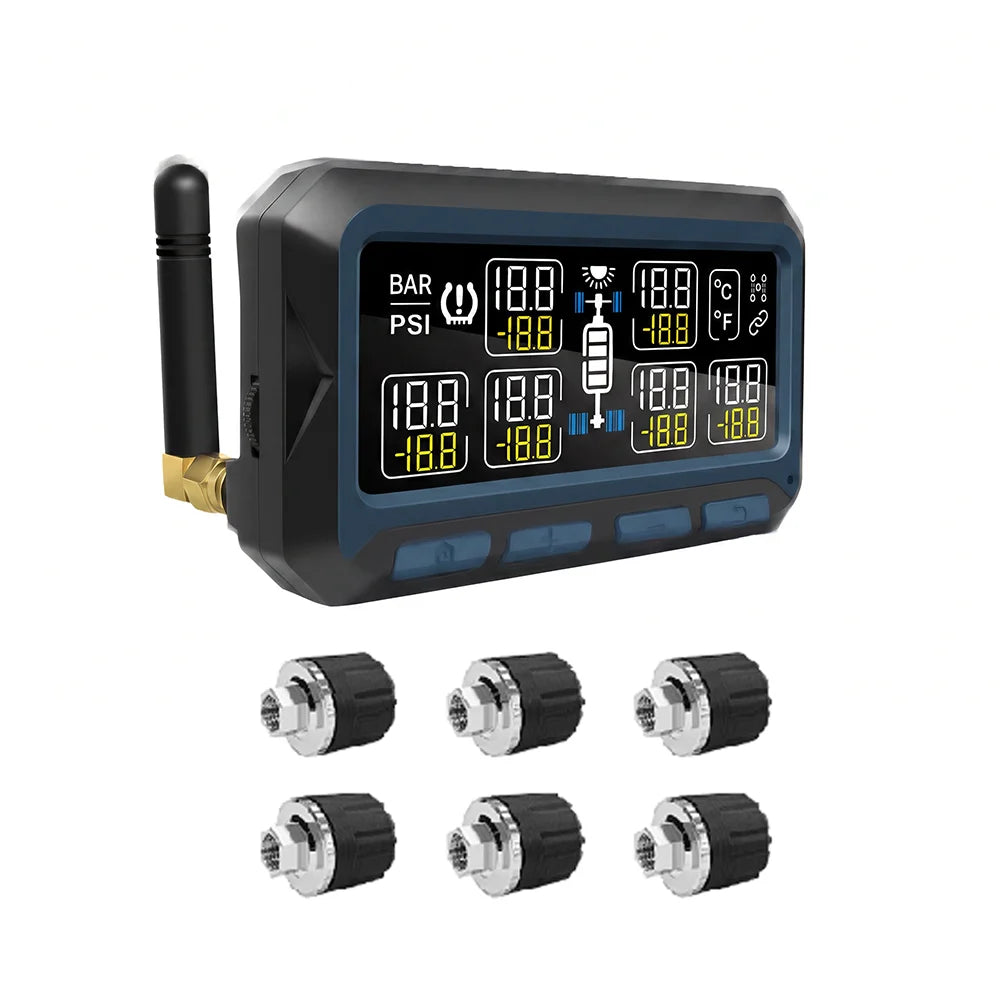
The 550S is worth shortlisting when your priority is an expandable retrofit with solar and USB charging. The external-sensor configuration compared here uses screw-on cap sensors, so allow for removal during inflation. The product family also lists an internal-sensor option; specify the sensor version on the quote rather than buying by model name alone.
| Parameter | GRUNDIG 550S |
|---|---|
| Supported configuration | 6–36 wheel positions, depending on kit |
| Pressure range | 0–200 PSI |
| Display power | Solar and USB Type-C |
| Sensor battery | User-replaceable CR1632 |
| Selection check | Correct sensor count, valve access and booster package |
Product image and specifications: GRUNDIG 550S. Its advantage here is configuration scale and accessible sensor servicing, rather than inflation through the sensor.
GRUNDIG S04 Internal Sensor: keep the six-wheel limit in view
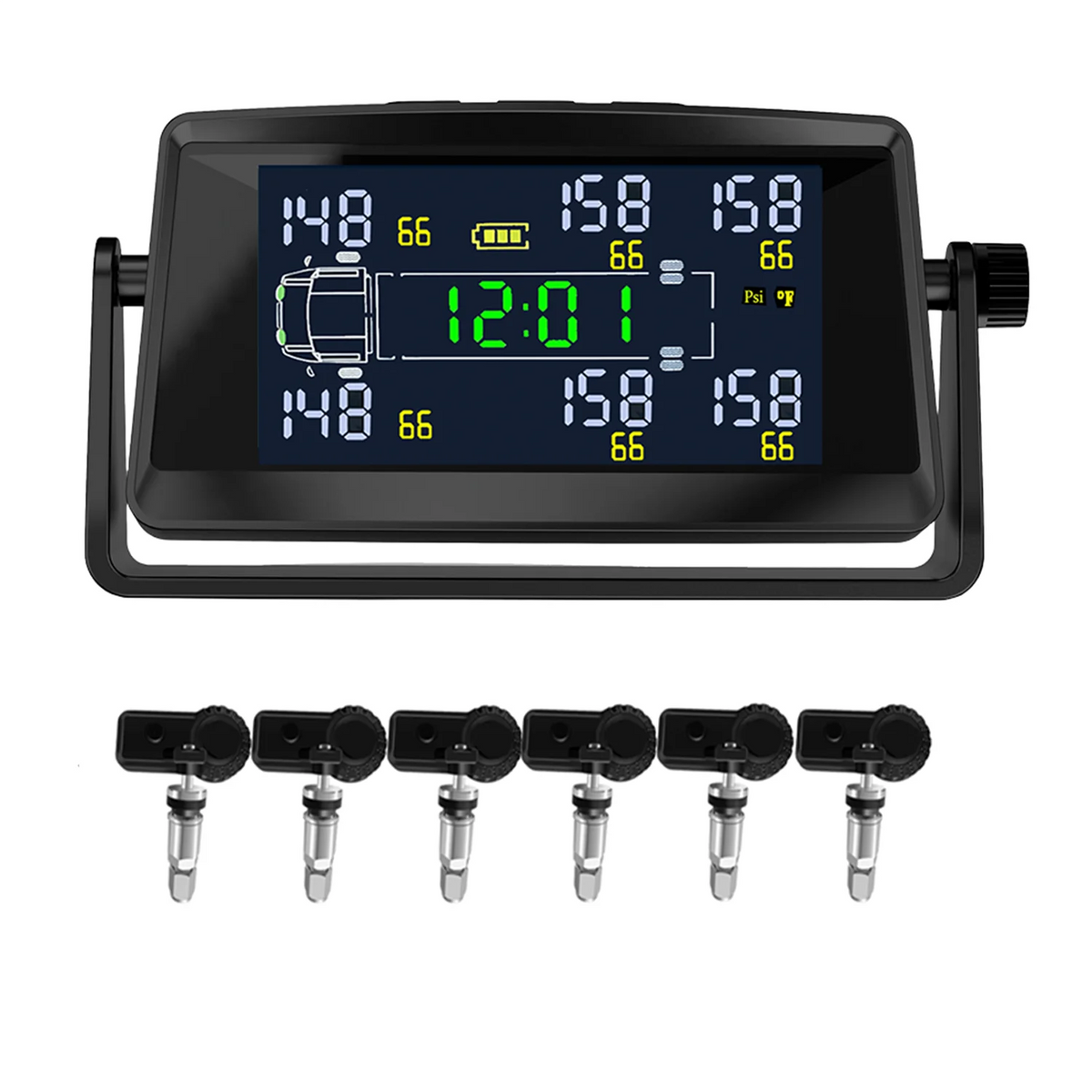
The S04 internal version is a possible match for a six-wheel vehicle. Its pressure versions must be selected explicitly; a high-pressure option does not increase the number of wheels it monitors.
| Parameter | S04 Internal Sensor version |
|---|---|
| Included sensor configuration | Six internal sensors |
| Available pressure versions | 116 PSI or 217 PSI |
| Display charging | Solar and USB Type-C |
| Purchase check | Match the pressure version and wheel configuration |
Product image and specifications: S04 Internal Sensor. Do not stretch this six-wheel configuration into a recommendation for an entire multi-axle combination. Arrange internal-sensor installation with a qualified tire shop and confirm the valve and wheel fit before ordering.
TST-507-FT-4-C: a documented flow-through alternative
Image source: TST-507-FT-4-C flow-through TPMS kit with color display and repeater.
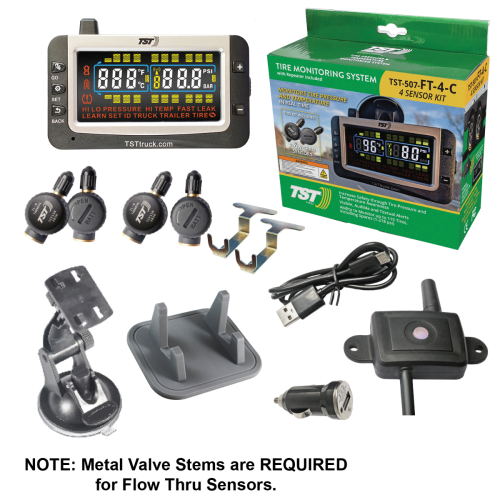
| Parameter | TST-507-FT-4-C |
|---|---|
| Kit sensors | Four flow-through sensors |
| Display | 3.5-inch widescreen color |
| Repeater | Included |
| Valve requirement | Metal stems only |
| Sensor battery | User-replaceable |
Product image and specifications: TST's kit listing. This is a four-sensor package, not a like-for-like substitute for a larger kit. Use its flow-through design as the comparison point; obtain the correct full-vehicle configuration before treating it as a purchase option.
A published cost reference for wheel work
For a specific US commercial-service example, Broz Mobile Tire's Jacksonville, Florida price list, checked on 21 October 2026, lists mounting/dismounting for 22.5- and 24.5-inch semi-truck tires as follows:
| Published service condition | Listed charge, USD |
|---|---|
| Regular hours | $85 per wheel |
| After hours | $95 per wheel |
| Dual-wheel position | Additional $10 |
These are that provider's tire-service charges, not a national average or a TPMS installation quote. Applicable dispatch, travel and other service charges must be checked separately. Internal-sensor fitting, pairing, valve work and balancing are not established as included by those rates.
Use the example to ask your own shop for an itemized quote. If a tire is already being removed for scheduled replacement, compare the incremental sensor-fitting work rather than automatically adding a second full mounting charge. If no tire work is planned, ask which additional removal and refitting operations the internal installation requires.
How to choose for your operating pattern
For a regional delivery truck with difficult inner-dual access, have the tire shop show how the air chuck will reach both valves with the proposed hardware installed. A sensor that fits the thread may still leave too little clearance for normal servicing.
For a long-haul rig that parks unattended, internal placement removes an exposed sensor from the valve tip. That is an installation difference, not a promise against theft or damage. For external designs, check the supplied locking hardware and whether its use still permits practical pressure checks.
For a tractor-trailer that changes wheel count or trailer length, start with the complete combination. Ask for the sensor count, pressure version and repeater arrangement in the same quote. A pressure rating alone says nothing about whether the furthest wheel will communicate through the actual trailer structure.
For a six-wheel work vehicle already due for tire replacement, internal installation can be evaluated alongside that scheduled service. If the tires are staying on the rims, include the extra labor in the decision rather than comparing hardware prices alone.
Installation checks that prevent the wrong purchase
Record each wheel position and the vehicle or tire manufacturer's approved cold inflation requirements. Ask the installer to verify valve condition, extension fit, wheel clearance and the pressure rating of every added component. After installation, verify the wheel map and check for leaks before dispatch.
Use a gauge as part of the inspection routine. NHTSA's TireWise guidance explains why pressure should be checked cold and why monitoring does not replace maintenance. For a commercial rig, also follow its tire/load guidance and fleet procedures; do not copy a passenger-vehicle pressure into a truck setup.
Common mistakes include buying by sensor style without counting tires, treating cap sensors as flow-through, fitting external hardware without checking stems, and interpreting an old or missing display value as proof that a tire is safe. Stop and investigate missing data or an alarm using the manufacturer's instructions.
What the sources establish
Product specifications were checked on 21 October 2026. The linked GRUNDIG pages describe the selected configurations; TST's kit page and 507 manual document its package and flow-through servicing. These are manufacturer statements, not an independent head-to-head test.
Michelin's commercial truck and bus maintenance guide ties cold-pressure selection to operating conditions and calls for inspection of valve components. That supports checking the actual wheel and valve installation alongside the sensor choice.
No controlled comparison of these kits' failure rates, theft resistance or communication through a loaded trailer is presented here. Obtain the current kit contents, valve compatibility, warranty terms and installation quote in writing. Select by the documented workflow and demonstrated fit, rather than treating the largest pressure number as proof of overall superiority.
Frequently asked questions
Can I inflate a tire without removing its TPMS sensor?
Yes with a flow-through design, or with an internal sensor that leaves normal valve access available. An external screw-on cap sensor normally needs to be removed first.
Is a six-wheel kit enough for an 18-tire combination?
No. Count every tire position you need to monitor across the tow vehicle and trailer, then select a compatible complete configuration.
Does a higher pressure rating mean better signal range?
No. Pressure capability and wireless coverage are separate. Verify the repeater arrangement and rear-wheel communication on the actual rig.
Are internal sensors always the best choice?
No. They reduce external hardware but can add wheel-service labor. Compare inflation access, fit, service access and total installed cost.
Does TPMS replace manual tire checks?
No. Continue the required inspection and pressure-check routine, and use the approved cold inflation requirements for the vehicle and load.
Choose your next step
Match the complete rig before choosing the sensor style: count every tire, check the operating pressure, and decide how you will inflate and service dual wheels.