

Continuous tire temperature telemetry catches dragging trailer brakes and failing wheel bearings before heat causes highway fires.
Trailer brake shoe drag, seized S-cam rollers, frozen slack adjusters and dry wheel bearings transfer intense thermal energy through the steel hub and wheel rim directly to the tire valve stem. While standard pressure gauges cannot detect heat buildup until a tire casing delaminates, continuous temperature monitoring systems trigger real-time audible and visual alarms when wheel positions exceed safety limits (typically 158°F / 70°C). The GRUNDIG 860 Commercial TPMS provides dedicated real-time temperature and pressure monitoring across up to 110 wheel positions up to 200 PSI, alerting fleet operators before thermal damage escalates into roadside fires.
Always investigate isolated high-temperature warnings immediately at a safe stopping area. A TPMS alerts drivers to abnormal heat trends; it does not replace mandatory DOT pre-trip foundation brake and hub seal inspections.
How thermal telemetry diagnoses mechanical trailer faults
Real-time temperature telemetry separates normal highway thermal rise from severe mechanical dragging:
| Driving Condition | Temperature Behavior | Pressure Behavior | Root Cause & Action Required |
|---|---|---|---|
| Normal highway towing | Gradual, uniform 10–25°F rise across all tires on the same axle | Uniform 10–15% PSI rise due to hot air expansion | Normal tire flexing; no maintenance action needed |
| Dragging brake shoe / seized slack adjuster | Rapid 40–80°F spike on a single wheel position | Accelerating pressure rise driven by intense hub heat transfer | Mechanical brake fault; pull over immediately to inspect brake drum and chamber |
| Failing wheel bearing / dry hub seal | High thermal elevation localized at the hub cap and valve stem | Moderate pressure increase accompanied by metallic hub heat | Bearing breakdown; inspect oil bath hub level before spindle damage occurs |
| Slow tire puncture under load | Rapid temperature increase combined with declining PSI | Dropping tire pressure below cold baseline | Under-inflation blowout hazard; replace punctured tire before sidewall failure |
The Federal Motor Carrier Safety Administration (FMCSA) commercial vehicle safety studies indicate that brake-related defects and wheel assembly failures represent leading mechanical factors in commercial vehicle roadside fires. Continuous telemetry provides the critical minutes needed to pull over safely.
Compare three commercial temperature and pressure monitoring systems
Specifications verified from official manufacturer documentation on October 29, 2026. This comparison provides technical specifications for purchasing evaluation.
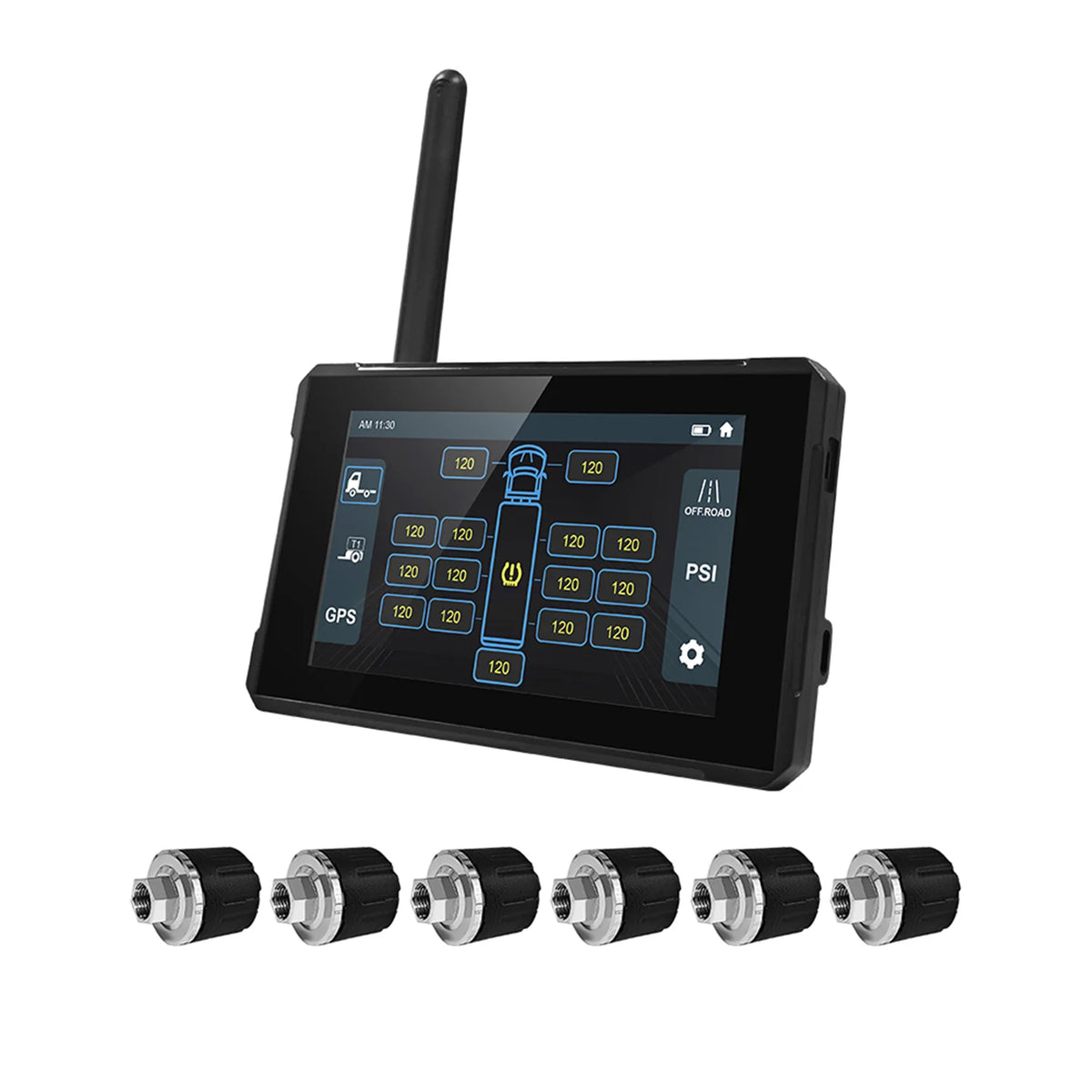
| Technical Feature | GRUNDIG 860 | TST 507 Commercial | TireMinder i10 |
|---|---|---|---|
| Temperature sensing range | -40°F to 257°F (-40°C to 125°C) | -40°F to 176°F (-40°C to 80°C) | -4°F to 185°F (-20°C to 85°C) |
| High-temperature alert threshold | Configurable (default 158°F / 70°C) | Fixed alert at 158°F (70°C) | Fixed alert at 167°F (75°C) |
| Monitored wheel capacity | 6 to 110 wheel positions | Up to 38 tire positions | Up to 20 tire positions |
| Operating pressure range | 0–200 PSI | 0–218 PSI | 0–199 PSI |
| Display interface | 5.0-inch color touch screen | Button-controlled widescreen | Button-controlled color LCD |
| Multi-trailer fleet memory | Instant multi-trailer profile switching | Multi-step trailer drop mode | Multi-step trailer disconnect |
Sources: GRUNDIG 860 commercial product guide, TST 507 fleet manual, and TireMinder technical specifications.
Driver protocol when a high-temperature alarm triggers
Follow this protocol when your TPMS alerts to elevated wheel temperature:
- Safely decelerate and pull over onto a wide highway shoulder or rest area.
- Check the monitor to identify the exact wheel position reporting the heat spike.
- Use an infrared thermal thermometer to measure temperature at the hub cap, brake drum and tire sidewall.
- If the brake drum is significantly hotter than the tire, inspect for a seized parking brake chamber, frozen slack adjuster or broken return spring.
- If the hub cap center is glowing or leaking grease, do not drive further; call for mobile roadside bearing service to prevent spindle failure.
Frequently asked questions
Why does a dragging brake trigger a TPMS alarm before smoke is visible?
Heat conducts through the metal wheel rim and brass valve stem directly into the sensor's temperature probe within 2 to 3 minutes of friction buildup, alerting the cab long before brake lining smoke escapes into passing airflow.
What is the recommended high-temperature alarm threshold for semi-trailers?
A threshold of 158°F (70°C) is the industry standard recommendation. It accommodates normal summer highway thermal expansion while alerting drivers well before tire rubber compounding degrades at temperatures above 190°F.
Can an infrared heat gun replace continuous TPMS telemetry?
An infrared thermometer verifies component heat during static pre-trip and post-trip stops, but cannot alert drivers to sudden brake drag or bearing breakdown occurring between inspection stops on the highway.
Check your commercial fleet TPMS configuration
Verify your fleet's axle configurations, operating pressure ranges and multi-trailer requirements before selecting your monitoring package.
Check GRUNDIG 860 Commercial Fleet TPMS packages and specifications