

Choose farm-truck TPMS with saved trailer profiles, axle-specific alerts and a verified sensor map for each trailer. The GRUNDIG 860 is a relevant shortlist option because its multi-trailer memory and independent axle alarms address that workflow. Confirm the complete sensor and repeater configuration before buying; a waterproof rating alone does not establish durability on your farm roads.
The objective is straightforward: when you hitch a different trailer, the monitor should show the tires you are actually towing. You should not have to guess whether a warning belongs to the livestock trailer behind you or the empty dump trailer parked in the yard.
What matters most for multi-trailer work
- Store a recognizable profile for each trailer and verify the active wheel map at every change.
- Keep sensors assigned to their intended tires; profile selection is different from moving sensors between trailers.
- Set alerts using the approved cold pressures for the vehicle, tires and load, rather than copying one value across every axle.
- Include the tow vehicle in the count if you intend to monitor it.
- Verify rear-wheel communication with the specified repeater setup on the actual rig.
GRUNDIG 860: the relevant features in one place
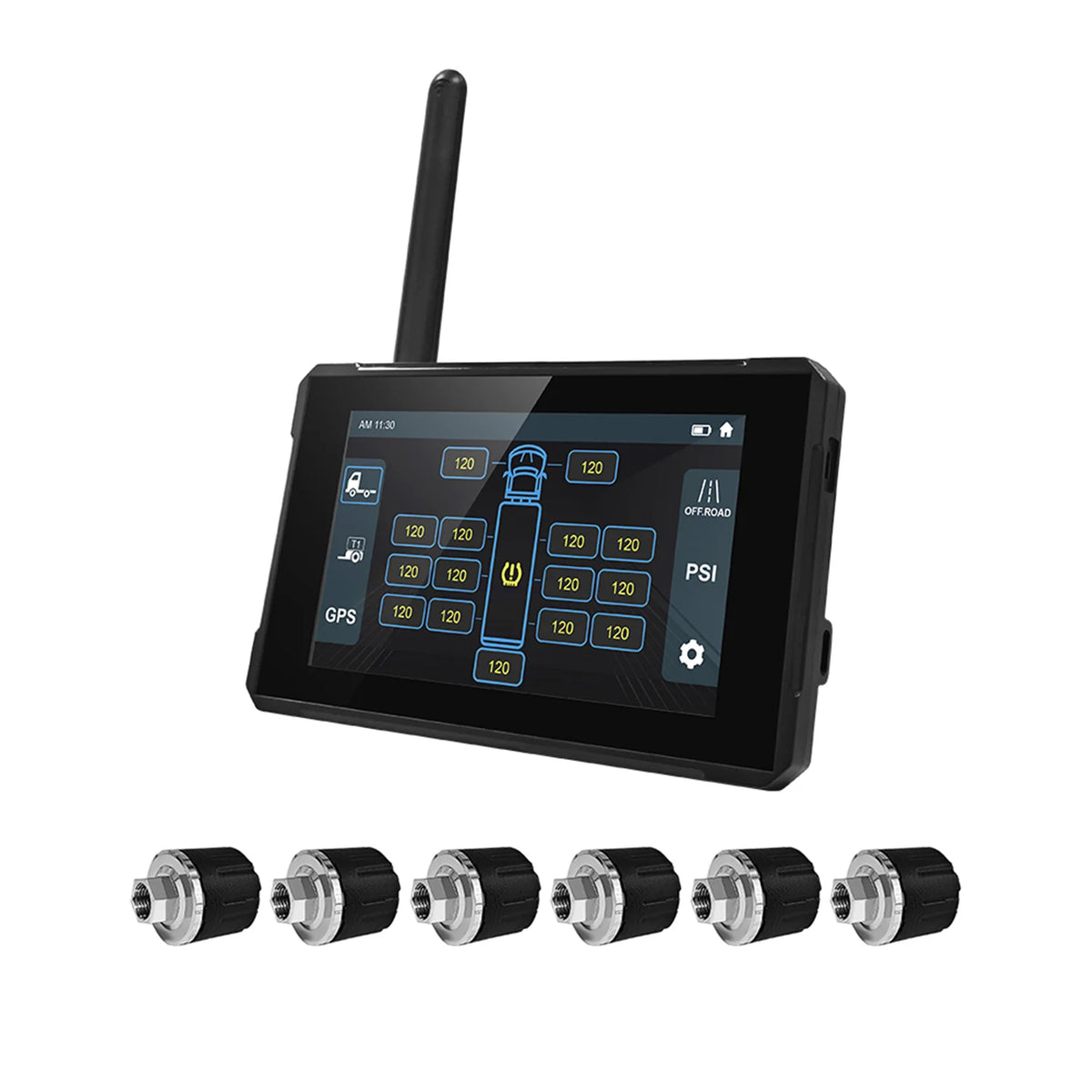
| Parameter | GRUNDIG 860 |
|---|---|
| Configuration capacity | 6–110 wheel positions, depending on kit |
| Pressure range | 0–200 PSI |
| Display | 5-inch touchscreen |
| Trailer handling | Stored profiles and switching |
| Axle settings | Independent pressure alarms |
| Sensor protection | IP67 external sensors |
| Sensor battery | User-replaceable CR1632 |
| Radio frequency | 433.92 MHz, according to the manufacturer |
Product image and specification source: GRUNDIG 860. Its central advantage for this use case is the stored-profile workflow. A capacity ceiling is not a statement that every package includes enough sensors for three trailers, or that every trailer can use the same repeater placement.
The product instructions also call for verifying the booster arrangement for longer combinations. Work with the supplier on your overall length, metal structures, wheel count and power provision. Do not translate an advertised range into a guarantee that the rear axle will always report through a loaded trailer.
Compare trailer selection and servicing features
Image source: TST-507-FT-4-C kit with a color display, flow-through sensors and repeater.
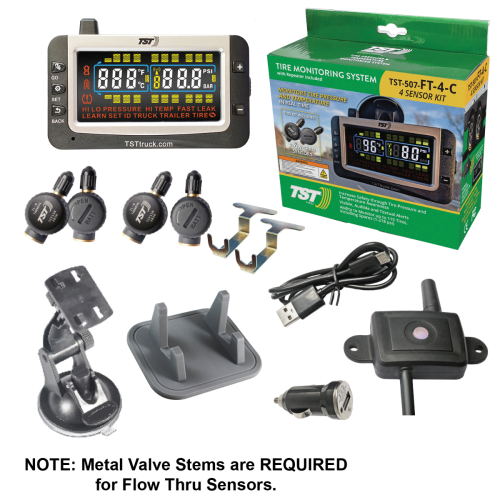
| Parameter | TST-507-FT-4-C |
|---|---|
| Included sensors | Four flow-through sensors |
| Display | 3.5-inch widescreen color |
| Repeater | Included |
| Valve stems | Metal only |
| Sensor batteries | User-replaceable |
Image and kit specifications: TST's listing. The 507 manual describes selecting programmed trailers and configuring axle pressure alarms. Trailer selection is therefore not unique to Grundig. Compare the particular display workflow, sensor count and installed quote you will use.
| Farm requirement | GRUNDIG 860 | TST 507 flow-through system |
|---|---|---|
| Switching trailers | Stored profile selection on touchscreen | Programmed-trailer selection described in manual |
| Pressure setup | Independent axle alarms | Axle pressure settings described in manual |
| Inflation access | External sensor service method must be allowed for | Flow-through inflation documented |
| Buying check | Select total sensors and repeater arrangement | Expand beyond four included sensors if needed |
| Best reason to shortlist | Touchscreen profile workflow | Flow-through servicing workflow |
For mud, salt and impact exposure, compare the exact operating limits, installation conditions and warranty terms. IP67 describes ingress protection under specified conditions; it is not a blanket promise against farm-road damage or a guarantee of reliable communication.
Worked example: installed sensors are not the active wheel count
Suppose a farm truck has six tire positions, a flatbed gooseneck has four, a livestock trailer has six and a dump trailer has four. These are example counts, not a kit specification.
| Equipment | Sensors left installed | Active combination when hitched |
|---|---|---|
| Truck | 6 | Included with every trailer |
| Flatbed gooseneck | 4 | 6 + 4 = 10 |
| Livestock trailer | 6 | 6 + 6 = 12 |
| Dump trailer | 4 | 6 + 4 = 10 |
Keeping sensors on all four pieces of equipment requires 6 + 4 + 6 + 4 = 20 sensors. The largest active combination in this example has 12 positions, not 20. Ask the supplier to confirm both the stored-profile requirement and the active layout before choosing a package. The 860's advertised 110-wheel ceiling is not evidence that a six-sensor package includes twenty sensors or that every possible profile arrangement is supported.
This distinction avoids buying for the largest active trailer while overlooking sensors that remain on parked trailers.
Make each trailer a distinct setup
For the flatbed gooseneck, record which wheel positions belong to the trailer and which belong to the truck. Check the axle labels and use the approved pressure requirements for the actual tire and load combination. A profile named only “Trailer 1” is less useful to a relief driver than a name that matches the equipment record.
For the livestock trailer, verify the complete monitoring map before loading and dispatch. Pressure loss deserves prompt action under your operating procedure. TPMS is a monitoring aid; it cannot promise to prevent a rollover, protect every animal or detect every form of tire damage.
For the dump trailer, check the active profile again after changing the hitch connection. Confirm the power and repeater arrangement with the bed and trailer in the intended travel configuration. If a reading is missing, resolve it before assuming that the tire is simply unchanged.
A practical trailer-change check
Use one handover record per trailer change. This is a proposed acceptance workflow, not a manufacturer-certified test:
- Match the equipment. Record the trailer ID and select its saved profile. Compare the visible wheel map with the actual tire positions.
- Check the alarm setup. Verify the displayed axle settings against the approved tire, load and vehicle requirements for this combination.
- Confirm communication. Check each required position using the manufacturer's normal reading and fault indications. Ask the supplier how this display distinguishes a current reading from a stale or missing transmission.
- Check the repeater arrangement. Confirm the agreed power supply and placement for this trailer, in its intended travel configuration. Resolve missing readings before departure.
- Record exceptions. Note a missing sensor, an incorrect map or a valve problem and assign its resolution. A profile name alone is not proof that the attached trailer is being monitored.
Michelin's commercial tire maintenance guide links cold inflation requirements to the load and operating conditions. Use the applicable vehicle and tire guidance when setting each profile; a generic pressure copied from another trailer is not a substitute.
After fitting external sensors, have a qualified technician check valve and extension compatibility and inspect for leaks. When wheel positions change during service, update and verify the map before returning the trailer to work.
Battery and signal details to confirm
The 860 product page lists replaceable CR1632 cells and a 433.92 MHz radio. Those are service and frequency specifications, not a measured battery life under farm vibration or a verified transmission distance through a loaded metal trailer. Keep the relevant batteries and the correct seal-service instructions in the maintenance plan, and record the actual battery replacements.
The product page gives more than one booster-planning instruction, with different distance and configuration conditions. Have the supplier confirm the number, location and power arrangement for each of your combinations in writing. This article does not substitute a guessed distance for an on-vehicle coverage check.
Product specifications were checked on 21 October 2026. No controlled farm-road durability or loaded-trailer range test for these exact kits is supplied here; the comparison is based on documented features and the proposed acceptance workflow.
Mistakes that make trailer switching harder
Buying enough sensors for only one trailer while expecting all three trailers to retain their setups creates avoidable servicing work. Decide whether each trailer keeps its own sensors, then price the full arrangement.
Using one pressure setting for the entire combination can ignore different axle requirements. Configure each required axle against its approved values; monitor thresholds are warnings, not permission to exceed tire or wheel ratings.
Treating an old reading as current can hide a communication problem. Distinguish a stable value from a missing transmission according to the manual. Finally, do not replace required inspection with the presence of a green screen: sidewall damage, loading problems and mechanical faults still need direct checks.
When the 860 belongs on the shortlist
Choose it for evaluation when frequently changing trailers is the central problem and a touchscreen profile workflow matches your drivers. Confirm sensor quantities, wheel layouts, pressure requirements, repeater placement and power before checkout. If inflation convenience outweighs that workflow, evaluate a flow-through system on the same installed-cost basis.
Frequently asked questions
Do I have to move sensors whenever I change trailers?
Not if the chosen setup keeps sensors on each trailer and supports saved profiles. Confirm the required sensor quantities and select the correct active profile when hitching.
Can different axles have different pressure alarms?
The GRUNDIG 860 supports independent axle pressure alarms. Configure them against the approved requirements for the specific tires, vehicle and load.
Does IP67 prove the system is safe for every farm-road condition?
No. It addresses specified ingress conditions. Mechanical impact, installation quality, operating limits and radio coverage still need separate checks.
Can TPMS prevent every livestock-trailer blowout or rollover?
No. It can alert you to monitored pressure or temperature conditions, but it cannot replace inspection, correct loading, tire maintenance or safe operating practices.
What should I verify before ordering a multi-trailer kit?
Confirm both the active wheel count and all sensors left on parked trailers, the required saved profiles, approved axle pressures, repeater power and placement, and the driver handover workflow.
Choose your next step
Count the tow-vehicle and trailer tires, list each axle’s pressure requirements, and match the repeater package to the real combination before ordering.