


Direct TPMS vs Indirect TPMS:
Which One Actually Works — and Which One Doesn't
Your vehicle may already have a TPMS warning light. That does not mean your tires are being monitored. Here's the critical difference between the system your car came with and the one that actually provides real-time data.
Most modern vehicles sold in the US since 2008 include a TPMS warning light as standard equipment. For most drivers, the presence of this light creates a reasonable assumption: their tires are being monitored. In many cases, that assumption is incorrect — or at least incomplete. Factory OEM systems are frequently indirect TPMS, which does not measure tire pressure at all. It infers it from wheel speed data. The difference between indirect inference and the direct sensor-based aftermarket monitoring that Grundig produces is not marginal. It determines what the system can and cannot detect — and in a number of common scenarios, indirect TPMS cannot detect the exact conditions most likely to cause a tire failure.
Understanding this distinction is particularly important for RV owners and commercial truck operators, whose vehicles often run configurations and pressures that push indirect systems to their limitations fastest — and whose tire failures carry the most significant consequences when they occur.
How Each System Works
Direct vs Indirect: The Fundamental Difference
Estimates pressure from wheel speed — no sensors on the tire
- Uses ABS wheel speed sensors already in the vehicle
- An underinflated tire has a smaller radius and rotates faster
- System compares rotation speeds between tires to infer pressure difference
- No physical sensor inside the tire or on the valve stem
- No actual pressure number displayed — only a warning light
- Must be recalibrated every time tires are inflated or rotated
Measures actual pressure with a sensor on every wheel
- Physical sensor mounted on valve stem inside each tire
- Measures absolute pressure in PSI in real time
- Transmits readings to dashboard display every minute or less
- Shows exact PSI for each tire position simultaneously
- Also measures temperature in systems like Grundig's
- No recalibration required after inflation or rotation
Where Indirect TPMS Fails
The Four Scenarios It Cannot Detect
All Four Tires Losing Pressure Simultaneously
Indirect TPMS works by comparing wheel speeds between tires. If all four tires lose pressure at the same rate — as happens in temperature-driven pressure changes or when a vehicle sits for a season — the rotation speeds remain equal and the system detects no anomaly. Four tires 15 PSI below their minimum can produce no warning light from an indirect system. This is not a hypothetical failure mode — it is the predictable result of how indirect systems are designed.
Temperature-Related Pressure Changes
Overnight temperature drops, altitude changes, and seasonal pressure variations all affect multiple tires simultaneously. Because indirect systems require a differential between tires to detect a problem, uniform pressure changes across all tires are invisible. A vehicle correctly inflated in summer that loses 4–5 PSI overnight in fall conditions shows no warning — even though every tire may be below safe operating pressure for the loaded morning departure.
Any Pressure Reading Beyond "Low" or "OK"
Indirect TPMS provides binary information: warning light on or warning light off. It cannot tell you that a tire is at 95 PSI when it should be at 110 PSI, or that a tire is at 118 PSI on a summer afternoon when it should be below 115 PSI. The actual pressure values — the numbers you need to make informed decisions about driving, stopping, and inflation corrections — are simply not available from an indirect system.
Tire Temperature — The Early Warning That Pressure Misses
Temperature monitoring does not exist in indirect TPMS and is absent from many budget direct TPMS systems. A tire generating abnormal heat from internal damage, underinflation, or overloading will show elevated temperature before it shows abnormal pressure. For RV and commercial drivers where a tire failure at speed has catastrophic potential, temperature monitoring is the early warning that provides the most reaction time.
Full Comparison
Direct vs Indirect Across Every Specification That Matters
| Feature | Indirect (OEM) | Direct Aftermarket |
|---|---|---|
| Measurement method | Wheel speed inference | Physical sensor — actual PSI |
| Pressure display | Warning light only | Exact PSI per tire position |
| Temperature monitoring | None | Real-time °F / °C per position |
| Detects uniform pressure loss | No — blind to equal-rate loss | Yes — reads absolute pressure |
| Recalibration needed | After every inflation or rotation | Never required |
| Dual rear tire coverage | Typically no — one sensor per axle | Yes — sensor per tire position |
| Trailer tire coverage | No | Yes — up to 12 positions |
| Alarm types | Single low-pressure warning | Low, high, temperature, rapid leak, sensor battery |
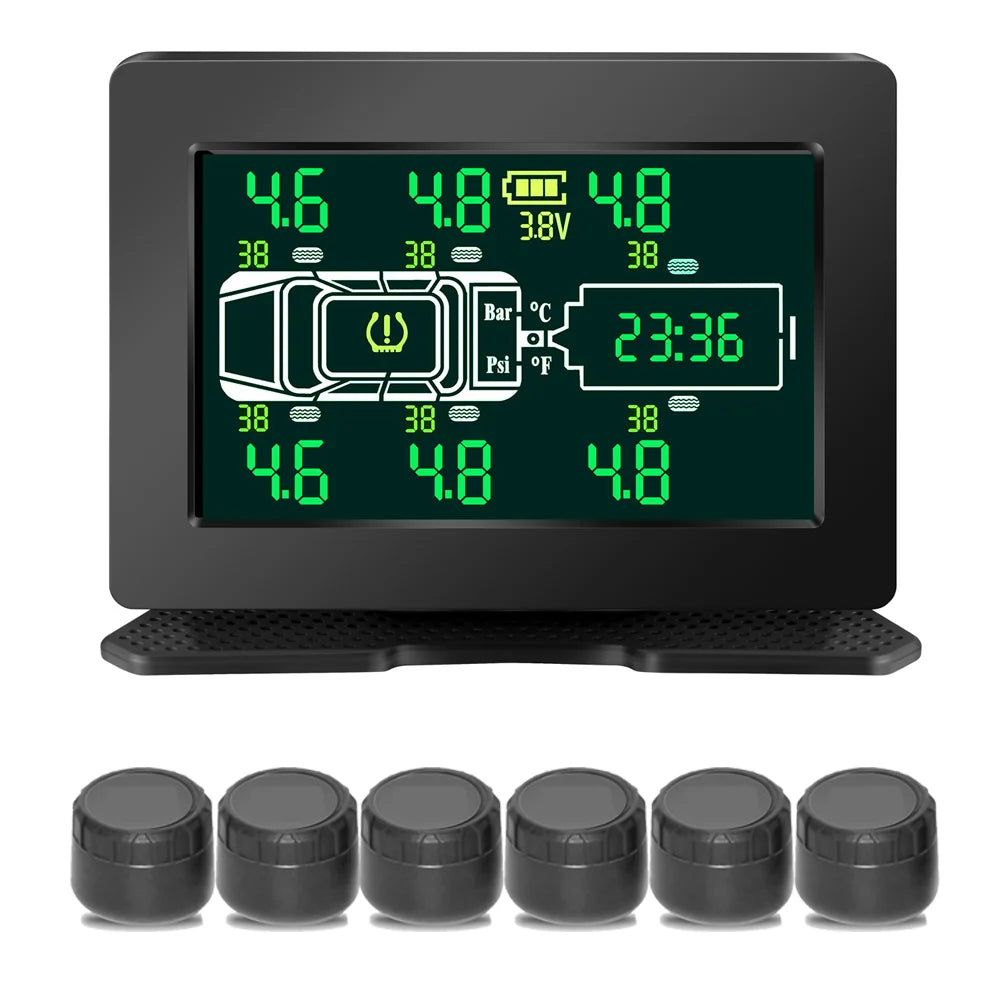
The Grundig Direct TPMS Range
Three Purpose-Built Systems for Three Vehicle Types
Grundig RV TPMS
116 PSI, 4/6/8-wheel. Direct sensors on every position. Real-time PSI and temperature. Covers dual rears, trailers, and any configuration up to 8 wheels.
$119
Shop Now →Solar TPMS 6-Wheel
6 direct sensors including inner duals. Solar + USB powered. 6 alarm modes. No monitor battery maintenance. Purpose-built for daily commercial dually operators.
See product
Shop Now →Grundig S08 TPMS
218 PSI, 8/12-wheel. Direct sensors for Class A diesel pushers and heavy commercial vehicles where indirect systems are entirely inadequate.
$259
Shop Now →Actual pressure. Actual temperature. Every position. In real time. Free shipping on all systems · From $119
Shop All TPMS →