

Driving a Fifth Wheel or Gooseneck Trailer?
Why Your TPMS Needs to Monitor Every Axle
Most tow vehicle owners monitor the truck. Almost none monitor the trailer. The tires that are most likely to fail are the ones nobody is watching.
There is a well-established blind spot in how most fifth wheel and gooseneck trailer owners approach tire monitoring. The tow vehicle gets attention — it's the powered unit, it has more systems to monitor, the driver sits inside it and can feel changes in how it behaves. The trailer tires get a visual check at the hitch and then nothing for the duration of the drive, because there is no direct feedback from the trailer to the driver's seat about what is happening to those tires at highway speed.
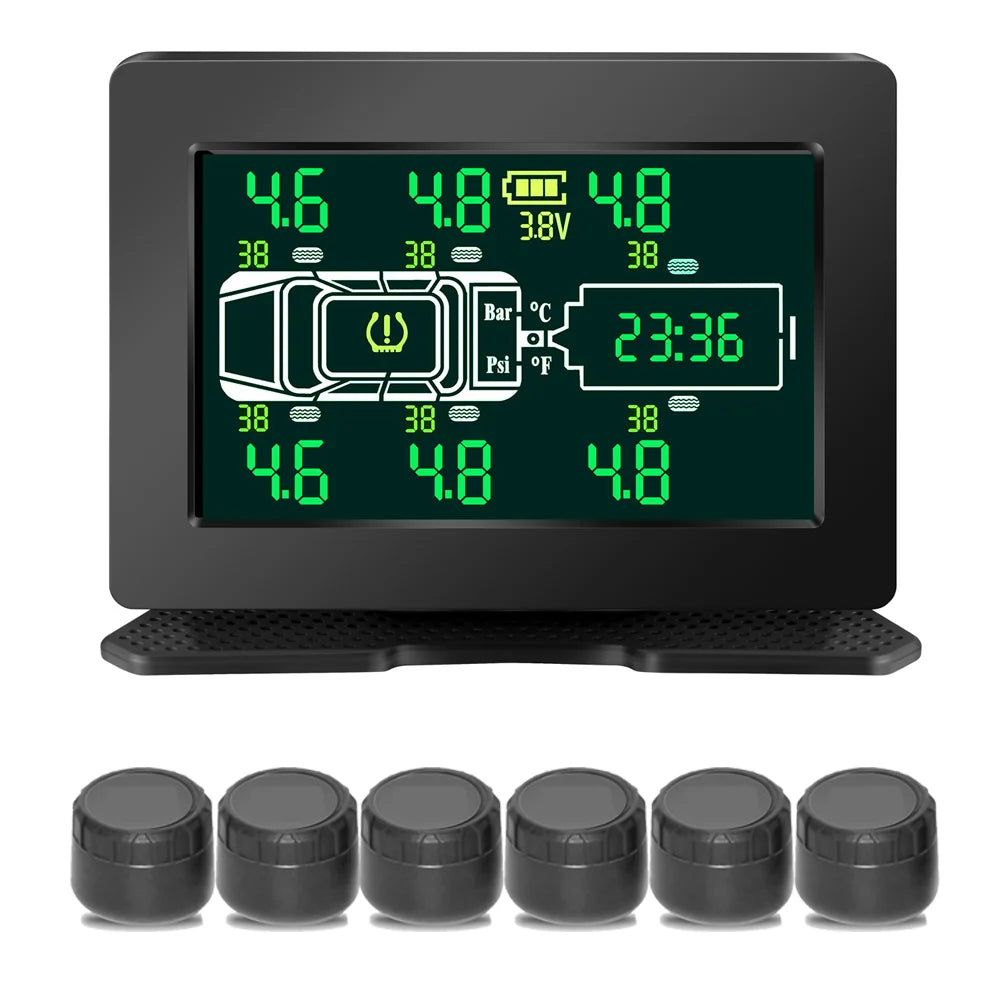
This is the specific gap that a switchable 4/6/8-wheel RV TPMS addresses for towing combinations. In 6-wheel mode, the system monitors all four tow vehicle tires plus both trailer axle tires on a single-axle trailer. In 8-wheel mode, it extends coverage to tandem-axle trailers or dually tow vehicle combinations. The trailer tires that drivers cannot feel through the steering wheel and cannot see in the mirrors get the same real-time pressure and temperature monitoring as the tires directly beneath the driver.
Understanding why this matters requires understanding what trailer tires actually experience during a long tow — which is different in important ways from what tow vehicle tires experience, and routinely overlooked for exactly that reason.
The Trailer Tire Problem
Why Trailer Tires Fail More Often Than Tow Vehicle Tires
Fifth wheel and gooseneck trailers impose specific load characteristics on their tires that differ from those on the tow vehicle. The king pin or gooseneck ball transfers a significant portion of the trailer's weight to the tow vehicle's rear axle — but the remaining weight, often 60–70% of the total trailer load, rests entirely on the trailer axles. Those axles are fixed, unpowered, and have no independent suspension in many trailer configurations.
A fixed-axle trailer tire with insufficient inflation for its actual carried weight generates heat in its carcass through the same mechanism as any underinflated commercial tire, but with two additional complications. First, fixed axle trailers don't distribute load dynamically the way a vehicle with independent suspension does — the load is constant and unforgiving. Second, the driver has no tactile feedback from the trailer: no steering wheel vibration, no vehicle pull, no brake response change to indicate that a trailer tire is developing a problem.
Wheel Count and Configuration
Matching the Monitoring Mode to Your Actual Setup
4-Wheel Mode
Tow vehicle only. Useful when trailer tires are on a separate dedicated system or when towing a trailer with pre-monitored axles.
6-Wheel Mode
Tow vehicle (4) + single-axle trailer (2). Covers the most common fifth wheel and gooseneck configuration. All six positions on one display.
8-Wheel Mode
Dually tow vehicle (6) + single-axle trailer (2), or standard tow vehicle + tandem-axle trailer (4). Covers larger towing combinations.
The switchable mode design means a single system purchased for a current 6-wheel configuration can be reconfigured to 8-wheel coverage when a larger trailer is added, or reduced to 4-wheel monitoring when the trailer is disconnected. This is not a premium feature for owners who plan to change configurations — it is basic future-proofing that avoids purchasing a new system every time the towing setup changes.
Real-World Scenarios
The Situations Where Trailer Tire Monitoring Pays Off
Slow Leak Developing Over 200 Miles
A trailer tire with a small nail puncture loses 2–3 PSI per hour at highway speed. Over 200 miles, a tire that started at 80 PSI can drop to 65 PSI — 15 PSI below its load-rated minimum. Without monitoring, the driver has no indication. With monitoring, the alarm triggers at the threshold drop and the driver can exit and inspect before a structural failure develops.
Hot Afternoon + Mountain Grade
A fully loaded fifth wheel on a summer afternoon descent has trailer tires that are simultaneously dealing with ambient heat, load-generated heat, and reduced airflow at slow speeds. Pressure can rise above the safe maximum or, if a tire was marginal entering the grade, drop into structural failure range. Real-time monitoring catches both conditions.
Overnight Pressure Drop at Camp
Temperature drops of 20–30°F overnight can reduce trailer tire pressure by 2–3 PSI. A tire that was correctly inflated at departure may be 5 PSI low at the next morning's departure. A TPMS check before moving provides accurate inflation data for the actual temperature conditions at departure.
Tandem Axle Load Distribution
On a tandem-axle trailer, if one axle is bearing significantly more load than the other, the tires on the heavier axle run hotter and at higher pressure. Monitoring all four trailer tires on a tandem setup can identify asymmetric loading before it becomes a tire problem.
The Product
One System for the Complete Towing Combination
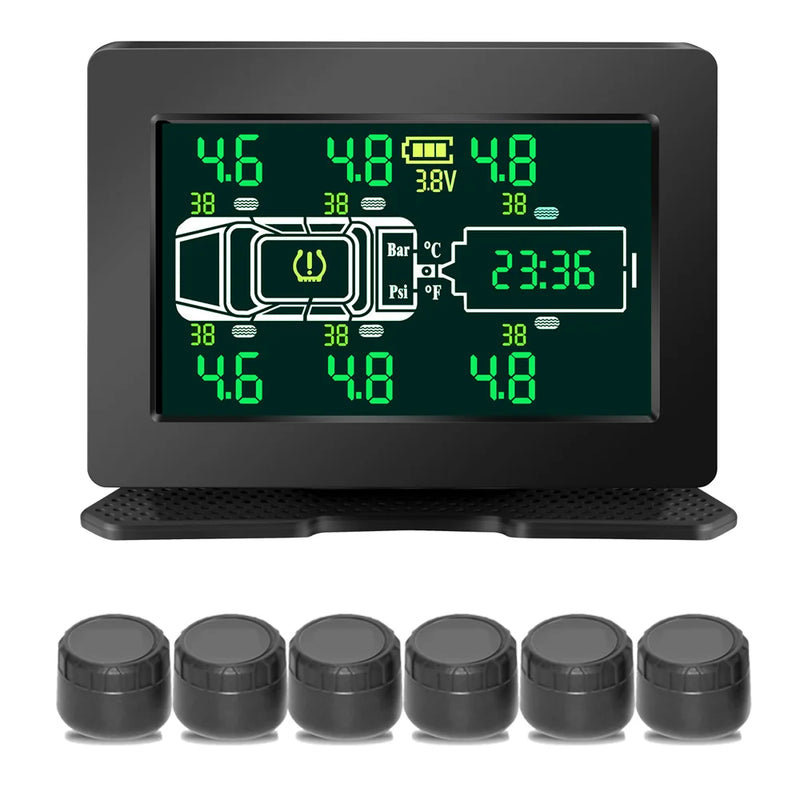
Grundig RV TPMS
4/6/8-Wheel Switchable
116 PSI range, ±1.5 PSI precision. 5.0" display showing all monitored positions simultaneously. Switchable 4/6/8-wheel modes for tow vehicle + trailer combinations. Full alarm suite. Free shipping.
$119
Shop Now →For larger towing combinations where axle pressures approach or exceed 116 PSI, or where the total wheel count reaches 12, the Grundig S08 heavy-duty TPMS extends coverage to 218 PSI across 8/12-wheel configurations. Browse the full Grundig TPMS lineup to match your specific towing configuration to the right system.
Monitor every axle. Tow vehicle and trailer. 4/6/8-wheel switchable · Free shipping · 116 PSI range
Shop RV TPMS →