

Where Is the TPMS Sensor Located? (And Is It Universal?)
Where sensors actually sit on a wheel, why "universal" is the wrong question to ask, and how to check what actually fits your setup.
Short answer: on an aftermarket system, the TPMS sensor threads onto the outside of the valve stem — not inside the tire, not bolted to the wheel. And no, TPMS sensors are not universal in the sense of "one sensor fits every vehicle" — but external cap-style sensors come close, because what actually varies between vehicles is valve stem size, wheel count, and pairing protocol, not the sensor itself.
People usually land on this question from one of two directions: either something on their dash lit up and they're trying to find the physical sensor to check it, or they're shopping for a TPMS kit and trying to figure out if it'll actually fit their RV, trailer, or dually truck. Both questions have the same starting point — understanding where the sensor sits and what "fit" actually depends on.
Sensor Location
Where Are TPMS Sensors Located?
There are two different answers depending on the type of system:
Factory (internal) TPMS — on most cars built after 2007, the sensor is mounted inside the tire, either banded to the wheel or built into the valve stem itself. You can't see it without removing the tire, and replacing one usually means a trip to a tire shop.
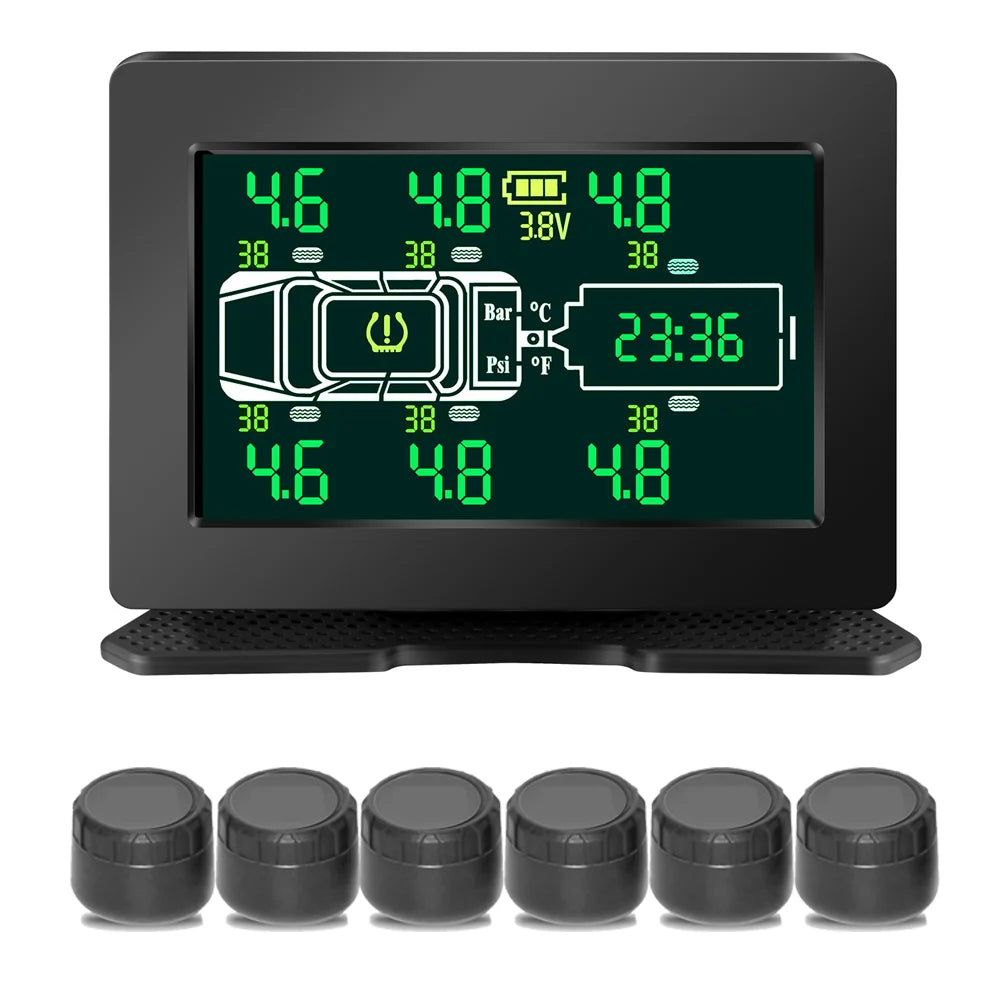
Aftermarket (external cap) TPMS — this is the type used on RV and trailer kits, including Grundig's RV TPMS. The sensor screws onto the outside of the existing valve stem, in place of the regular valve cap. It's visible, it's removable by hand, and installing one takes about two minutes per tire with no tools beyond a valve cap wrench.
That external placement is the entire reason aftermarket TPMS exists as a category — it lets any vehicle add tire monitoring without opening up the wheel.
Compatibility
Are TPMS Sensors Universal? What Actually Varies
Not exactly — but not for the reason people expect. The sensor's core function (measure pressure, transmit wirelessly) is the same across brands. What determines whether a given sensor "fits" your setup comes down to three things:
| Factor | Why It Matters |
|---|---|
| Valve stem size | Standard car stems vs. the larger bolt-in stems common on trailers and heavy-duty wheels — the sensor's threading has to match. |
| Number of tire positions | A passenger car needs 4 sensors; a dually truck needs 6; a multi-axle RV or trailer can need 6–12. The monitor has to support that count. |
| Pairing protocol | Each sensor is factory-paired to work with a specific monitor/receiver — sensors from one system generally won't pair to a different brand's monitor. |
In practice, this means the honest version of "is TPMS universal" is: the installation is universal, the system isn't. Any external cap sensor threads onto any standard valve stem the same way — but the sensor has to be part of a kit that supports your tire count and comes paired to its own monitor.
RV vs. Trailer
RV TPMS vs. Trailer TPMS — What's the Difference?
Since both are external cap systems, the difference isn't in the sensor — it's in what the kit is built to support:
| RV TPMS | Trailer TPMS | |
|---|---|---|
| Typical tire count | 4, 6, or 8-wheel kits | Configurable per axle count, including multi-axle trailers |
| Pressure range | Up to 116 PSI | Sized to trailer tire pressures |
| Display | In-cab monitor, mounted for driver visibility | In-cab or tow-vehicle monitor, depending on setup |
Explore both: RV TPMS system · Trailer TPMS system
Quick Check
How to Confirm a Kit Fits Your Setup
Before buying, confirm three things against the product page: how many tire positions the kit supports, whether the valve stem type matches your wheels (standard vs. trailer bolt-in stems), and whether the monitor is rated for your pressure range. Any kit that clears those three checks will physically install the same way — thread on, pair once, done.
FAQ
Common Questions
Can I use one TPMS system for both my tow vehicle and trailer?
Only if the monitor supports enough total positions to cover both and the sensors are all paired to it. Most owners run the tow vehicle's factory TPMS separately and add a dedicated trailer kit for the towed tires.
Do all tires on an RV or trailer need a sensor?
For full coverage, yes — a sensor on every position, including inner duals on multi-wheel axles, is what gives you position-by-position alerts instead of a single average reading.
Will a sensor with the wrong valve stem size still work?
It may not thread on securely, which risks a slow air leak. Confirm valve stem compatibility before installing rather than forcing a fit.
Shop TPMS
Find the Right Fit for Your Setup
Grundig RV TPMS
116 PSI, 4/6/8-wheel. External cap sensors, no tools beyond a valve wrench. Covers most RV and towing configurations.
$119
Shop Now →Trailer TPMS System
Wireless external sensors sized for trailer valve stems and multi-axle setups. Pairs to a single in-cab monitor.
Shop the range
Shop Now →Solar TPMS 6-Wheel
6 external cap sensors for all dually positions, including inner duals. Solar + USB monitor.
$109
Shop Now →Not sure which kit matches your wheel count? RV TPMS $119 · Trailer TPMS · Solar 6-Wheel $109 · Free shipping
Shop All TPMS →