

If you have ever plugged a standard RV tire pressure monitor into a heavy truck, you already know the problem: the screen flashes an error, or reads a number that is obviously wrong, and the whole thing is useless. The issue is not the sensor. It is the pressure ceiling. Most TPMS units are built for passenger cars, RVs, and light trailers that run 35 to 116 PSI — and heavy trucks simply do not live in that range.
A high-pressure TPMS is a different category of hardware entirely. It reads the 100 to 130+ PSI that commercial steer, drive, and trailer tires actually run, and it keeps working all the way up to 200 or 217 PSI. If your rig runs high-pressure tires, this is not an upgrade — it is the minimum bar for a monitor that can do its job. Here is why, in plain numbers.
Why "High-Pressure" TPMS Is a Different Category Altogether
A tire pressure sensor is not a simple pressure gauge. The electronics and the pressure diaphragm inside the sensor are engineered for a specific measuring range, and that range has a hard ceiling. A sensor designed for a 0–87 PSI system is simply not capable of resolving a 125 PSI tire — it saturates at the top of its range and reports either an error or a clamped, meaningless value.
That is why tire pressure monitors are not interchangeable across vehicle classes. The same brand that sells a perfectly good car TPMS often cannot cover a Class 8 truck, and the difference is not marketing — it is the physical sensor range. When you are choosing a monitor for a heavy truck, the very first spec to check is the maximum PSI the system can read, before you look at anything else.
What PSI Do Heavy Trucks & Trailers Actually Run?
To understand why the ceiling matters, look at the real numbers on the sidewalls of heavy-duty tires. They are far higher than most people assume.
Steer, Drive & Trailer Axle Pressures
Commercial truck steer tires commonly run 110 to 130 PSI. Drive and trailer tires, on a fully loaded combination, run 95 to 110 PSI — and many fleets deliberately set them to 100 PSI or higher for a safety margin against underinflation. Compare that to a passenger car's 32–36 PSI and the scale of the difference is obvious.
Load Range G & H Tires (110–125 PSI)
Trailer tires are rated by load range, and the heavier classes sit at the top of the pressure scale. Load Range G tires carry a maximum cold pressure of 110 PSI, and Load Range H reaches 125 PSI. A tandem dually trailer riding on Load Range H rubber is running every single tire above the ceiling of a typical RV TPMS — which is why so many trailer owners buy a monitor and find it cannot read half their wheels.
The Problem With Standard RV TPMS (The 87–116 PSI Ceiling)
Most "RV" tire pressure monitors top out between 87 and 116 PSI. That range is fine for a motorhome on 80 PSI tires or a light trailer on Load Range E (80 PSI). It fails the moment you mount it on anything heavier.
If your tire sidewall says "Max Load … at 120 PSI Cold," and your TPMS ceiling is 116 PSI, the monitor literally cannot see the top of your operating range. It will not alert you correctly, because it cannot measure the tire.
This produces a quietly dangerous situation. The monitor shows a value, so you trust it — but it is pinned at its ceiling, not reporting your actual pressure. A tire that is genuinely 10 PSI low may look exactly like a full tire on the display. You bought a safety instrument, and it is lying to you.
Reading Your Sidewall: The One Number That Decides Everything
Before you buy any tire pressure monitor, walk out to your truck and read two things off the tire sidewall. First, find the line that reads "Max Load … at … PSI Cold" — that PSI is the highest cold pressure the tire is rated for, and it is the number your monitor must be able to read. Second, note the Load Range letter (G, H, and so on), which tells you the tire's structural rating.
Now compare that number to the monitor's ceiling. The rule of thumb is simple: your highest tire pressure should sit well below the monitor's maximum, with at least 30–40 PSI of headroom. A 110 PSI Load Range G tire is comfortable under a 200 PSI monitor, marginal under a 116 PSI one, and invisible to an 87 PSI system. The sidewall number is the only spec that truly decides which monitor is safe for your rig — everything else is preference.
For the record, cold pressure is the only pressure that matters for setup: it is measured before the vehicle has driven a mile, and it is the baseline every tire maker and every fleet uses. A hot tire reads 4–8 PSI higher after an hour on the highway, which is exactly why a monitor must have headroom above your cold target — so it never saturates when the tires warm up.
Why 200 PSI (and 217 PSI) Is the Sweet Spot for Heavy Duty
The fix is simple: buy a monitor whose ceiling comfortably exceeds your highest tire pressure, so every tire sits well inside the measuring range with headroom to spare. That is why GRUNDIG builds its heavy-duty line around 200 PSI, with the S08 extending to 217 PSI.

GRUNDIG S08 — 217 PSI (15.0 BAR) for the Highest-Pressure Rigs
8/10/12-wheel modes, 5" HD display, 40-meter stable signal, anti-theft nuts. Built for Class A diesel pushers, heavy trailers, and any rig running above 116 PSI.
View the S08 Heavy-Duty TPMS →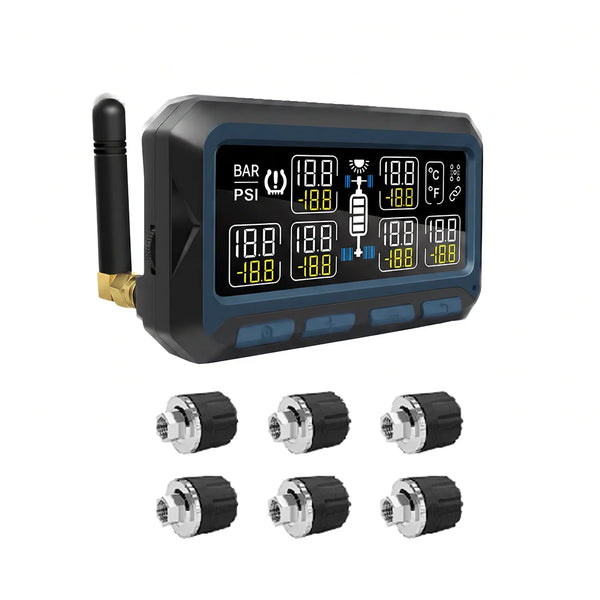
GRUNDIG 550S — 200 PSI Solar, 6–36 Wheels
Solar + Type-C power, German Infineon chip, ±1.5 PSI accuracy, IP67 sensors. A 200 PSI ceiling with room for every heavy tire up to the high end.
View the 550S Solar TPMS →
GRUNDIG 860 — 200 PSI, 6–110 Wheels, Multi-Trailer
5" touch screen, multi-trailer switching, independent axle alerts, optional GPS. Fleet-grade coverage at 200 PSI across up to 110 wheels.
View the 860 Touch-Screen TPMS →Between those three systems, the entire heavy-truck pressure range is covered: 200 PSI for the vast majority of commercial tires, 217 PSI for the rare ultra-high-pressure setups, and 6 to 110 wheels of capacity so the monitor grows with your operation rather than needing replacement when you add a trailer.
PSI Ceiling Comparison Table
Here is how the common TPMS pressure ceilings stack up against GRUNDIG's heavy-duty range. The column that matters is the last one: does the monitor cover your heaviest tire with headroom to spare?
| System type | Typical max PSI | Covers passenger / light RV | Covers Load Range E (80 PSI) | Covers Load Range G/H (110–125 PSI) |
|---|---|---|---|---|
| Passenger-car TPMS | ~60–80 PSI | Yes | No | No |
| Standard RV TPMS | 87 PSI | Yes | Partial | No |
| Mid-range RV TPMS | 116 PSI | Yes | Yes | No |
| Premium RV TPMS | 144–188 PSI | Yes | Yes | Partial |
| GRUNDIG 550S / D550 / 860 RECOMMENDED | 200 PSI | Yes | Yes | Yes |
| GRUNDIG S08 HIGHEST | 217 PSI | Yes | Yes | Yes |
Why ±1.5 PSI Accuracy Matters on a 130 PSI Tire
Range is only half the story. Accuracy is the other half, and it matters more as pressure climbs. A tolerance of ±3 PSI on a 35 PSI car tire is nearly a 10% error; on a 130 PSI truck tire the same absolute error is more tolerable, but you still want the tightest sensor you can get. GRUNDIG systems use a German Infineon processor to hold accuracy to ±1.5 PSI and ±3°C — tight enough to catch the first few PSI of a slow leak on a high-pressure tire before it becomes a heat problem.
The practical takeaway: when you are shopping for a heavy-truck monitor, treat "200 PSI range" and "±1.5 PSI accuracy" as the two numbers that matter. Everything else — screen size, solar charging, multi-trailer switching — is about how you want to use it, not whether it can protect your tires at all.
PSI ↔ BAR ↔ kPa Converter
Heavy tire pressures are quoted in three units depending on where you are — PSI in North America, BAR in Europe, and kPa in Australia. Use this to convert any value instantly.
Pressure Unit Converter
Type in any field — the other two update automatically.
Frequently Asked Questions
What PSI is considered "high pressure" for a TPMS?
Will a 116 PSI TPMS work on my 110 PSI trailer tires?
Is a higher PSI ceiling harder on the sensors?
Do I need a 217 PSI system, or is 200 enough?
Why do some monitors show a wrong number instead of an error at high PSI?
Does a high-pressure TPMS work on a standard RV too?
How do I know if my current monitor is already over its ceiling?
Is 200 PSI enough for a road train or B-double?
Get a Monitor That Can Actually Read Your Tires
Stop fighting a 116 PSI ceiling. GRUNDIG's 200–217 PSI TPMS line covers every tire from a light trailer to a loaded road train.
Shop High-Pressure TPMS →Free shipping · Trusted German Heritage since 1945