

Trailer sway is the moment every tower dreads: the trailer starts oscillating side to side behind the truck, each swing a little wider than the last, until the combination feels like it is steering itself. Ask around and you will hear a dozen causes — a gust of wind, a passing semi, a bad hitch. But the real root cause is almost always the same, and one of the biggest triggers is one nobody mentions: tire pressure.
This guide breaks down what actually causes tandem trailer sway, how to load a trailer so it cannot sway, and the hidden tire-pressure link that turns a stable rig into a pendulum. We make the TPMS and camera we recommend at the end, so we will tie every explanation back to something you can fix before the next trip — starting with the loading and the tire pressures, which between them cause the vast majority of sway incidents.
What Is Trailer Sway — and Why It's Dangerous
Sway is a feedback loop. The trailer moves slightly off line, the hitch resists, and the trailer swings back past center — and if the energy is not damped, each swing gets bigger. A tandem trailer is usually more stable than a single-axle trailer because its two axles resist the pivoting motion, but that stability only holds when the trailer is loaded right and the tires are right. Get either wrong and a tandem will sway just as violently — and with more mass behind it, the consequences are worse.
The danger is not the sway itself; it is that sway escalates to loss of control. A swinging trailer can push the back of the truck sideways, and if the driver brakes or steers hard, the combination can jackknife or roll. Sway is the kind of problem that feels minor right up until it is catastrophic — which is why it is worth understanding before you ever feel it.
The #1 Cause: Too Much Weight Behind the Axle
Strip away the wind and the passing trucks, and the single biggest cause of sway is weight distribution — specifically, too much weight behind the trailer's axle. A trailer is a lever, and the axle is the fulcrum. Put weight behind the axle and the rear of the trailer wants to swing wide; put too much there and it becomes a pendulum that steers the truck from behind.
The tell-tale sign is a trailer that feels twitchy and wanders at speed, or that sways worse on downhill runs. The fix is not a bigger hitch — it is moving the load forward so the center of gravity sits ahead of the axle. No sway-control device on the market can correct a fundamentally rear-heavy load.
The 60/40 Rule & Tongue Weight (10–15%) Explained
The numbers that keep a trailer stable are simple. Aim for roughly 60% of the load ahead of the axle and 40% behind — on a tandem, measure from the midpoint between the two axles, not from either axle alone. That front-heavy bias puts the right share of weight on the hitch, and the right share on the hitch is called tongue weight.
Tongue weight should sit between 10% and 15% of the total loaded trailer weight. Too little, and the trailer lifts off the hitch and swings freely; too much, and the truck's front tires unload and steering goes light. If you are not sure, a hitch with a built-in scale — or a quick visit to a CAT scale — takes the guesswork out. It is the single cheapest thing you can do to make a tandem trailer tow straight.
The Hidden Tire-Pressure Link to Sway
Here is the part most sway guides skip: tire pressure. A tire is a spring, and its stiffness is set by its pressure. When a trailer tire runs low, that corner of the trailer sits softer, flexes more, and steers differently than the other corner — which is exactly the asymmetry that starts a sway oscillation. Two tires at different pressures, even on the same axle, are enough to make a trailer wander.
An underinflated tire also has less lateral stiffness, so it lets the trailer "walk" sideways under crosswind or a passing truck's bow wave. In short, a tire-pressure imbalance does not just cause blowouts — it can cause sway. That is why a trailer that "just started feeling twitchy" often turns out to have one tire a few PSI low that nobody caught.
Before you blame the hitch, check every tire. A TPMS that shows all trailer tires at their correct cold pressure removes the single most overlooked cause of trailer sway.
Early Warning Signs: Catch It Before It Gets Violent
Sway rarely comes out of nowhere — it builds through stages you can learn to read. The earliest sign is a trailer that feels "busy" behind the truck, subtly hunting side to side on a straight, flat road. Next comes a light pull at the hitch that you feel in the steering wheel, especially when a truck passes or a gust hits. By the time the trailer is visibly swinging in your mirrors, you are already past the point of easy recovery.
The practical lesson: do not wait for the mirror to show you the problem. If the trailer starts feeling twitchy, treat it as a warning and check the two things that matter most — the load's position and every tire's pressure — before the next leg. A camera gives you the rear view that makes these early signs visible, and a TPMS tells you the tire pressure is right before you leave.
Speed, Crosswinds & Passing Trucks: Triggers That Amplify Sway
Once the trailer is loaded wrong or a tire is low, outside forces turn a latent problem into a violent one. The three big triggers are speed, crosswinds, and passing trucks. Sway tends to build above the trailer's comfort speed, which is why a rig that is rock-solid at 60 can start moving at 70. A crosswind pushes the trailer sideways and, if it starts the pendulum, the motion feeds itself. A passing semi punches a bow wave of displaced air that shoves the trailer off line for a moment — exactly the push a marginal setup does not recover from.
The takeaway is not to drive slower forever; it is to fix the underlying instability so the trailer shrugs off these triggers. A correctly loaded, correctly inflated trailer will take a truck's bow wave and settle right back into line.
Sway-Control Devices: Weight Distribution Hitches & Sway Bars
For a tandem trailer that already has a proper load, the right hardware adds a layer of damping. A weight-distribution hitch uses spring bars to push some of the tongue weight back onto the truck's front axle, restoring steering and leveling the combination. A sway-control bar adds friction that resists the side-to-side pivoting, damping the oscillation before it builds. Both are worth it on a heavy tandem or any trailer approaching the truck's limits.
The important caveat: these devices correct a stable trailer that needs a little help — they do not fix a rear-heavy load or a low tire. Hardware is the second step, never the first.
What to Do If Your Trailer Starts to Sway
Your instinct will be to brake and steer against the swing. Both are wrong. Hard braking can lock the trailer brakes and provoke a jackknife, and steering into the oscillation can feed it. The correct response is counter-intuitive: ease off the accelerator, keep the wheel straight, and do not touch the brakes unless you have a trailer-brake controller — in which case, apply the trailer brakes manually and gradually, which "pulls" the trailer straight.
Let the combination slow on its own, and the sway will usually damp out below its trigger speed. Then pull over, and before you drive on, check the two things that usually caused it: the load's position and every tire's pressure.
How TPMS + Camera Give You Back Control
Two pieces of gear remove the guesswork from both halves of the sway problem — the tires and the visibility. A TPMS watches every trailer tire's pressure and temperature continuously, so the low tire that starts a sway is flagged before it can. And a backup camera gives you a live rear view of the trailer, so you can see a load shift, a low tire, or the first hint of wander before you feel it.
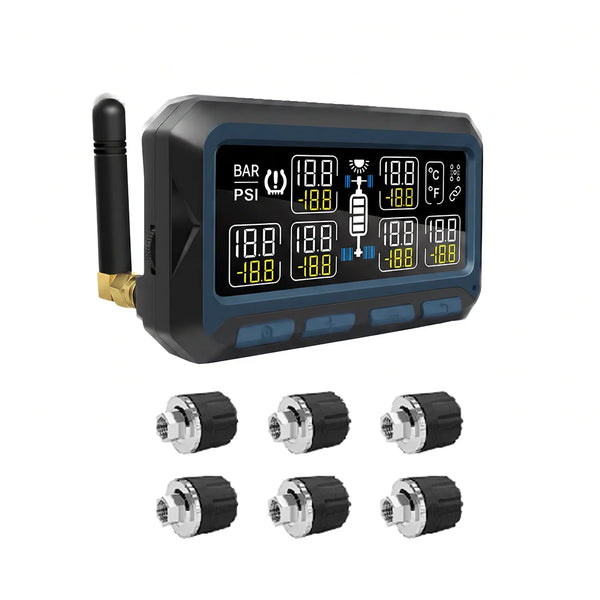
GRUNDIG 550S Solar TPMS — Catch the Low Tire Before It Sways
6–36 wheels, 200 PSI, real-time pressure and temperature on every trailer tire — including the one that's a few PSI low and quietly causing wander.
View the 550S Solar TPMS →
GRUNDIG Solar Wireless Backup Camera — Watch the Trailer, Not Just Feel It
Magnetic, solar, wire-free. A full-color rear view on a 7-inch monitor so you see a load shift or a wandering trailer before it becomes sway.
View the Backup Camera →Sway Cause → Fix
| Cause | What it does | The fix |
|---|---|---|
| Weight behind the axle #1 CAUSE | Makes the trailer a pendulum | Load 60/40, ahead of the axle |
| Low / uneven tire pressure | Softer corner, trailer walks sideways | Set cold PSI + TPMS alerts |
| Too little tongue weight | Trailer lifts and swings free | 10–15% tongue weight |
| Excess speed | Sway builds past trigger speed | Slow to a stable speed |
| Crosswind / passing trucks | Shoves trailer off line | Fix load & tires; add sway bar |
Frequently Asked Questions
Can low tire pressure really cause trailer sway?
What is the 60/40 rule for loading a tandem trailer?
How much tongue weight should my trailer have?
Do I need a sway-control bar if my trailer is loaded right?
What should I do the moment my trailer starts to sway?
Does a tandem trailer sway more or less than a single-axle trailer?
Will a weight-distribution hitch fix all sway?
Stop Sway Before You Feel It
Watch every tire with a TPMS and see the trailer with a wire-free camera — the two fixes for the sway you can't predict.
Shop TPMS Systems →Free shipping · Trusted German Heritage since 1945