

Où se trouve le capteur TPMS ? (Et est-il universel ?)
Où se trouvent réellement les capteurs sur une roue, pourquoi « universel » n’est pas la bonne question à poser et comment vérifier ce qui convient réellement à votre configuration.
Réponse courte : sur un système adaptable, le capteur TPMS se visse à l’extérieur de la valve — il n’est ni à l’intérieur du pneu ni boulonné à la jante. Et non, les capteurs TPMS ne sont pas universels au sens où « un seul capteur convient à tous les véhicules » — mais les capteurs externes de type bouchon s’en approchent, car ce qui varie réellement d’un véhicule à l’autre, c’est la taille de la valve, le nombre de roues et le protocole d’appairage, pas le capteur lui-même.
On arrive généralement à cette question pour l’une de ces deux raisons : soit un voyant s’est allumé sur le tableau de bord et l’on cherche le capteur physique pour le vérifier, soit l’on envisage d’acheter un kit TPMS et l’on veut savoir s’il conviendra réellement à son camping-car, sa remorque ou son camion à roues jumelées. Les deux questions ont le même point de départ : comprendre où se trouve le capteur et de quoi dépend réellement la compatibilité.
Emplacement du capteur
Où se trouvent les capteurs TPMS ?
Il existe deux réponses différentes selon le type de système :
TPMS d’origine (interne) — sur la plupart des voitures fabriquées après 2007, le capteur est monté à l’intérieur du pneu, soit fixé à la jante par une sangle, soit intégré directement à la valve. Il est invisible sans démonter le pneu et son remplacement nécessite généralement de se rendre chez un spécialiste du pneumatique.
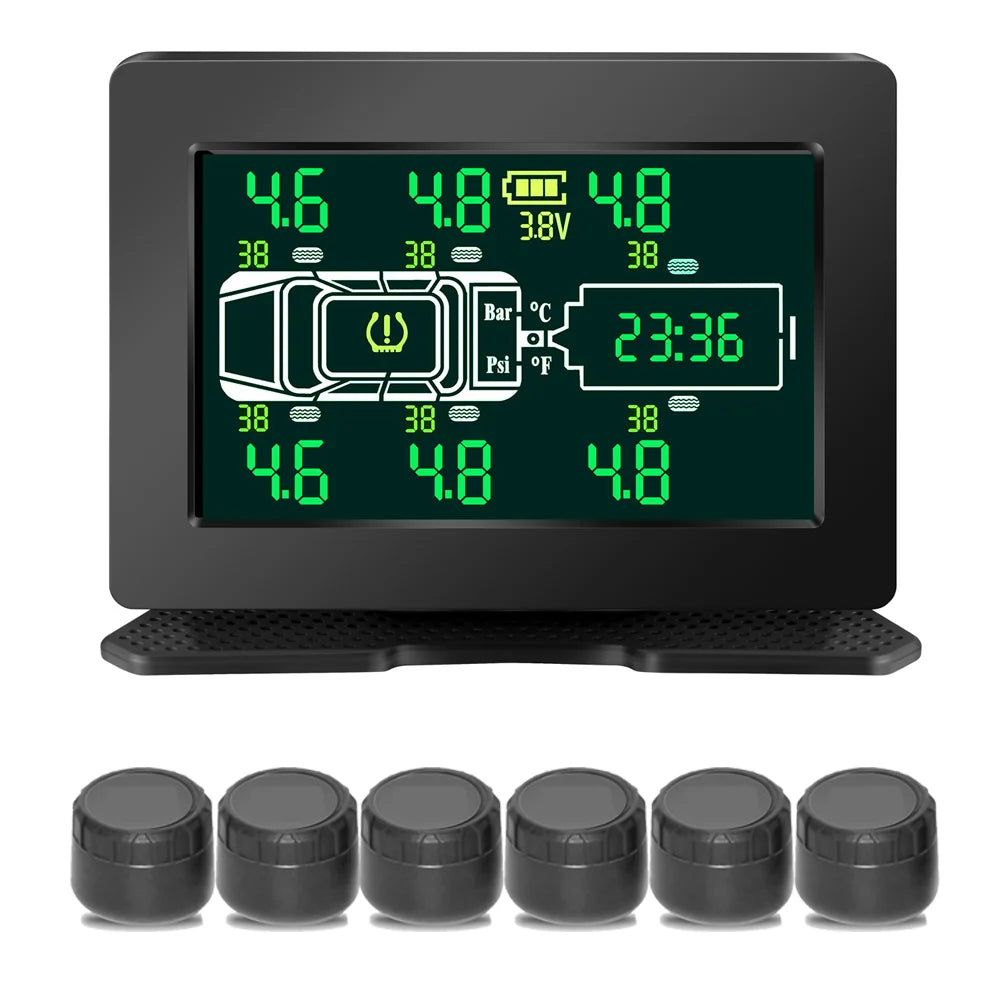
TPMS adaptable (bouchon externe) — c’est le type utilisé sur les kits pour camping-cars et remorques, notamment le TPMS pour camping-car de Grundig. Le capteur se visse à l’extérieur de la valve existante, à la place du bouchon de valve classique. Il est visible, se retire à la main et son installation prend environ deux minutes par pneu, sans autre outil qu’une clé à bouchon de valve.
Cette installation externe est précisément la raison pour laquelle les TPMS de rechange existent en tant que catégorie : elle permet d’ajouter un système de surveillance de la pression des pneus à n’importe quel véhicule sans ouvrir la roue.
Compatibilité
Les capteurs TPMS sont-ils universels ? Ce qui varie réellement
Pas exactement — mais pas pour la raison à laquelle on pourrait s’attendre. La fonction essentielle du capteur — mesurer la pression et transmettre les données sans fil — est la même d’une marque à l’autre. Pour déterminer si un capteur donné convient à votre configuration, trois éléments entrent en jeu :
| Facteur | Pourquoi c’est important |
|---|---|
| Taille de la valve | Valves standard de voiture contre valves boulonnées plus grandes, courantes sur les remorques et les roues pour véhicules lourds : le filetage du capteur doit correspondre. |
| Nombre de positions de pneus | Une voiture particulière nécessite 4 capteurs ; un camion à roues jumelées en nécessite 6 ; un camping-car ou une remorque à plusieurs essieux peut en nécessiter 6 à 12. Le moniteur doit prendre en charge ce nombre. |
| Protocole d’association | Chaque capteur est associé en usine à un moniteur ou récepteur précis ; les capteurs d’un système ne s’associent généralement pas au moniteur d’une autre marque. |
En pratique, la formulation honnête de la question « Le TPMS est-il universel ? » est la suivante : l’installation est universelle, mais pas le système. Tout capteur externe à capuchon se visse de la même manière sur toute valve standard, mais le capteur doit faire partie d’un kit compatible avec votre nombre de pneus et être associé à son propre moniteur.
Camping-car ou remorque
TPMS pour camping-car ou pour remorque — quelle est la différence ?
Comme les deux sont des systèmes à capuchons externes, la différence ne réside pas dans le capteur, mais dans ce que le kit est conçu pour prendre en charge :
| TPMS pour camping-car | TPMS pour remorque | |
|---|---|---|
| Nombre habituel de pneus | Kits à 4, 6 ou 8 roues | Configurable selon le nombre d’essieux, y compris pour les remorques à plusieurs essieux |
| Plage de pression | Jusqu’à 116 PSI | Dimensionné pour la pression des pneus de remorque |
| Écran | Moniteur dans la cabine, installé de manière à être visible par le conducteur | Moniteur dans la cabine ou dans le véhicule tracteur, selon la configuration |
Découvrez les deux systèmes : système TPMS pour camping-car · système TPMS pour remorque
Vérification rapide
Comment vérifier qu’un kit convient à votre configuration
Avant l’achat, vérifiez trois éléments sur la page du produit : le nombre de positions de pneus prises en charge par le kit, la compatibilité du type de valve avec vos roues (valves standard ou valves vissées de remorque) et la plage de pression prise en charge par le moniteur. Tout kit qui satisfait ces trois critères s’installe de la même manière : visser, associer une fois, et c’est terminé.
FAQ
Questions fréquentes
Puis-je utiliser un seul système TPMS pour mon véhicule tracteur et ma remorque ?
Seulement si le moniteur prend en charge suffisamment de positions au total pour couvrir les deux véhicules et si tous les capteurs y sont associés. La plupart des propriétaires utilisent séparément le TPMS d’origine du véhicule tracteur et ajoutent un kit dédié pour les pneus de la remorque.
Tous les pneus d’un camping-car ou d’une remorque doivent-ils être équipés d’un capteur ?
Pour une couverture complète, oui : un capteur sur chaque position, y compris sur les roues jumelées intérieures des essieux à plusieurs roues, permet de recevoir des alertes pour chaque position plutôt qu’une seule valeur moyenne.
Un capteur dont la taille ne correspond pas à celle de la valve fonctionnera-t-il quand même ?
Il peut ne pas se visser correctement, ce qui présente un risque de fuite d’air lente. Vérifiez la compatibilité avec la valve avant l’installation au lieu de forcer.
Acheter un TPMS
Trouvez la configuration adaptée à votre véhicule
TPMS Grundig pour camping-car
116 PSI, 4/6/8 roues. Capteurs externes à fixer sur les valves, sans autre outil qu’une clé à valve. Compatible avec la plupart des configurations de camping-car et de remorquage.
$119
Achetez maintenant →Système TPMS pour remorque
Capteurs externes sans fil adaptés aux valves de remorque et aux configurations à plusieurs essieux. Se connectent à un seul moniteur dans la cabine.
Découvrez la gamme
Achetez maintenant →TPMS solaire 6 roues
6 capteurs externes à fixer sur les valves pour toutes les positions de roues jumelées, y compris les roues jumelées intérieures. Moniteur solaire + USB.
$109
Achetez maintenant →Vous ne savez pas quel kit correspond au nombre de roues de votre véhicule ? TPMS pour camping-car 119 $ · TPMS pour remorque · Solaire 6 roues 109 $ · Livraison gratuite
Achetez tous les systèmes TPMS →