

Here's a scenario every dually owner knows but few can put a number on: you check your rear tires before a trip, both outer tires look full, and you pull away confident. What you cannot see is the inner dual — the tire tucked directly behind the outer one — and that invisible tire is the one that goes flat first. Not because it is weaker, but because nobody watches it.
This guide explains why the inner dual is such a dangerous blind spot, what a flat inner tire quietly does to the rest of your rig, and how a 6-wheel TPMS finally puts both duals on the screen. We make the monitor we recommend at the end, so we will keep the explanation grounded in what actually happens out on the road — and in what it costs when it goes unnoticed.
The Dually Tire Setup Most Drivers Never Think About
A dually axle puts four tires across the back of the truck — two per side — to carry the heavy load a single rear wheel cannot. On paper that is straightforward. In practice, it creates a geometry problem: the inner tire sits recessed behind the outer tire, its valve stem buried in the gap between the two wheels, and its sidewall invisible from every normal viewing angle.
The outer tire takes the abuse you can see — curbs, scrapes, road debris. The inner tire takes the abuse you cannot see: it runs hotter (less airflow between the two tires), it carries the load when the outer is soft, and it is the tire most people never check simply because reaching it is a chore. That combination — invisible, hot, and un-checked — is exactly why inner duals fail disproportionately.
Why the Inner Dual Is Nearly Invisible (and Hard to Reach)
Walk around your truck and try to read the inner tire's sidewall. From the side, the outer tire blocks it. From behind, the wheel well and the outer wheel's dish block it. You cannot see the inner tire's tread, its pressure, or its temperature without bending down, shining a light into the gap, and specifically looking for it — which nobody does at a fuel stop after six hours of driving.
Reaching it with a gauge is worse. The valve stem on an inner dual points through a cutout in the outer wheel, and a standard air chuck does not fit the gap. You need a dual-foot gauge or an angled chuck, and even then you are working blind with your hand wedged between two wheels. Most owners skip the inner tire, check the outer, and call it done. That is not laziness — it is the natural result of a design that hides the most important tire.
The "Both Tires Look Fine" Trap: When the Inner One Is Flat
The real danger is not that the inner tire looks flat — it is that it looks fine. On a dually, the outer tire holds the visual shape of the wheel even when the inner tire is completely empty. You glance at the wheel, see a full-looking outer tire, and assume both are fine. Meanwhile the inner tire has been running flat — or close to it — for hundreds of miles.
A flat inner dual is invisible from the driver's seat, from the mirror, and from a casual walkaround. The only thing that knows it is flat is a sensor on that wheel.
This is not a rare edge case. It is the single most common dually tire failure, and it is why "I check my tires before every trip" does not actually protect a dually the way it protects a single-rear-wheel vehicle.
The Hidden Costs of a Flat Inner Dual (Outer Overload, Heat, Blowout)
When the inner tire goes flat, it stops carrying its half of the load. The outer tire — which looked fine — is now silently carrying double. Double the load means double the flex, double the heat, and a tire that was comfortably within its rating is now over its limit. The sequence ends the same way it always does: the outer tire overheats and blows, often at highway speed, often fully loaded.
And it is not just the tires. A flat inner dual runs against the outer tire sidewall, generating heat that can damage both tires and, in the worst case, take out the wheel or the brake hardware on that corner. What started as a slow leak in an invisible tire becomes a roadside repair that costs far more than a sensor.
What a Flat Inner Dual Actually Does (The Real-World Timeline)
Here is how it usually goes, from a slow leak to a roadside stop. Hour one: a small puncture or a valve core that is not fully sealed lets the inner tire bleed air slowly. The outer tire picks up a little extra load, but nobody notices because the wheel still looks normal. Hour three: the inner tire is 15 PSI low, flexing hard and building heat; the outer tire is now carrying most of the corner's load. Hour five: the inner tire is flat and rubbing the outer's sidewall, and the outer tire is over its limit and heating fast. The blowout, when it comes, is the outer tire — the one that looked fine — because the flat inner tire quietly transferred all the damage to it.
Every step of that timeline is invisible from the cab. The only instrument that breaks the chain is a pressure and temperature sensor on the inner dual, alerting you at hour one instead of hour five.
Not Just Trucks: Inner Duals on Trailers & Goosenecks Too
The same blind spot exists on the trailer side. Heavy tandem-axle trailers, goosenecks, and equipment haulers run dual wheels on some axles, and those inner duals are even easier to ignore — you do not even drive the trailer, so there is no seat-of-the-pants signal that something is off. A flat inner dual on a trailer goes unnoticed until it takes out the outer tire, the fender, or the brake lines on that corner.
That is why multi-axle TPMS coverage matters as much behind the truck as on it. The 550S extends from six wheels up to 36, so the same monitor that watches your truck's inner duals also covers the trailer's — one screen, every hidden tire in the combination.
Checking Inner Dual Pressure by Hand: The Real Hassle
Let's be honest about what a manual check involves on a dually. You need the right tools — a dual-foot or angled gauge — and the willingness to kneel beside a hot wheel, reach into the gap, and seat the chuck on a stem you cannot see. You need to do it for both inner tires, on a truck that might have been driven an hour ago. And when you finish, you have a single snapshot: accurate for that moment, meaningless 200 miles later when a leak starts.
That is the fundamental limit of any manual check. It tells you the pressure now, not the pressure in fifty miles. For a tire that hides its problems, a once-a-week snapshot is not enough — the failure develops between checks.
How a 6-Wheel TPMS Watches Both Duals on Every Axle
The answer is a sensor on every tire, including — especially — the inner duals. A 6-wheel TPMS puts an external sensor on each of the truck's six tires, so the inner and outer duals on both sides report independently to the same display. When the inner tire starts losing air, you get an alert while the outer still looks fine — which is exactly the early warning a dually needs.
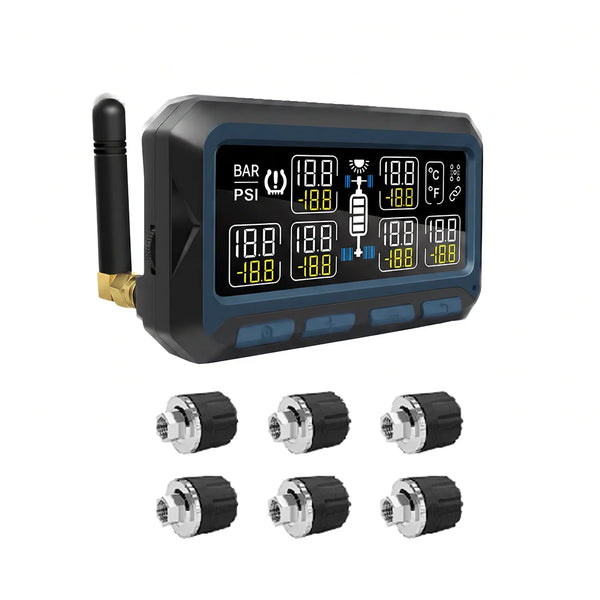
GRUNDIG 550S — Inner & Outer Dual Coverage on Every Axle
6–36 wheels, 200 PSI, solar + Type-C, ±1.5 PSI accuracy, IP67 sensors. The display shows each dual as its own position, so a flat inner tire is caught the moment it starts leaking.
View the 550S Solar TPMS →Because the sensors are external, installing one on an inner dual is the same two-minute job as an outer tire — no dismounting, no special tools. And because the 550S monitors up to 36 wheels, the same system extends to a tandem trailer or a second rig, so the inner dual is never the only tire you are watching.
Manual Check vs a 6-Wheel TPMS
| Manual gauge | 6-Wheel TPMS | |
|---|---|---|
| Reaches the inner dual | Only with special chuck, by feel | Sensor lives on the valve stem ✓ |
| Coverage | One snapshot, when you remember | Continuous, every mile |
| Catches a mid-trip leak | No | Yes — fast-leak alert |
| Watches temperature | No | Yes — heat is the killer |
| Time per check | Several minutes per dual | Zero — always on |
Frequently Asked Questions
How do I check my inner dual tire pressure by hand?
Does an external TPMS sensor fit on an inner dual valve stem?
Why does the inner dual run hotter than the outer?
How many sensors do I need for a dually truck?
Can a flat inner dual damage the outer tire?
Should the inner and outer duals run the same pressure?
Do inner dual sensors need metal valve stems?
Can one monitor watch my truck's duals and my trailer's tires at once?
How often should I check my inner dual tires?
See the Tire You've Been Missing
A 6-wheel TPMS puts your inner duals on the screen — so a hidden flat never becomes a highway blowout.
Shop TPMS Systems →Free shipping · Trusted German Heritage since 1945