


Long-Haul Trucking and Tire Blowouts:
What the Data Says and How TPMS Changes the Equation
Tire failure is the leading cause of commercial truck breakdowns on US highways. The cost of a single blowout event is measurable. The cost of preventing it is fixed and knowable in advance.
Tire-related failures account for more commercial truck breakdowns on US interstate highways than any other single mechanical category. The Federal Motor Carrier Safety Administration's data is consistent across multiple reporting cycles: underinflation is the primary contributing factor in the majority of those failures, and the progression from underinflation to failure typically spans dozens to hundreds of miles — a window during which real-time monitoring can identify the problem and allow for a controlled response.
The economic case for TPMS on commercial trucks is not complicated, but it requires accounting for the full cost of a blowout event rather than just the tire itself. A solar-powered 6-wheel TPMS for a commercial dually truck eliminates monitor battery management entirely and covers all six tire positions — including the inner dual rears that are invisible from outside and most commonly run underinflated without detection. The conversation about whether the cost is justified becomes straightforward once the full cost of the alternative is correctly calculated.
This article walks through what FMCSA data says about commercial truck tire failures, what a blowout event actually costs when all variables are included, and how the break-even calculation compares to what a monitoring system costs.
The Data
What FMCSA Statistics Say About Commercial Truck Tire Failures
The Federal Motor Carrier Safety Administration identifies tire-related issues as a top mechanical violation category in roadside inspections and a leading contributor to commercial motor vehicle crashes. Underinflation is consistently identified as the primary factor — not blowouts from external damage or sudden failure, but the progressive structural degradation that underinflation produces in a tire operating under commercial load at highway speed.
The mechanism is well-documented. An underinflated tire under commercial load flexes more than it was designed to with each rotation. That excess flex generates heat in the sidewall and carcass plies. At highway speed, a commercial truck tire completes hundreds of rotations per minute. Heat accumulates faster than it dissipates. The carcass compounds deteriorate. The separation that produces a blowout can develop over many miles before it becomes a sudden catastrophic event.
The Real Cost of a Blowout
Adding Up What a Single Tire Failure Actually Costs
The tire itself is the smallest line item. When calculating the true cost of a commercial truck blowout, the complete picture includes direct costs — tire replacement, roadside service call, rim and wheel inspection, potential suspension and body damage from the failure event — and indirect costs that are often larger.
| Cost Category | Typical Range | Notes |
|---|---|---|
| Commercial truck tire replacement | $300 – $600 | Steer tire or drive tire, roadside pricing |
| Roadside service call | $250 – $500+ | Higher on weekends, nights, remote locations |
| Rim and wheel inspection | $100 – $300 | Impact damage assessment, potential replacement |
| Downtime — driver time | 2–6 hours | At commercial driver rates plus delay costs |
| Late delivery penalty / cargo risk | Variable | Contract-dependent, can exceed hardware costs |
| Secondary vehicle damage | $0 – $3,000+ | Fender, mudflap, suspension — common in rear blowouts |
| Realistic single-event total | $1,500 – $5,000+ | Excludes cargo loss and accident costs |
A single blowout event at the conservative end of this range costs more than three years of TPMS hardware. At the realistic middle range, it costs more than five years. For a fleet operator or owner-operator running high annual mileage, the expected value calculation is not marginal — a single prevented event typically covers the full cost of the monitoring system within the first year of operation.
The Monitoring Gap
Why Inner Dual Rear Tires Are the Highest-Risk Position Without TPMS
On a dually commercial truck, the inner rear tires on each side are invisible from outside the vehicle during a walkaround inspection. The only way to check their pressure without a monitoring system is to physically access each inner tire with a long-stem gauge or right-angle adapter — a process that most drivers skip due to time constraints and physical difficulty.
The result is predictable. Inner dual rear tires on commercial trucks routinely run 10–20 PSI below their required operating pressure for extended periods without detection. They generate heat from the underinflation load, transfer that heat to the outer tire running adjacent to them, and create a failure risk in both tires simultaneously. A single-axle blowout on a dual rear position can take out both tires.
The Products
Purpose-Built Commercial Monitoring Solutions

Grundig Solar TPMS
6-Wheel System
Solar + USB dual charging — no monitor battery maintenance. 6 sensors covering all positions including inner duals. 6 alarm modes. Real-time pressure and temperature. Designed for daily commercial operation.
Shop Now
View Product →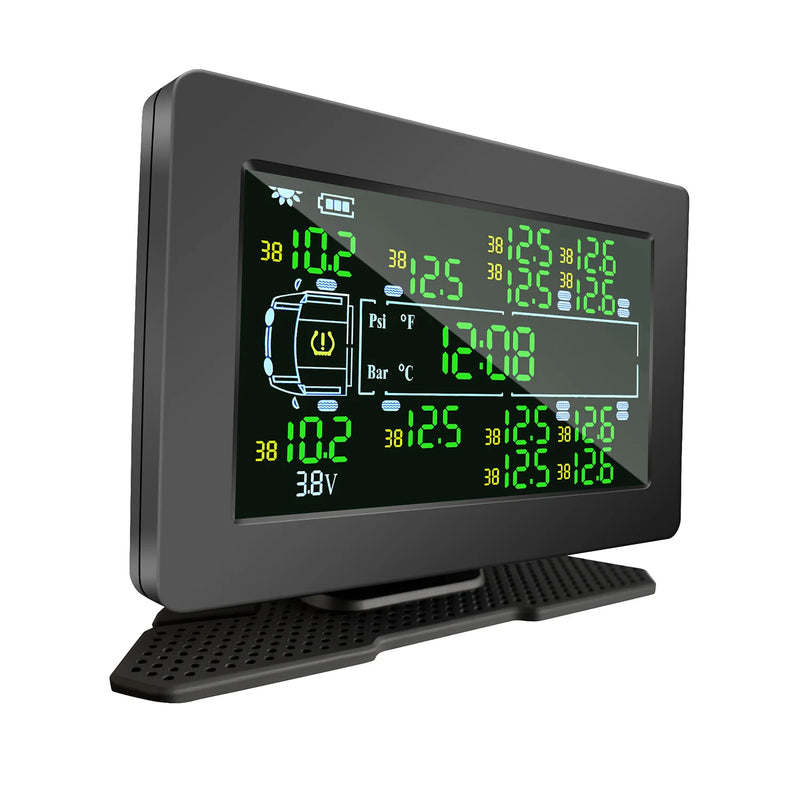
Grundig S08
Heavy-Duty TPMS
218 PSI maximum range. 8/12-wheel switchable for large commercial configurations. Purpose-built for heavy chassis vehicles where standard systems can't reach operating pressures. $259.
$259
View Product →Browse the complete Grundig commercial TPMS range to match your specific vehicle configuration, wheel count, and pressure range to the right monitoring system.
Monitor every position. Prevent every preventable event. Solar-powered · 6-wheel coverage · Free shipping
Shop Solar TPMS →