

RV TPMS Buying Guide 2026:
What to Look for Before Your Next Road Trip
Tire pressure failures cause more RV breakdowns than any other single factor. Here's everything you need to know before buying a monitoring system — and what separates a useful one from a frustrating one.
Tire blowouts and slow leaks are the leading cause of roadside breakdowns for RV owners. The problem is rarely dramatic — it's usually a gradual pressure drop that starts miles before the failure and goes undetected until it's too late. A TPMS doesn't prevent blowouts, but it gives you the window to pull over safely before one happens.
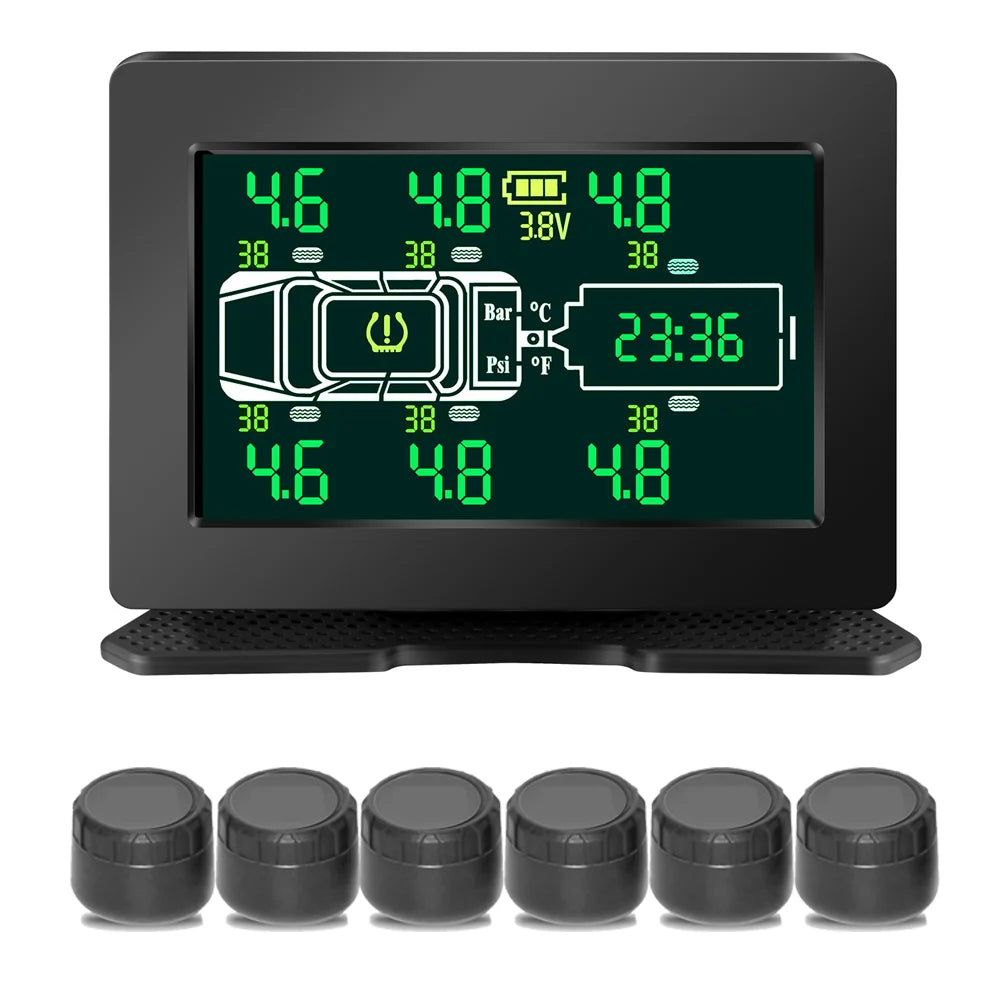
Not all TPMS systems are built for RV use. Passenger car sensors max out around 50 PSI — far below the 80–100 PSI that a loaded Class A diesel pusher runs on its rear tires. A system that can't read your actual operating pressure is not monitoring your tires, it's just adding weight to the dashboard. The Grundig RV TPMS covers up to 116 PSI across switchable 4, 6, and 8-wheel configurations — built specifically for the pressure ranges and vehicle types that RV owners actually operate.
This guide walks through every specification that matters when choosing an RV tire pressure monitoring system, what the numbers mean in real-world use, and how to match the right system to your specific vehicle configuration. Whether you're in a Class B campervan, a 5th-wheel trailer, or a full-size Class A motorhome, the decision criteria are different — and getting them right is the difference between a system you trust and one you stop looking at after the first month.
Spec #1
PSI Range: The Number Most Buyers Get Wrong
The single most important specification on any RV TPMS is its maximum pressure range — and it's the one most buyers overlook because they're comparing to their passenger car experience.
Standard passenger cars run 32–36 PSI. Most standard TPMS systems max out around 50–58 PSI. An RV is not a passenger car. A loaded Class C motorhome typically runs 70–85 PSI on its rear axle. A Class A diesel pusher can run 100–120 PSI on dual rear tires fully loaded. If your TPMS can't read above 80 PSI, it simply cannot monitor your rear tires under real driving conditions — it will either read nothing or display constant error codes.
The Grundig RV TPMS handles up to 116 PSI with ±1.5 PSI measurement precision. That covers the full operating range of Class A, B, and C motorhomes, dually pickup tow vehicles, and fifth-wheel setups without running into the ceiling that makes cheaper systems useless on heavier configurations.
Spec #2
Wheel Count Flexibility: Why Switchable Modes Matter
RV owners rarely drive one vehicle for their entire ownership life. They upgrade. They change tow vehicles. They add a trailer. A TPMS locked to a fixed wheel count becomes obsolete the moment the configuration changes.
4-Wheel Mode
Class B campervans, standard motorhomes, single-axle trailers. Standard coverage for most entry-level RV setups.
6-Wheel Mode
Dually trucks, Class A motorhomes with dual rear tires, 5th-wheel setups with trailer axle monitoring included.
8-Wheel Mode
Full Class A diesel pusher plus trailer, tandem axle trailer monitoring, or heavy-duty dually tow vehicle plus trailer.
The switchable 4/6/8-wheel design means you buy one system and reconfigure it as your setup changes. The alternative — buying a new TPMS every time you change vehicles — costs more and creates unnecessary disruption to monitoring continuity. For owners who plan to upgrade or change configurations within three to five years, switchability is not a premium feature. It is basic future-proofing.
Spec #3
Display Size and Readability: What You Can Actually See While Driving
A TPMS display needs to be readable at a glance without taking your eyes off the road. The majority of budget TPMS systems use 2.4–3.5-inch displays that require focusing on the screen to distinguish which tire is being shown and what the reading is. At highway speed, this is not a minor inconvenience — it is a safety issue.
The 5.0-inch display on the Grundig RV TPMS shows all monitored tires simultaneously with distinct position labeling. At a glance, you can see every tire's pressure and temperature without squinting, zooming, or scrolling through screens. This matters most in the moments when you need the information fastest: when a reading has dropped abnormally and you're deciding whether to pull over.
Spec #4
Alarm Modes: What the System Should Tell You and When
A TPMS that only alarms for low pressure misses half the failure scenarios that actually strand RV owners on the highway. Temperature is equally critical — a tire running at the correct pressure but overheating from an internal defect, sustained high speed, or a brake issue will fail just as certainly as an underinflated one.
-
↓Low Pressure AlarmTriggers when tire pressure drops below your set threshold. Most critical alarm for slow leaks and valve stem failures that develop gradually over miles.
-
↑High Pressure AlarmTriggers when heat expansion pushes pressure above safe limits. Important in summer driving and on extended mountain descents where brake heat transfers to tire temperature.
-
🌡High Temperature AlarmCatches internal tire failures, overloading, and underinflation-induced heat buildup before they reach catastrophic levels.
-
⚡Rapid Leak AlarmDistinguishes between slow gradual pressure loss and a sudden sharp drop — the kind caused by a nail or sidewall puncture that requires immediate action.
-
🔋Low Sensor BatteryAlerts before a sensor loses power and drops out of monitoring — not after, which is when most systems notify you.
Complete Spec Review
Grundig RV TPMS: The Numbers That Matter
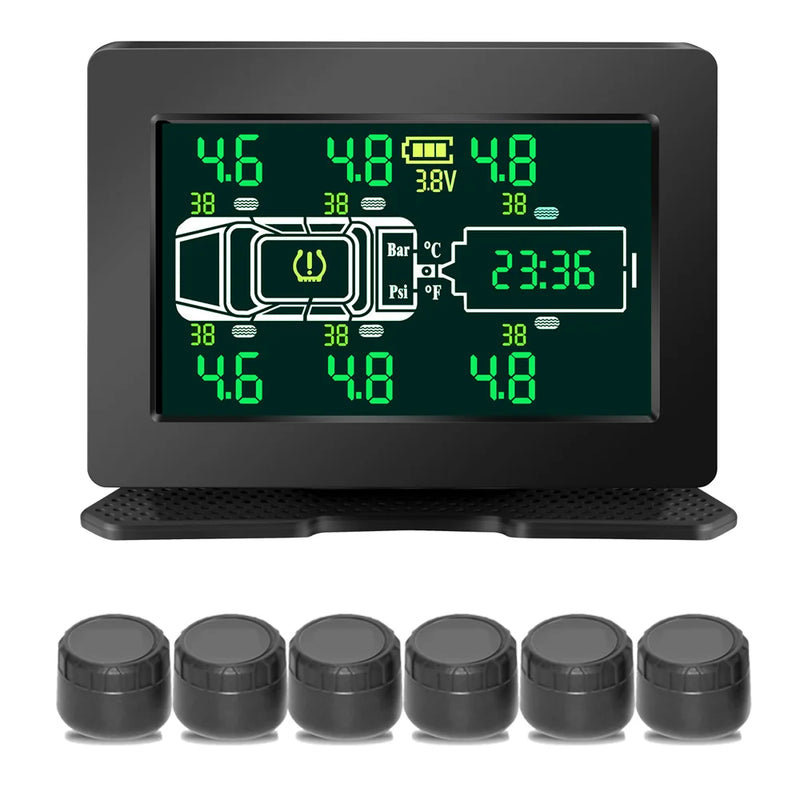
Grundig RV TPMS
4/6/8-Wheel Switchable
116 PSI range with ±1.5 PSI precision. 5.0" display showing all tires simultaneously. Full alarm suite: low/high pressure, temperature, rapid leak, sensor battery. Switchable 4/6/8-wheel modes. Free shipping.
$119
Shop Now →Matching System to Vehicle
Which RV Configuration Needs Which TPMS
The Grundig RV TPMS at $119 covers the majority of RV configurations — Class A, B, and C motorhomes, dually tow vehicles, and fifth-wheel setups up to 8 wheels at pressures to 116 PSI. It is the right choice for most recreational RV owners.
If you operate a heavy-duty Class A diesel pusher, a commercial chassis motorhome, or a vehicle with axle pressures approaching 200 PSI, the Grundig S08 heavy-duty TPMS extends coverage to 218 PSI across 8/12-wheel configurations — designed specifically for the top tier of heavy recreational and commercial vehicles.
Browse the complete Grundig TPMS collection to compare all available systems against your specific vehicle type and axle configuration. The right system is the one rated for your actual operating pressures — not the one that looks similar at a lower price.
Monitor every tire. Drive with confidence. Free shipping · 4/6/8-wheel switchable · 116 PSI range
Shop RV TPMS →