


The Diesel Dually Owner's TPMS Guide:
F-450, Ram 3500, and Sierra 3500HD
Three of the most capable work trucks in America. All three share the same critical monitoring blind spot — the inner dual rear tires your factory system can't see.
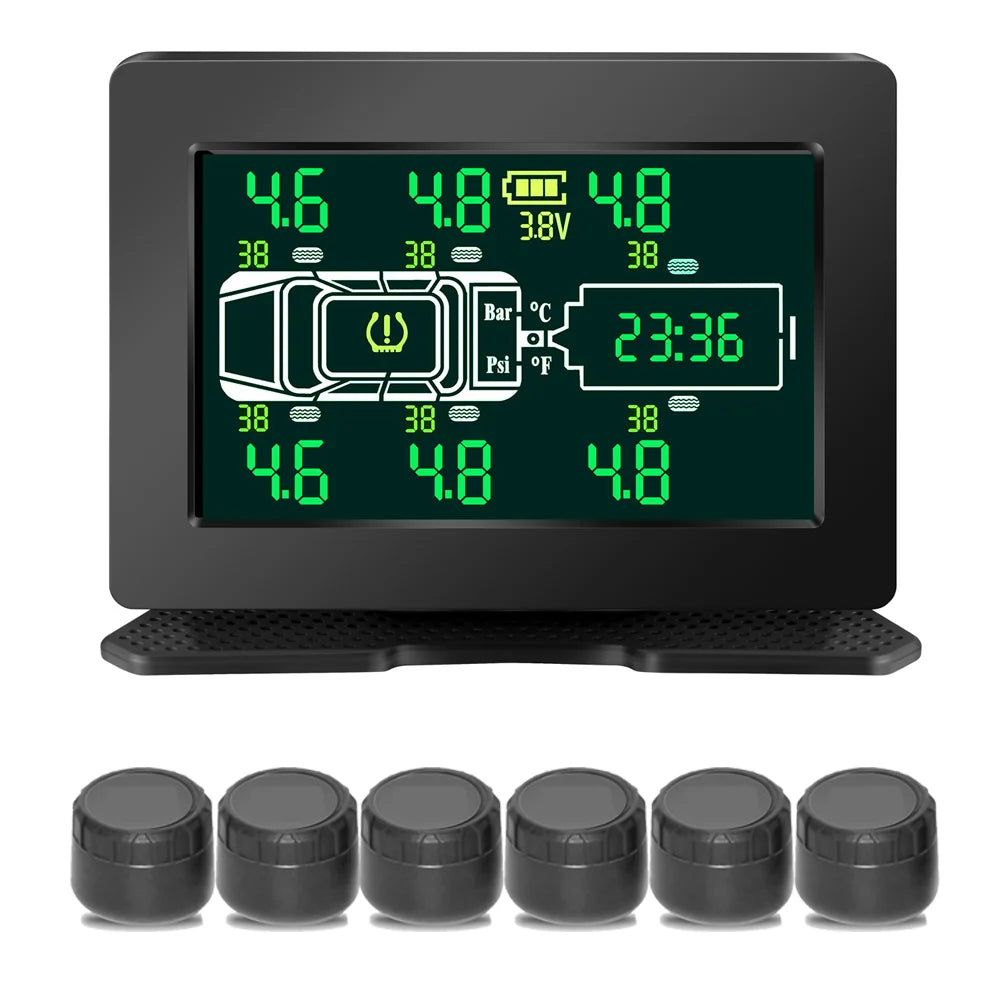
The Ford F-450, Ram 3500, and GMC Sierra 3500HD represent the peak of American light-duty commercial trucking — purpose-built to haul heavy loads, tow large trailers, and operate at the kind of sustained duty cycles that expose every weakness in tire monitoring coverage. All three share a critical factory TPMS limitation: the inner dual rear tires on each side of the rear axle either have no dedicated sensor coverage, or are monitored by a single sensor that represents both tires on that side. The Grundig Solar TPMS for 6-Wheel Trucks addresses this precisely — a sensor on every position, including both inner duals, monitoring all six tires simultaneously without requiring monitor battery maintenance on a daily-use commercial vehicle.
This guide covers the specific rear axle specifications for each truck, the factory TPMS limitation each one carries, and the pressure ranges relevant to their most common loading and towing configurations. The goal is straightforward: matching the right monitoring configuration to the specific characteristics of each platform, rather than applying a generic solution to three trucks that differ meaningfully in their operating parameters.
Vehicle Profiles
Specifications, Pressure Ranges, and Factory TPMS Limitations
Ford F-450 Super Duty
Highest GVWR in the light-duty segment — the most demanding tire management requirements of the three
Factory limitation: The F-450's factory system monitors outer dual rear tires only. Inner dual rears have no dedicated sensor. At maximum GVWR, inner rear tires carry load equivalent to the outer tires — but with zero monitoring coverage unless an aftermarket system is added.
Ram 3500 Heavy Duty
Best-in-class towing capability — generates the highest sustained tire load conditions under towing at highway speed
Factory limitation: The Ram 3500 uses an indirect TPMS system that infers pressure from wheel speed data across four positions. Inner dual rear tires are grouped with the outer, meaning a 15 PSI pressure difference between inner and outer is invisible to the system — the average reads within acceptable range even as one tire is critically underinflated.
GMC Sierra 3500HD
Workhorse commercial configuration — high annual mileage, sustained payload, frequent fifth-wheel and gooseneck towing
Factory limitation: Where the Sierra 3500HD runs a direct system, sensors are placed on the outer dual rear tires only. Inner duals require the operator to physically access them with a gauge for pressure verification — which most operators skip due to physical difficulty, leaving the highest-risk positions unmonitored between service intervals.
The Shared Problem
Why Inner Dual Rear Tires Are the Highest-Risk Position on All Three Trucks
Inner dual rear tires on all three platforms share three characteristics that make them the highest-risk monitoring gap in the dually configuration. First, they are physically inaccessible for a quick visual check — confirming their condition requires going under the truck or reaching between the dual tires. Second, they carry load equivalent to the outer tires but generate different heat profiles because they have less direct airflow exposure. Third, the outer tire running adjacent to an underinflated inner can mask the inner's condition, with the outer performing normally while the inner is failing.
Configuration Match
How the 6-Wheel System Maps to Each Truck's Positions
| Position | F-450 | Ram 3500 | Sierra 3500HD | Covered by Solar 6-Wheel |
|---|---|---|---|---|
| Front Left | Monitored (factory) | Monitored (factory) | Monitored (factory) | ✓ Sensor 1 |
| Front Right | Monitored (factory) | Monitored (factory) | Monitored (factory) | ✓ Sensor 2 |
| Rear Left Outer | Monitored (factory) | Inferred only | Monitored (factory) | ✓ Sensor 3 |
| Rear Left Inner | No coverage | No coverage | No coverage | ✓ Sensor 4 |
| Rear Right Outer | Monitored (factory) | Inferred only | Monitored (factory) | ✓ Sensor 5 |
| Rear Right Inner | No coverage | No coverage | No coverage | ✓ Sensor 6 |
All six positions are covered by a single system, displayed simultaneously on one monitor, with independent pressure and temperature readings for each. The two inner dual positions that represent the most significant factory monitoring gap are treated identically to the other four — not grouped, not inferred, but individually sensored and individually reported. Browse the complete Grundig TPMS range for additional configurations.
Why Solar Charging Matters for These Trucks
The Operational Case for Battery-Free Monitor Power
All three trucks in this guide are typically operated as daily commercial or heavy-use vehicles — high annual mileage, frequent towing, year-round operation. This operating profile creates a specific problem with battery-powered TPMS monitor units: the monitor's battery depletes during normal use, and if it depletes while the vehicle is parked overnight or on a weekend, the driver begins the next day without monitoring coverage from the moment of startup.
The solar charging panel on the Grundig Solar TPMS monitor maintains continuous power throughout all daylight driving hours, supplemented by USB charging for overnight or covered parking. For an F-450, Ram 3500, or Sierra 3500HD operator running 50,000–100,000+ miles annually, eliminating monitor battery management from the maintenance schedule is a meaningful operational benefit — one less failure mode in a system that exists specifically to prevent failures.
Grundig Solar TPMS
6-Wheel Truck System
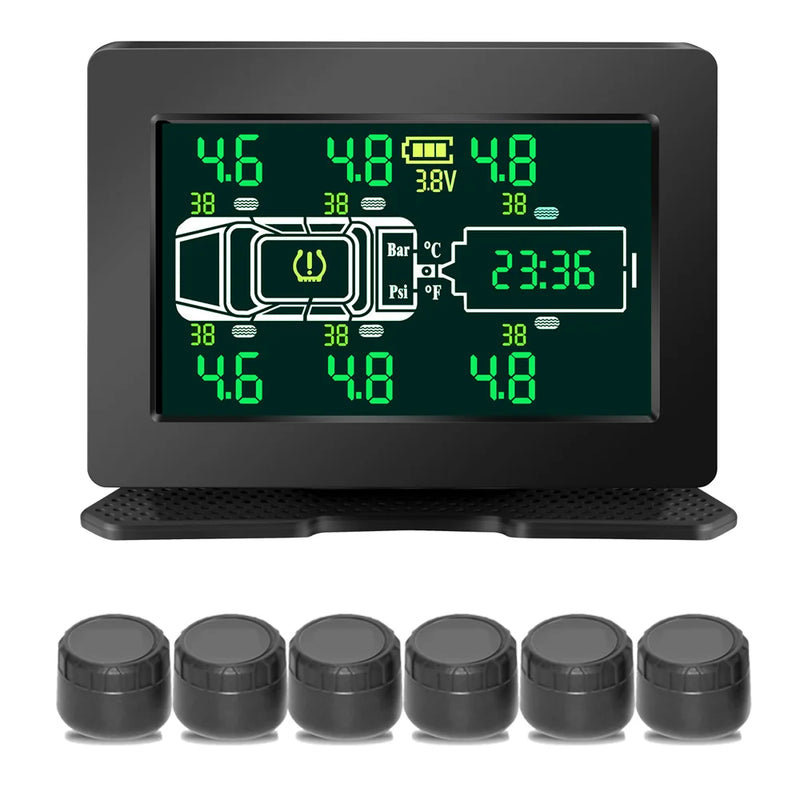
6 direct sensors covering all positions including both inner dual rears. Solar + USB monitor charging — no battery management. 6 alarm modes: low/high pressure, high temperature, rapid leak, signal loss, sensor battery. Real-time PSI and temperature. Free shipping.
See product page
Shop Now →Six sensors. Six positions. Every inner dual included. F-450 · Ram 3500 · Sierra 3500HD · Free shipping
Shop Solar TPMS →