


The True Cost of Overinflated Tires —
and Why TPMS Monitors Both Extremes
Every article about tire safety focuses on underinflation. Overinflation is equally dangerous — and in summer heat, it's the risk that correct morning inflation doesn't protect against.
The scenario plays out on desert highways every summer: an RV owner inflated their tires correctly that morning, set to the right cold pressure for the loaded weight, did everything by the book. By 2pm on a desert interstate, the TPMS high-pressure alarm fires — and the driver, who has read nothing about overinflation, has no idea what to do. Releasing air from a hot tire is the wrong response. Continuing to drive at current pressure may be equally wrong. The only reason the driver knows about the situation at all is because the TPMS system is monitoring both pressure extremes simultaneously — not just the low end that every tire safety article covers, but the high end that almost none of them mention.
Overinflation is the overlooked direction in tire pressure management. It produces real mechanical consequences, it happens regularly to drivers who are doing everything else correctly, and it is entirely invisible without a monitoring system that catches it while driving. A manual gauge check at 7am tells you nothing about what your tire pressure will be at noon in direct sun at highway speed.
What Overinflation Does
Three Mechanical Consequences That Get More Serious With Heat
Edge Wear Pattern
Both outer edges wear faster. Tire bows outward at center. Sidewall flexes excessively, generating dangerous heat in carcass.
Even Wear Pattern
Full contact patch engaged. Load distributed evenly across tread. Correct heat generation within designed parameters.
Center Wear Pattern
Tire crowns in middle. Only center tread contacts road. Reduced contact area increases peak stress and blowout susceptibility.
The reduced contact patch from overinflation has three compounding effects. First, braking distance increases because less rubber is in contact with the road surface. Second, the smaller, higher-stressed contact area is more vulnerable to sudden failure from road hazards — a pot hole or road debris that a correctly inflated tire would absorb becomes a potential blowout event for an overinflated one. Third, in summer heat, the tire that's already operating at elevated pressure from morning inflation has less thermal margin before reaching its structural limits.
How Overinflation Happens
Three Routes to Too Much Pressure — Even When You Inflate Correctly
Summer Heat Stack — The Most Common Route
A tire correctly inflated at 65°F cold gains approximately 1 PSI per 10°F of temperature rise. Add ambient temperature increase from morning to afternoon (up to 35°F on a summer day), friction heat from highway driving (+5–6 PSI), and solar radiation on dark sidewalls (+2–3 PSI), and a tire starting at 100 PSI can reach 112–114 PSI by peak afternoon conditions — well above safe operating range for many commercial and RV tire specifications without any driver error involved.
Altitude Descent — Heat Plus Atmospheric Change
A vehicle descending from high altitude accumulates brake heat on long grades while simultaneously losing the atmospheric pressure reduction that had been making gauge readings appear lower. Both effects raise the gauge reading simultaneously. A tire at 105 PSI at a 10,000-foot summit may read 107–108 PSI at the valley floor after a brake-heated descent — on top of any additional heat from the drive.
Setting Inflation at Operating Temperature — The Setup Error
A driver who inflates their tires after driving — when the tires are already hot — and sets them to the "correct" number is actually underinflating for cold conditions. When those tires cool overnight and are then driven again, they start below the correct cold inflation baseline. The driver then adds more air, compounds the correction, and departs with tires that will reach overinflation territory earlier in the day's heat cycle than correctly set cold tires would.
The High-Pressure Alarm
What TPMS Does That No Gauge Can Match
A manual gauge measures cold inflation at rest. It provides no information about what tire pressure becomes during the drive — which is precisely when overinflation develops. The entire overinflation risk window is invisible to a static gauge check because it occurs while the vehicle is moving, hours after the last opportunity to measure anything.
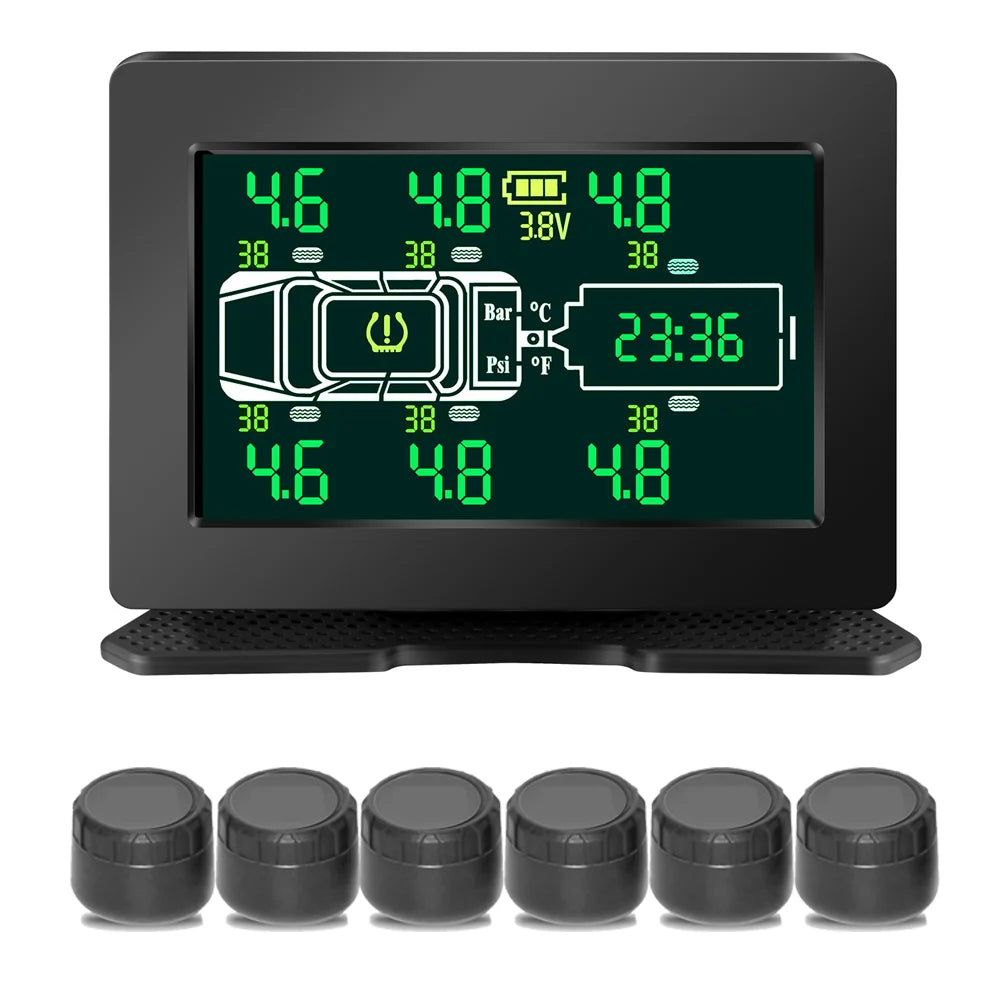
The TPMS high-pressure alarm is the only tool that catches overinflation in real time, at the point in the drive when the pressure has actually exceeded the threshold — not before, and not after the driver stops at a rest area and checks manually. For RV and commercial truck operators running near the upper end of their tire's rated pressure at cold inflation, the margin between correct operating pressure and overinflation territory can be as little as 8–10 PSI — a gap that summer heat conditions cross routinely. Browse the complete TPMS range to see which system covers your vehicle's pressure range and wheel count.
When the High-Pressure Alarm Fires
The Correct Response — and the Wrong One
Reduce Speed Immediately
Lower highway speed reduces friction heat generation. This alone can halt further pressure rise and buy time to find a safe stopping point. Do not continue at full highway speed when the high-pressure alarm is active.
Pull Over and Allow the Tires to Cool
Park in shade if available. Allow 30–45 minutes for tire temperature to reduce. Do not release air while the tire is hot — pressure will drop as it cools, and you will be underinflated when you return to the road.
Check Cold Pressure After Cooling
Only after the tires have cooled to ambient temperature should pressure be measured. If cold pressure is above the maximum cold inflation specification for the tire's load rating, release air to the correct specification. If it's within range, the overinflation was heat-induced and normal — the correct response is to drive at lower speeds through the peak heat window.
Adjust Departure Timing on Future Trips
If the high-pressure alarm is firing consistently in summer conditions with correct cold inflation, the practical solution is earlier departures — before ambient temperature peaks — and lower sustained speeds. The alarm is indicating that current conditions are exceeding the thermal margin of the tire's pressure specification.
The Full Range
Grundig RV TPMS
116 PSI range. High AND low pressure alarms. Real-time temperature. 4/6/8-wheel. The high-pressure alarm is active throughout every drive. $119.
$119
Shop Now →Solar TPMS 6-Wheel
6 direct sensors, 6 alarm modes including high pressure. Solar powered. Covers all positions including inner duals where overinflation is hardest to detect manually.
See product
Shop Now →Grundig S08 TPMS
218 PSI ceiling. High-pressure alarm for Class A diesel and heavy commercial vehicles where summer heat pushes operating pressure closest to structural limits. $259.
$259
Shop Now →Monitor both directions. High pressure matters as much as low. Free shipping · High & low pressure alarms · All systems
Shop All TPMS →