
Tire Pressure Monitoring System for Semi Trucks — all 18 wheels, one screen.
Inner duals, the back axle of a 53-foot trailer, a lift axle you can't see from the cab — a semi truck TPMS puts the pressure and temperature of every tire on your dash, and sounds an alarm the moment one starts to leak or overheat.
- 6–110tire positions
- 200 PSIsensor range
- 12V / 24Vor solar display
- IP67waterproof sensors
Built for tractors, trailers and multi-axle rigs
Three systems, sized by how many tires you run and how many trailers you pull.
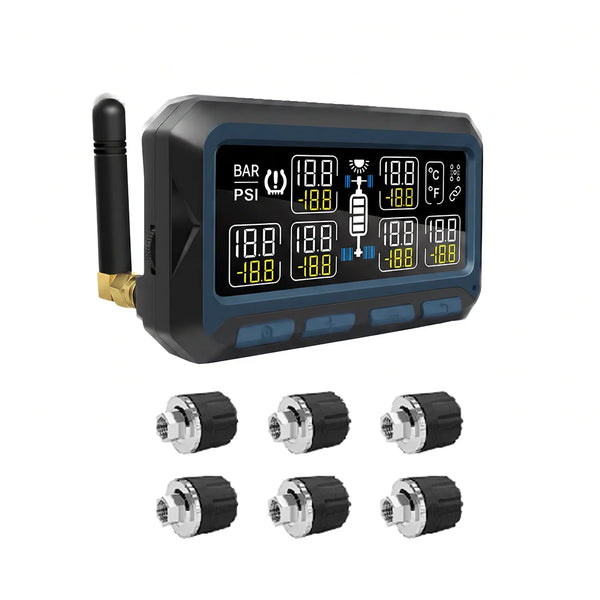
6–36 Wheels · 200 PSI · Solar
GRUNDIG 550S Solar TPMS
Covers a tractor and trailer up to 36 tires with no wiring — the solar display charges on the dash.
- Independent alarm limits per axle
- Swap tire positions on-screen after rotation
- Signal booster included on 10+ sensor kits
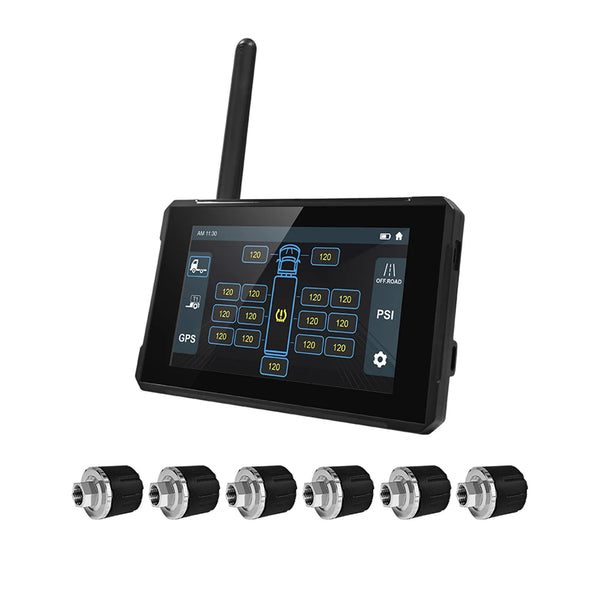
6–110 Wheels · 200 PSI · Touch Screen
GRUNDIG 860 TPMS
Store several trailer profiles and switch with a tap — no re-pairing when you drop one trailer and hook another.
- 5" color touch screen, 12V/24V powered
- Multi-trailer profile switching
- Scales from 6 up to 110 sensors

8/10/12 Wheels · Up to 217 PSI
Grundig S08 Heavy-Duty TPMS
For box trucks, dump trucks and single-unit trucks running up to 12 tires, with the highest pressure range in the line-up.
- 8 / 10 / 12-wheel modes
- 217 PSI sensors
- 5" HD display, Type-C rechargeable
One soft tire costs more than the whole system
On an 18-wheeler, a single under-inflated tire rarely announces itself. Its dual partner carries the extra load, both tires heat up, and the problem spreads before anyone notices.
Roadside calls and missed loads
A blowout means a service call, hours on the shoulder and a late delivery. A low-pressure alert lets you fix a slow leak at the next truck stop instead.
Duals that wear out together
When one dual runs low, its partner is overloaded. Catching pressure differences early helps both tires reach full tread life and keeps casings retreadable.
Rolling resistance adds up
Under-inflated truck tires increase rolling resistance across every mile. Holding every position at spec keeps fuel consumption where it should be.
Heat is the early warning: a tire running hotter than its axle partner often points to low pressure, a dragging brake or a failing wheel bearing. Grundig systems monitor temperature at every position, not just pressure.
How many TPMS sensors does a semi truck need?
One sensor per tire. Count steer, drive and trailer tires — plus lift axles if you want them covered.
| Setup | Typical tire count | Recommended kit |
|---|---|---|
| Box truck / single-axle straight truck | 6 | 550S 6-sensor or S08 |
| Tandem-axle dump truck | 10 (12 with a lift axle) | S08 10/12-sensor or 550S 10/12-sensor |
| Tandem tractor (bobtail) | 10 | 550S 10-sensor |
| Tractor + 53' tandem trailer (18-wheeler) | 18 | 860 18-sensor or 550S 22-sensor kit |
| Tractor + spread-axle or multi-axle trailer | 18–22 | 550S 22-sensor or 860 22-sensor |
| Doubles, triples or heavy-haul combinations | 22–40+ | 860 36/40-sensor kit |
| Drop-and-hook / several trailers in rotation | Tractor + each trailer | 860 with saved trailer profiles |
Super singles count as one tire per wheel end. Not sure about your layout? Send us your axle configuration and we'll size the kit.
What matters in a semi truck TPMS
Per-axle alarm limits
Steer, drive and trailer tires often run different pressures. Set separate high and low limits for each axle so alarms match reality.
Signal that reaches 70+ feet back
Sensors transmit on 433.92MHz. Signal boosters mounted mid-trailer relay the rear axles to the cab on long combinations.
Six alarm types
High pressure, low pressure, high temperature, fast leak, sensor low battery and sensor fault — each shown at its exact wheel position.
Multi-trailer profiles
On the 860, each trailer's sensors are saved as a profile. Drop one, hook another, and select it on the touch screen.
Tough external sensors
IP67 waterproof and dustproof, with anti-theft lock nuts and user-replaceable CR1632 batteries rated for about two years.
No connection to the truck's ECU
The system runs on its own monitor, so it installs the same way on any make — no dealer programming or diagnostic tools needed.
TPMS for Peterbilt, Kenworth, Freightliner, Volvo and Mack trucks
Because Grundig sensors screw onto the valve stem and talk only to their own monitor, the same kit fits any Class 8 tractor and trailer.
Peterbilt
Fits common tandem-axle tractors; pair with a trailer kit for full 18-wheel coverage.
Kenworth
Monitors steer, drive and trailer positions on long-haul and regional tractors.
Freightliner
Works on highway tractors and on Freightliner-chassis box trucks and motorhomes.
Volvo Trucks
Adds trailer tire monitoring that factory systems on many tractors don't cover.
Mack
Suits highway tractors and vocational dump trucks, including lift-axle setups.
Check the valve stems before ordering: metal stems with an accessible outer dual valve (or valve extensions) are recommended for external sensors.
Installing a TPMS on a semi truck
No tire removal and no dealer visit. Plan around 20–30 minutes for an 18-wheel rig:
- Power on the monitor first — wire the 860 to 12V/24V, or charge the 550S display — then choose your wheel layout.
- Set alarm limits per axle based on the cold pressure on each tire's sidewall and your fleet spec.
- Fit sensors in the on-screen order, thread on the anti-theft nut, and tighten with the included wrench.
- Mount the signal booster near the middle of the trailer on long combinations, wired to a constant power source.
- Leak-check each valve with soapy water, then drive a few minutes to confirm every position reports.
Semi Truck TPMS FAQ
Do semi trucks come with a tire pressure monitoring system?
Some newer tractors offer factory tire monitoring, but it usually covers the tractor only. Most trailers have none. An aftermarket semi truck TPMS adds sensors to every tire you choose — tractor and trailer — on one display.
What PSI range do I need for semi truck tires?
Most steer and drive tires on Class 8 trucks run cold pressures in the 100–120 PSI range — check the sidewall and your fleet spec. Grundig's 550S and 860 sensors read up to 200 PSI, and the S08 up to 217 PSI, so there is plenty of headroom for hot running pressures.
Can one monitor cover the tractor and the trailer?
Yes. Choose a kit with enough sensors for both — for example 18 for a standard tractor-trailer. The 550S covers up to 36 tires and the 860 up to 110.
What happens when I drop my trailer and pick up a different one?
With the 860, you save each trailer's sensors as a profile and select the trailer you're pulling on the touch screen — no re-pairing. With the 550S, sensors are paired to wheel positions, so it suits trucks that stay with the same trailer.
Do I need a signal booster on an 18-wheeler?
Yes for most tractor-trailer combinations. Mount the booster near the middle of the trailer so the rear axles reach the cab reliably. Larger 550S and 860 kits include boosters.
Is a semi truck TPMS worth it for a dump truck?
Dump trucks run heavy loads on rough job sites, where punctures and slow leaks are common. A 10- or 12-sensor kit covers a tandem dump truck including a lift axle, and alerts you before a soft tire damages its dual partner.
Running a dually pickup or an RV instead? See our RV TPMS guide or compare every model on the TPMS comparison page.
Every tire. Every axle. Every mile.
From a single box truck to a fleet of 18-wheelers, there's a Grundig semi truck tire pressure monitoring system sized for your rig.
Peterbilt, Kenworth, Freightliner, Volvo and Mack are trademarks of their respective owners. Grundig-auto is not affiliated with or endorsed by these manufacturers; brand names are used only to describe compatibility.