

Can TPMS Give False Readings? Why Your System Might Not Be Accurate
Five specific scenarios where TPMS produces misleading data — and how Grundig TPMS ±1.5 PSI direct measurement turns ambiguous warnings into verifiable numbers.
Quick Answer: Yes — TPMS can produce misleading readings in five scenarios: temperature-related pressure changes, indirect TPMS failing to detect uniform pressure loss, sensor calibration drift, signal dropout producing stale readings, and incorrect threshold configuration. The most common "false reading" is not a sensor error at all — it is an accurate reading of a real pressure change the driver didn't expect. Grundig TPMS direct sensors measure actual PSI at ±1.5 PSI accuracy, replacing ambiguous warning lights with verifiable numbers.
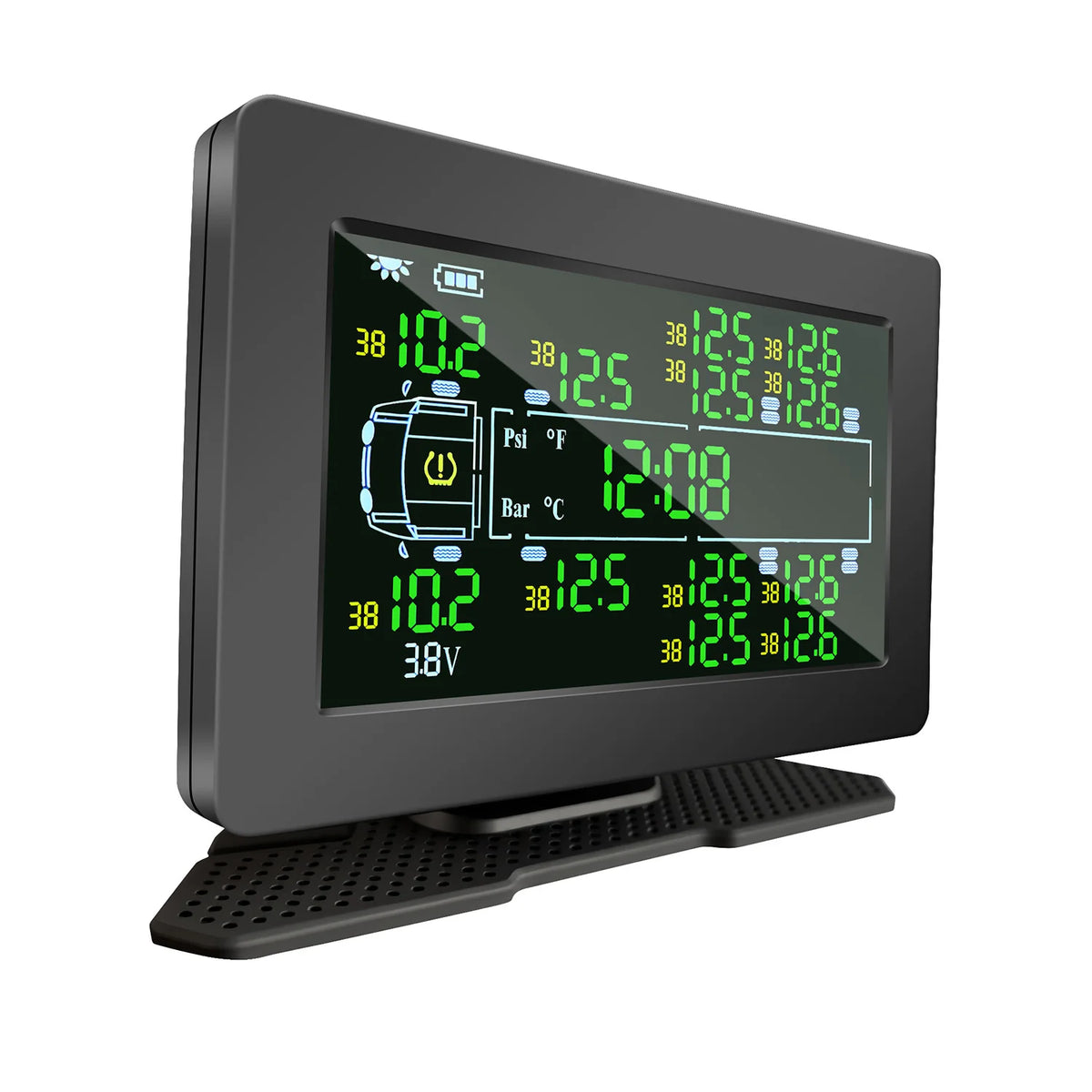
The frustration of a TPMS warning when tires appear visually normal is universal. Before concluding that the system is malfunctioning, it is worth understanding what the system is actually designed to measure — and what scenarios produce readings that seem wrong but are technically accurate. Most apparent TPMS inaccuracies are one of five identifiable conditions, each with a specific cause and a specific resolution. The Grundig TPMS monitor makes these distinctions visible by showing actual PSI at every position rather than a single warning light that communicates nothing about magnitude or location.
The 5 Scenarios Where TPMS Appears to Give False Readings
Temperature-Related Pressure Changes (Most Common — Not a False Reading)
Tire pressure drops approximately 1 PSI for every 10°F decrease in ambient temperature. A tire correctly inflated to 35 PSI at 70°F will read approximately 32 PSI at 40°F — below the factory 25% warning threshold on a vehicle with a 32 PSI specification. The TPMS alert is technically accurate: the tire IS below the threshold. But the driver who inflated correctly the day before experiences it as a false alarm. The Grundig TPMS display shows the actual current PSI at every position, making it immediately clear whether a morning alert is a 2–3 PSI temperature drop (add air) or a 10+ PSI real pressure loss (stop driving).
✓ Diagnosis: Grundig TPMS shows exact PSI. If all four tires are 2–3 PSI below spec on a cold morning, this is temperature physics — not a sensor error. Inflate to correct cold specification.Indirect TPMS: The Uniform Pressure Loss Blind Spot (Genuine System Limitation)
Indirect TPMS infers pressure from wheel rotation speed differences. When all four tires lose the same amount of pressure simultaneously — from overnight temperature drops, seasonal air density changes, or slow permeation over weeks — the relative wheel speeds remain equal and the system detects no anomaly. All four tires may be 8–10 PSI below their correct inflation with zero warning from the factory indirect system. This is a fundamental design limitation, not a calibration error. Grundig TPMS direct sensors measure actual PSI independently at every position — uniform pressure loss across all four tires triggers individual position alerts on the Grundig direct monitoring system that indirect TPMS physically cannot provide.
✓ Diagnosis: Check all four tires with a calibrated gauge during cold conditions. If all four are significantly below spec with no factory warning, the vehicle has indirect TPMS — incapable of detecting this scenario by design.Sensor Calibration Drift (Genuine Sensor Inaccuracy)
TPMS sensors contain MEMS pressure transducers that can drift in calibration accuracy over years of operation and exposure to temperature extremes. A sensor that has drifted may consistently read 4–5 PSI above or below the actual tire pressure across the full operating range. This is a genuine accuracy problem — not a threshold issue. Calibration drift is most common in sensors over 5 years old and those that have been exposed to sustained heat above 250°F (common in high-performance brake applications). Grundig TPMS sensors showing a consistent discrepancy of 3+ PSI from a quality gauge under the same temperature conditions should be replaced. The Grundig system's per-position display makes this drift immediately identifiable — one position reading consistently off from gauge checks identifies the drifted sensor without any additional diagnostic equipment.
✓ Diagnosis: Cross-check all four Grundig TPMS positions against a quality digital gauge on cold tires. Consistent discrepancy >3 PSI at one position = sensor calibration drift. Replace the sensor.Signal Dropout Producing Stale or Frozen Readings
A sensor with a declining battery may transmit infrequently — the display shows the last reading received, which may be minutes or hours old and may not reflect the current pressure. A tire that has lost 8 PSI since the last successful transmission will show the pre-loss reading on a monitor if the sensor has gone into sleep mode or intermittent dropout. This is not a false reading from the sensor — it is a stale reading from a sensor that is no longer transmitting reliably. Grundig TPMS addresses this with a low-battery warning indicator before dropout begins and transmission timestamp tracking — a position whose reading is not updating despite the vehicle moving is identifiable before the reading becomes dangerously outdated.
✓ Diagnosis: Inflate the suspect tire 5 PSI and check if the Grundig TPMS reading updates within 60 seconds. No update = sensor in dropout. Replace before the reading becomes a safety liability.Incorrect Alarm Threshold Configuration
On configurable TPMS systems, incorrect threshold settings produce persistent alerts at pressures the driver considers normal. A vehicle whose tires are specified at 32 PSI cold but whose Grundig TPMS alert is set to trigger at 30 PSI will alarm every winter morning regardless of tire condition. Conversely, a threshold set too low will never alert until a tire is dangerously underinflated. Correct threshold configuration for Grundig TPMS: set low-pressure alert at 10–15% below the vehicle's recommended cold inflation — on 32 PSI tires, set the alert at 27–29 PSI for early warning before the factory 25% threshold.
✓ Diagnosis: Review Grundig TPMS threshold settings against vehicle specification. Reconfigure low and high pressure alerts to 10–15% below and 15% above the vehicle's door-jamb-specified cold inflation.Accuracy Comparison: Indirect vs Direct vs Grundig TPMS
| System Type | Measurement Method | Accuracy | Detects Uniform Loss | Per-Position Reading |
|---|---|---|---|---|
| Indirect TPMS (factory) | Wheel speed inference | No PSI reading — cannot assess | No | Warning light only |
| Direct TPMS (factory, basic) | Pressure transducer | ±2–3 PSI (typical) | Yes | Warning light only (most vehicles) |
| Direct TPMS (factory, premium display) | Pressure transducer | ±2 PSI (typical) | Yes | Yes (on select vehicles) |
| Grundig TPMS (direct external) | Pressure transducer at valve stem | ±1.5 PSI specified | Yes | Every position, live, on 5.0" monitor |
What TPMS Is Not Designed to Detect
Understanding the limits of TPMS prevents the mistake of relying on it for things it cannot do — and distinguishes a genuine sensor inaccuracy from the system working as designed within its specified scope.
Tire Wear or Tread Depth
TPMS monitors pressure and temperature. It provides no information about tread condition, sidewall integrity, or the age of the rubber compound.
Slow Leaks Below Update Interval
A leak of 0.01 PSI per hour — typical of a nail in the tread — loses 0.24 PSI in 24 hours. This is detectable over time but may not trigger immediate alerts depending on threshold settings.
Blowout Timing Prediction
TPMS detects pressure below threshold but cannot predict the structural condition of a tire or forecast imminent blowout risk beyond what the pressure reading indicates.
Valve Core Leaks vs Tire Leaks
Pressure loss shows as a pressure reading — TPMS cannot distinguish whether loss is from the tire itself, the valve core, or a bead seal without physical inspection.
Temperature Without Pressure Context
A temperature alert indicates elevated heat at a position — but requires pressure context (Grundig provides both simultaneously) to distinguish between a hot-running underinflated tire and expected temperature rise from heavy braking.
Pre-Existing Damage Before Monitoring
TPMS monitors ongoing conditions from the point of installation. It cannot detect damage that occurred before sensors were installed or between sensor checks in vehicles without continuous monitoring.

Grundig RV TPMS
4/6/8-Wheel
Direct pressure measurement at ±1.5 PSI accuracy at every position. Distinguishes temperature-related pressure variation from genuine pressure loss. Cross-checkable against a gauge in seconds. 116 PSI range, real-time display, configurable thresholds. $119, free shipping.
$119 Free shipping
Shop Now →Frequently Asked Questions
Can TPMS give false readings?
Yes, in five scenarios: temperature-related pressure changes, indirect TPMS failing to detect uniform pressure loss, sensor calibration drift, signal dropout producing stale readings, and incorrect threshold configuration. Most apparent false readings are accurate measurements of real pressure changes — not sensor errors. Grundig TPMS shows actual PSI at ±1.5 PSI accuracy, making each scenario identifiable.
Why does my TPMS show low pressure when tires look fine?
Most commonly: overnight temperature drop (1 PSI per 10°F decrease). On a cold morning after a 30°F drop, tires lose 3 PSI from the previous day's correct inflation — enough to trigger the warning. The Grundig TPMS display shows exact current PSI, confirming whether the reading is a minor temperature-related dip or a genuine pressure loss requiring attention.
How accurate is TPMS?
Quality direct sensors achieve ±1.5–2 PSI accuracy. Grundig TPMS sensors are rated at ±1.5 PSI. Indirect TPMS has no PSI accuracy — it doesn't measure pressure. A reading differing from a gauge by more than 3 PSI on a direct system indicates sensor calibration drift.
Why is my TPMS reading different from my gauge?
A 1–2 PSI difference is within normal sensor tolerance. A consistent 3+ PSI difference at one position indicates sensor calibration drift at that sensor. Cross-check all Grundig TPMS positions against a quality digital gauge on cold tires to identify which sensor has drifted.
Can indirect TPMS give false readings?
Indirect TPMS is fundamentally unable to detect uniform pressure loss across all four tires — all wheels slow proportionally, producing no detectable speed difference. This is a design limitation, not a malfunction. Grundig TPMS direct sensors detect uniform loss at every position independently.
How do I verify my TPMS is accurate?
Cross-check the Grundig TPMS display against a quality digital gauge on cold tires (not driven for 3+ hours). All positions should read within 1–2 PSI of the gauge. A consistent 3+ PSI discrepancy at one position identifies a sensor requiring replacement.
Numbers, not guesses — Grundig TPMS at ±1.5 PSI per position. Direct measurement · Configurable thresholds · $119 · Free shipping
Shop Grundig TPMS Collection →