
TPMS for Gooseneck, Dump & Cargo Trailers — built for the job site.
Work trailers pick up screws, rebar and gravel, carry loads that change every stop, and get swapped between trucks. A TPMS for your gooseneck, dump or cargo trailer shows every tire's pressure and temperature in the cab — before a flat costs you the day.
- 6–22tires per kit
- 217 PSImax sensor range
- IP67dust & water rated
- Multi-trailerprofiles on the 860
Kits for goosenecks, dump trailers and cargo trailers
Size it by tires on the truck plus tires on the trailer — and how often you swap trailers.

8/10/12 Wheels · Up to 217 PSI
Grundig S08 Heavy-Duty TPMS
Dually plus a tandem or triple-axle gooseneck on one screen, with high-pressure sensors for 14- and 16-ply tires.
- 10/12-wheel modes for truck + trailer
- 217 PSI sensors
- Signal booster option
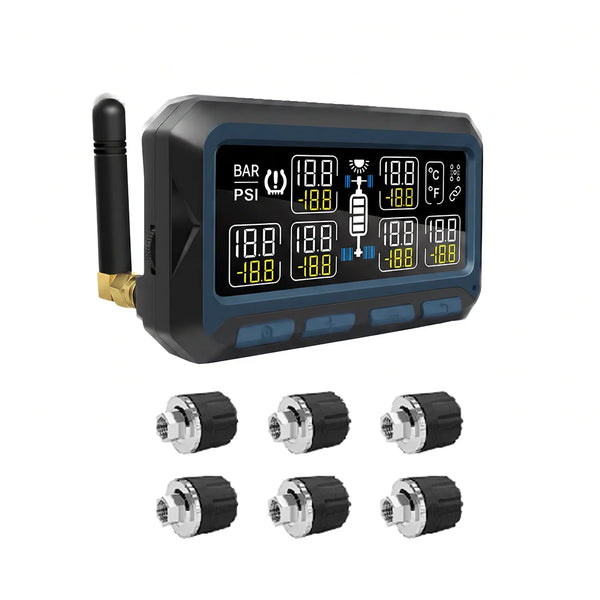
6–36 Wheels · 200 PSI · Solar
GRUNDIG 550S Solar TPMS
For tandem dually goosenecks and multi-axle equipment trailers — separate alarm limits for every axle.
- Independent per-axle alarms
- 14, 16 and 22-sensor kits
- Solar display, no wiring
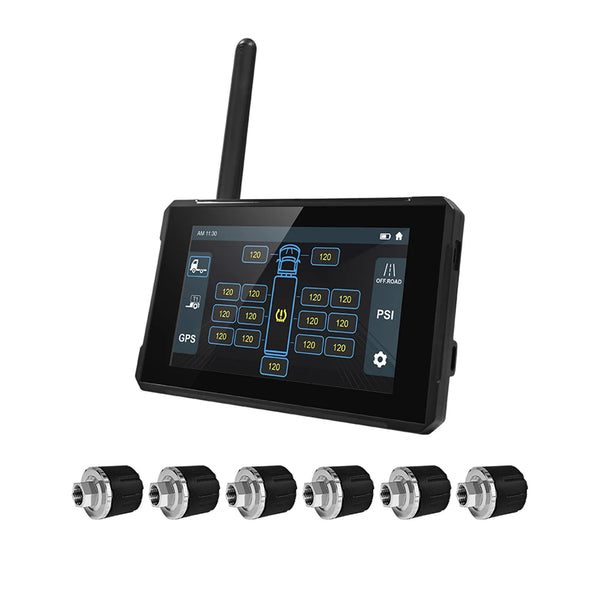
6–110 Wheels · 200 PSI · Touch Screen
GRUNDIG 860 TPMS
Keep sensors on every trailer in the yard and pick the one you're pulling on the touch screen.
- Multi-trailer profiles
- 12V/24V powered
- Scales up to 110 sensors

6 Sensors · Up to 217 PSI · Solar
Solar Powered TPMS
Truck plus a single-axle trailer, or a tandem dump trailer plus two spares — six sensors, no wiring.
- 116 or 217 PSI versions
- Solar + Type-C
- IP67 sensors
What job sites do to trailer tires
Work trailers don't get babied. These are the problems a TPMS catches early.
Common causes of work-trailer flats
- Screws, nails and rebar picked up on site cause slow leaks that drain overnight.
- Dump trailers go from empty to full in minutes — an under-inflated tire suddenly carries its full load.
- Equipment trailers run heavy, low and hot, with long gaps between pressure checks.
- Trailers move between trucks and drivers, so nobody owns the tire check.
What a work trailer TPMS gives you
- A low-pressure alarm as soon as a slow leak crosses your limit — often before the tire looks soft.
- Temperature at every wheel, which flags dragging brakes and bad bearings.
- The exact wheel position, so the fix takes minutes, not a walk-around guess.
- Profiles per trailer on the 860, so any driver hooking up sees the right tires.
Which TPMS kit fits your work trailer?
Add up the trailer tires and the truck tires you want to watch.
| Trailer | Tires (with truck) | Recommended kit |
|---|---|---|
| Single-axle enclosed cargo trailer | 2 + 4 = 6 | Solar Powered TPMS or GRUNDIG RV TPMS (6-wheel) |
| Tandem-axle cargo trailer | 4 + 4 = 8 | GRUNDIG RV TPMS (8-wheel) |
| Tandem dump trailer behind a dually | 4 + 6 = 10 | Grundig S08 (10-wheel) |
| Tandem gooseneck flatbed behind a dually | 4 + 6 = 10 | Grundig S08 (10-wheel) |
| Triple-axle gooseneck behind a dually | 6 + 6 = 12 | Grundig S08 (12-wheel) |
| Tandem dually gooseneck behind a dually | 8 + 6 = 14 | GRUNDIG 550S 14-sensor kit |
| Multi-axle equipment trailer / lowboy | 16–22 | 550S or 860 with booster |
| Several trailers in the yard | Each trailer + truck | GRUNDIG 860 with saved profiles |
Running a dump truck or tractor too? See our semi truck TPMS guide.
What to look for in a work trailer TPMS
Lock nuts on every sensor
Anti-theft hex nuts keep sensors tight and stop casual theft from trailers parked on site overnight.
High-pressure sensors
Heavy-duty 14- and 16-ply tires run higher pressures. 217 PSI sensors give plenty of headroom when tires heat up under load.
Per-axle limits
Truck, trailer and spread axles often run different pressures. Separate alarm limits keep the alerts meaningful.
Profiles for every trailer
The 860 saves each trailer's sensors, so switching from the dump trailer to the gooseneck is a tap on the screen.
Setting up TPMS on a work trailer
Most work trailers are done in 15–20 minutes:
- Fit metal valve stems if the trailer still has rubber ones — they hold the sensor steady over rough ground.
- Power on the monitor, choose the wheel layout and set limits for truck and trailer axles.
- Screw on each sensor in the on-screen order and lock it with the anti-theft nut.
- Mount the booster mid-trailer on goosenecks and long equipment trailers.
- Leak-check with soapy water and drive a short loop to confirm every position.
Gooseneck, Dump & Cargo Trailer TPMS FAQ
Will TPMS sensors survive a job site?
Grundig external sensors are IP67 waterproof and dustproof, with anti-theft lock nuts that keep them tight through rough ground and vibration. Fit metal valve stems on work trailers so a sensor can't snag and bend a rubber stem.
I hook up a different trailer most days. Will a TPMS still work?
Yes. Leave a set of sensors on each trailer. The GRUNDIG 860 stores each trailer as a profile, so you select the trailer you're pulling on the touch screen — no re-pairing every morning.
What pressure should a dump trailer run when loaded?
Dump trailers usually run light-truck or ST tires at or near the max cold pressure on the sidewall, because loads change from empty to full in one stop. Set your low-pressure alarm close to that number so a leak shows up before the next load.
Do gooseneck trailers need a signal booster?
Usually yes. A gooseneck plus truck often runs 30–40 feet from the cab to the rear axle, with a steel deck in between. Mount the booster near the middle of the trailer.
Can I monitor the truck and the trailer together?
Yes — count both. A dually plus a tandem gooseneck is 10 tires, a dually plus a triple-axle is 12, and a dually plus a tandem dually gooseneck is 14.
Will a TPMS catch a nail picked up on site?
A nail usually causes a slow leak. The TPMS shows that tire's pressure dropping against its axle partner and sounds the low-pressure alarm when it crosses your limit — often before the tire looks flat.
More guides: Dually TPMS · Trailer TPMS · Horse trailer TPMS
Flats cost jobs. Catch them in the cab.
From a single cargo trailer to a yard full of goosenecks, there's a Grundig TPMS built to work as hard as you do.