

Choose TPMS for a 10-truck fleet by installed cost, complete wheel coverage and maintenance needs, rather than kit price alone. A GRUNDIG 550S configuration is a practical shortlist option for an in-cab retrofit; a fleet that frequently changes trailers should also compare the GRUNDIG 860. Neither a lower kit price nor a higher wheel-capacity ceiling proves faster payback.
Start with three decisions: how many tires each active combination carries, who acts on an alert, and whether the manager needs a centralized fleet dashboard. Ten separate in-cab monitors are not automatically a ten-truck remote-management system.
Key takeaways
- Compare a complete installed configuration, including sensors, repeaters, power provision and labor.
- Include batteries, replacement sensors, wheel-service time and any recurring fees in the ownership calculation.
- Separate driver-visible alerts from remote fleet reporting; require explicit evidence for the reporting you need.
- Measure your own costs and maintenance outcomes before claiming fuel or tire savings.
- Pressure and temperature alerts do not diagnose a dragging brake or failing wheel bearing.
Shortlist by operating model
GRUNDIG 550S: start with the required wheel configuration
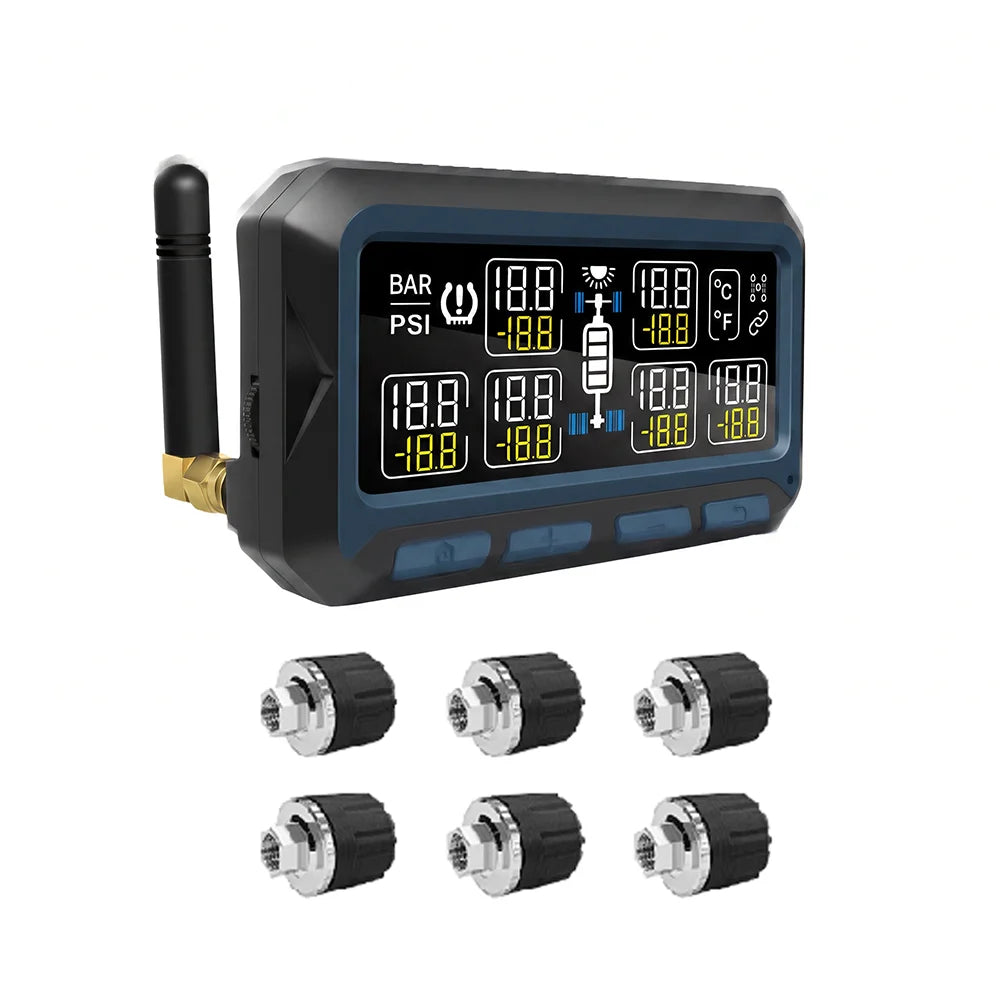
| Parameter | 550S configuration |
|---|---|
| Wheel capacity | 6–36 positions, depending on selected kit |
| Pressure range | 0–200 PSI |
| Display power | Solar and USB Type-C |
| Sensors | External screw-on configuration compared here |
| Battery service | User-replaceable CR1632 sensor batteries |
Image and specification source: GRUNDIG 550S. The scale and charging options make the external-sensor configuration a candidate for a driver-facing retrofit. Specify that version: the 550S product family also lists an internal-sensor option. A kit's wheel capacity applies to that configured monitoring system; it is not evidence of a central dashboard covering ten vehicles.
GRUNDIG 860: prioritize trailer changes and axle settings
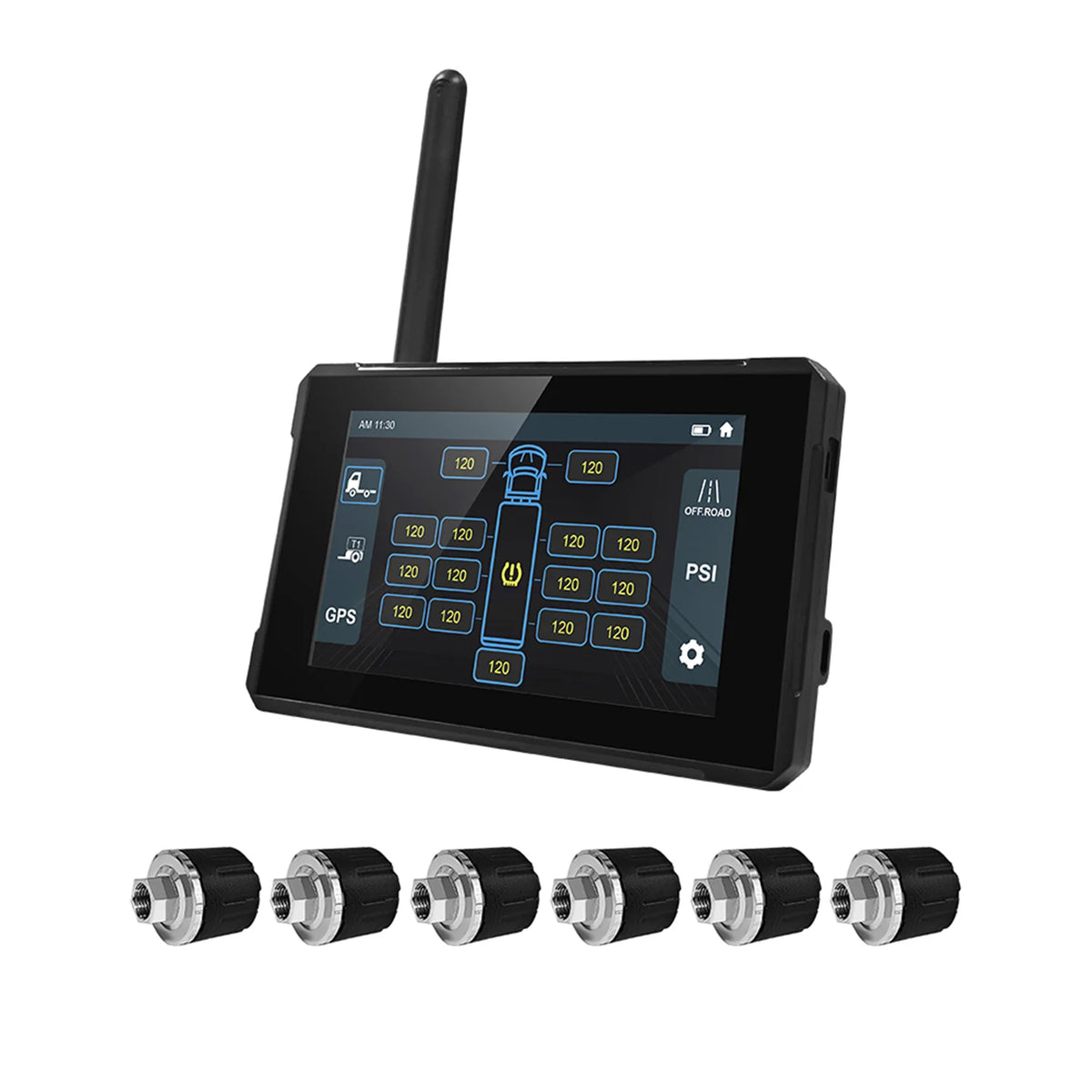
| Parameter | 860 configuration |
|---|---|
| Wheel capacity | 6–110 positions, depending on selected kit |
| Pressure range | 0–200 PSI |
| Display | 5-inch touchscreen |
| Trailer setup | Stored profiles and switching |
| Pressure alerts | Independent axle configuration |
Image and specification source: GRUNDIG 860. Its relevant advantage is managing changing trailer configurations from the cab. Do not infer remote maintenance reporting, dispatch integration or a whole-fleet data service from that feature.
A flow-through package as a service-access comparison
Image source: TST-507-FT-4-C four-sensor flow-through kit and display.
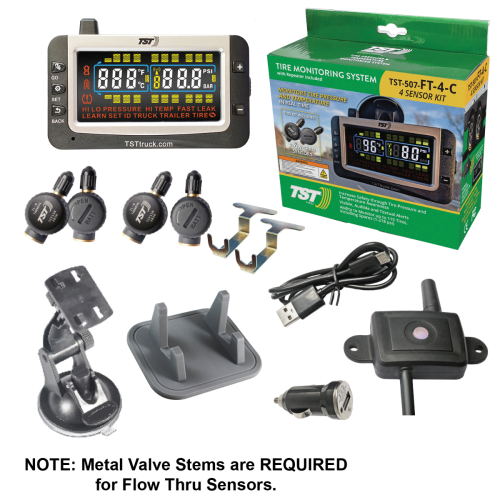
| Parameter | TST-507-FT-4-C |
|---|---|
| Kit coverage | Four included sensors |
| Sensor type | Flow-through |
| Display | 3.5-inch widescreen color |
| Repeater | Included |
| Stem requirement | Metal only |
Image and kit specifications: TST product listing. Its 507 manual documents inflation without sensor removal. Compare that maintenance convenience against a full-vehicle quote, rather than comparing this four-sensor package with a larger system's headline capacity.
Count active tires and spare trailers separately
For an illustrative ten-truck fleet, suppose every active combination has six tractor tires and twelve trailer tires. The active requirement is 10 × (6 + 12) = 180 sensor positions. If six additional twelve-tire trailers retain their own sensors, add 6 × 12 = 72, for 252 installed sensors across the equipment pool.
That does not mean one display must monitor 252 tires at once: each active combination in this example has eighteen positions. The supplier must separately confirm each display's wheel configuration, supported trailer profiles and compatibility with the sensors left on spare trailers. A 36-wheel or 110-wheel headline is not a ten-vehicle fleet license or a count of the sensors supplied.
Use your own wheel inventory in place of these example counts. This arithmetic explains why a quote for ten base kits can omit a substantial part of a drop-and-hook operation.
Compare the cost you will actually incur
| Cost or requirement | External-cap retrofit | Flow-through retrofit | Internal-sensor installation |
|---|---|---|---|
| Hardware | Match every required wheel | Match every required wheel | Match wheel and sensor fit |
| Inflation access | Allow removal and reinstallation time | Check chuck and valve clearance | Normal valve access |
| Installation | Include stems and repeaters if needed | Include suitable metal stems | Include wheel-shop labor |
| Maintenance | Battery and seal service as specified | Battery, seal and valve checks as specified | Confirm the sensor's service method |
| Operational fit | Driver alert process | Driver alert process | Driver alert process |
Request a written list of what the quote includes. If remote visibility is mandatory, add a separate acceptance item for fleetwide alerts, user access, data retention and any connectivity charge. PressurePro's official site provides a starting point for discussing connected tire-management options; verify the exact service and integration with the supplier rather than treating every TPMS as equivalent.
Use a simple ownership calculation
Use this planning equation:
Ownership cost = installed hardware and labor + recurring fees + expected service and replacement costs.
Use a quote worksheet instead of an invented kit price:
| Input | What the supplier or fleet must supply | Keep separate |
|---|---|---|
| Installed equipment | Sensors for active and spare equipment, displays, repeaters, mounting and power | Quantity, unit price and extended price |
| Initial labor | Pairing, wheel-map verification, valve work and any tire removal | One-time setup versus routine service |
| Ongoing service | Batteries, seals, replacement sensors and technician time | Assumed allowance versus recorded work orders |
| Connectivity | Any remote-reporting hardware, license and data fees | In-cab monitoring versus fleet reporting |
For a comparison period of H months, calculate period ownership cost = installed equipment + initial labor + service over H + recurring charges over H. Divide that total by 10 × H to obtain the required verified benefit per truck per month for this ten-truck scenario. This is a break-even requirement, not a forecast that TPMS will achieve it.
Measure the labor inputs during a pilot: record setup time, a normal inflation check, a trailer change where applicable, and a sensor battery service using the supplied instructions. Use the fleet's actual labor rate. Do not assign the same minutes to cap, flow-through and internal sensors, or invent time savings from their names.
Then compare that cost with documented outcomes. Count tire-related roadside events, tire replacements, service labor and vehicle miles over comparable periods. Account for changes in load, routes, tire age and operating conditions. A lower incident count after installation is useful evidence to investigate, but does not by itself prove that TPMS caused the change.
Avoid a promised percentage reduction in fuel use. NHTSA's tire guidance connects correct inflation with maintenance and fuel economy, but it does not establish a savings percentage for your fleet or this product. A defensible business case uses your fuel and tire records, not a generic manufacturer's claim copied into a payback spreadsheet.
For commercial-tire maintenance, Michelin's truck and bus guide covers valve condition and inflation requirements for the operating load. It supports including valve inspection and service labor in the plan; it does not validate a TPMS brand's payback.
Product specifications were checked on 21 October 2026. No independent, controlled ten-truck cost-saving trial for these exact kits is supplied here. Manufacturer specifications support the shortlist; a pilot and the fleet's records must support the business case.
Define acceptance before equipping every truck
Choose a representative combination for an initial operational check. Confirm that the map matches the installed tires and that the furthest wheel reports using the specified repeater arrangement. Record which driver receives an alert and who authorizes the maintenance response. Confirm that the chosen kit supports the required pressure settings.
Inspect the external sensors and valve hardware for leaks after fitting. Agree how batteries, missing readings and sensor faults are handled before the first truck leaves. These checks establish whether the setup is usable; they do not certify a reduction in failures.
Do not use a tire-temperature alert to label a brake or bearing defective. It is a reason to follow the fleet's inspection procedure, not a component diagnosis. TPMS also does not replace pre-trip inspections, repair of existing leaks or approved load and inflation practices.
Which option fits first?
For a mostly stable wheel layout and a driver-facing retrofit, price the correct 550S kit first. If trailer swaps dominate the workload, compare the 860's profile workflow before assuming that the lowest purchase price is cheapest to operate. If frequent inflation access is the main bottleneck, include a flow-through design in the evaluation. If dispatch needs remote reporting, make that a separate verified requirement.
If the purchase decision remains close, compare the completed quote worksheets and the recorded pilot tasks. Do not break the tie with an unverified fuel-saving percentage or an assumed labor-time advantage.
Frequently asked questions
Can one monitor cover all ten trucks remotely?
Do not assume so. Wheel capacity describes the supported configuration, while remote fleet reporting requires a separately verified service and connectivity arrangement.
How should I calculate TPMS payback?
Compare installed and ongoing ownership costs with your documented maintenance, tire and operating costs over a comparable period. Keep assumptions separate from measured results.
Will TPMS guarantee lower fuel costs?
No. Correct inflation is part of efficient tire maintenance, but fuel use also depends on load, route, speed, weather and other factors. Use fleet records to assess any change.
Can a tire temperature alarm diagnose a brake problem?
No. Treat it as an alert that needs the appropriate inspection. It does not identify the failed component by itself.
What belongs in the installed quote?
List the required sensors, monitor, repeaters, valve hardware, power provision, installation labor and maintenance items. Ask separately about recurring charges and remote reporting.
Choose your next step
Build the quote around your actual tire counts, trailer lengths and maintenance process. Select the kit configuration before comparing the headline price.