

A 40-foot motorhome towing a trailer should be planned around a compatible TPMS booster and a verified power supply.
Does a 40-foot motorhome towing a trailer need a booster with TireMinder, or will a 10-wheel Tymate work? For TireMinder i10, yes: its initial-setup instructions, printed page 1, require installing the powered booster. A ten-wheel Tymate description alone cannot establish range, pressure suitability or repeater compatibility; identify the exact model. GRUNDIG 550S offers a documented ten-sensor external kit with a booster, making it another configuration to compare rather than a promise of reception on every rig.
The buying decision has three separate parts: enough monitored tire positions, sufficient pressure range, and dependable communication from the most distant sensor. Passing one does not establish the others.
Start with the actual combination, not the motorhome length
Measure from the planned dashboard monitor location to the farthest trailer sensor. Include the hitch gap and trailer body; a coach advertised as 40 feet is not a 40-foot sensor-to-monitor path. Note any rear engine, metal storage compartments and bodywork between the two devices.
Count tires individually, including inner duals. A six-tire coach plus a four-tire trailer requires ten monitored positions; a tag axle changes that total. An eight-position kit cannot cover that ten-tire combination completely. Count a spare separately only if you intend to monitor it and the system supports that use.
Write down the coach and trailer's prescribed cold pressures separately. A low-pressure system can have enough wheel positions yet still be unsuitable for the coach tires. Finally, identify an appropriate booster power source and an accessible mounting location before placing an order.
Compare the exact systems and their installation requirements
These are manufacturer specifications checked on October 21, 2026, not results of an independent range or dropout test. Kit contents and system capacity are different fields.
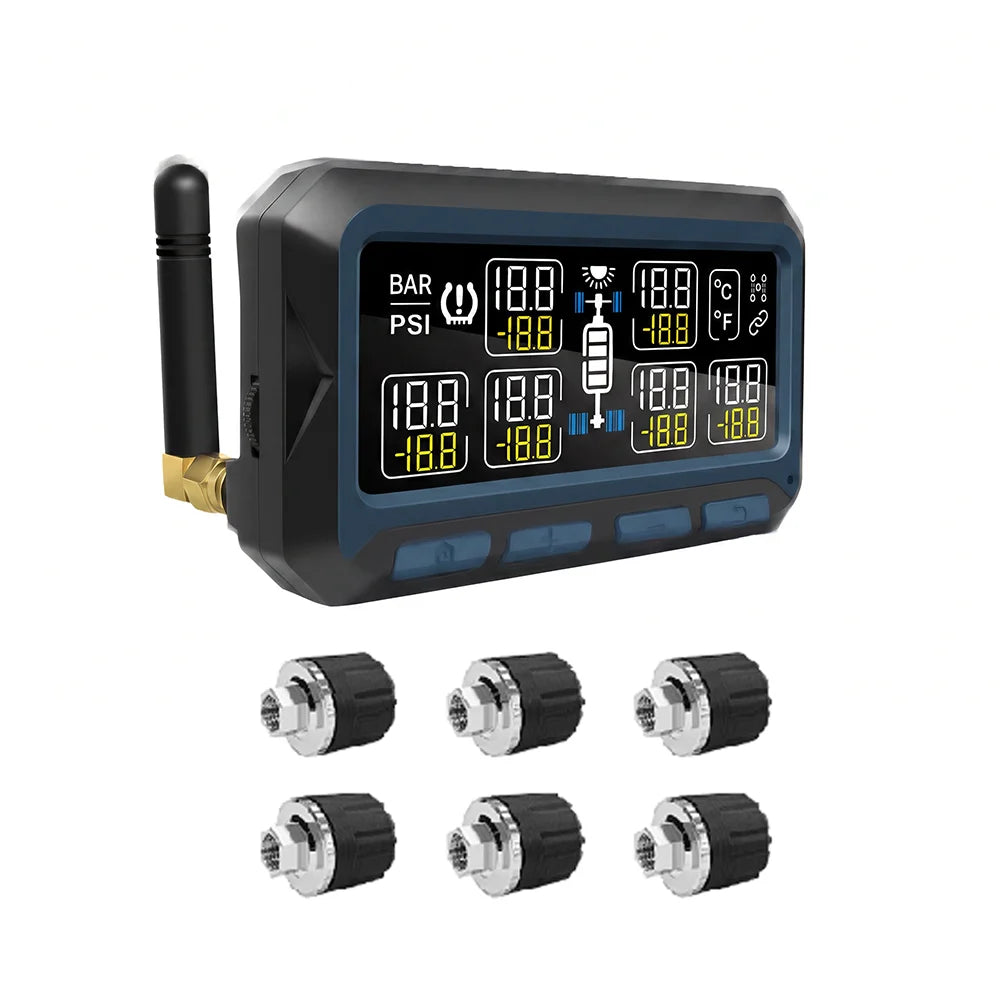
Image source: TireMinder i10 monitor and ten-transmitter kit shown on its official product page.

Image source: Tymate M12-3 color display and external sensors shown on the manufacturer's product page.

| Selection field | GRUNDIG 550S, external-sensor configuration | TireMinder i10 | Tymate M12-3, verified listing |
|---|---|---|---|
| Pressure range | 0–200 PSI | 0–199 PSI | 0–87 PSI |
| Wheel count relevant here | External configurations listed from 6–36 positions; select the actual kit | Up to 20 monitored tires; ten shown at once | Four- and six-sensor options listed; this listing does not establish a ten-position configuration |
| Display / power distinction | Backlit display; solar and USB-C charging | 3.15-inch color display | Color display; solar and USB-C charging |
| Booster planning | Ten-external-sensor variant explicitly includes a booster | Follow the brand's powered-booster instructions | Manufacturer recommends a repeater for trailers over 36 feet |
| Practical strength | Verified ten-sensor option, higher pressure range and axle-specific pressure alarms | More monitored positions than the verified M12-3 options | A simpler candidate when its listed tire count and pressure range fit |
| Purchase limitation | Booster quantity and placement still need confirmation for the full combination | Screen count does not define maximum monitoring capacity | Do not transfer specifications from another Tymate model |
Sources: GRUNDIG 550S configurations and specifications, TireMinder i10 specifications, and Tymate M12-3 specifications.
For a listing advertised as a “10-wheel Tymate,” request the model number and its own manual. The M12-3 information above cannot validate or disprove a different model's capacity. It does show why a brand name or an online listing headline is insufficient evidence for a ten-tire coach-and-trailer purchase.
A solar monitor does not power the repeater
Monitor charging and booster wiring are separate installation jobs. A solar-powered dashboard display does not establish that its repeater runs from solar or requires no wiring.
TireMinder's booster instructions specify 12- or 24-volt power. They place the booster near the rear of a motorhome, outside metal enclosures; diesel-coach guidance calls for an undercarriage location. Use the instructions for the actual combination and have an RV technician handle an uncertain electrical connection.
Estimate the parked power budget separately
The same official instructions list 12-volt Rhino-booster current at 75 mA while transmitting and 14 mA while inactive. Convert milliamps to amps and multiply by hours to screen a continuously powered installation:
| Illustrative 24-hour condition | Calculation | Charge used |
|---|---|---|
| Entire period at the listed inactive current | 0.014 A × 24 h | 0.336 Ah |
| Entire period at the listed transmitting current | 0.075 A × 24 h | 1.8 Ah |
These are arithmetic endpoints for two assumed states, not a measured daily average or a battery-runtime guarantee. Actual duty cycle, other electrical loads, battery condition and the supplied booster revision matter. Ask the installer whether the proposed supply remains live while parked and how it should be managed under the manufacturer's instructions. These current figures describe that TireMinder booster; they do not specify the electrical requirements of a GRUNDIG or Tymate repeater.
Tymate also offers its own repeater:
Image source: Tymate RP05 repeater installation illustration from the manufacturer's accessory page.

| Tymate RP05 field | Manufacturer information |
|---|---|
| Working frequency | 433.92 MHz |
| Compatibility | Tymate TPMS only; confirm the exact model |
| Installation planning | Power leads connect to a battery; rear-axle placement is suggested |
| Scope of this information | A compatible repeater accessory, not proof of a particular rig's reception |
See the official RP05 accessory instructions. A shared 433.92 MHz label does not establish interoperability between manufacturers. Do not mix sensors, monitors or boosters unless the supplier expressly confirms the combination.
GRUNDIG's 550S page contains different booster-selection cues: a distance-based banner and a long-vehicle installation recommendation. Treat these as a reason to request a configuration for your measured rig, rather than deriving one universal booster count from the product title. Ask for the compatible booster, its power requirements and installation position in writing.
Verify rear-tire coverage before relying on it
The following is a proposed owner acceptance procedure, not a completed product test:
- Record the starting setup. Photograph sensor IDs and wheel positions. Record the monitor and booster locations, power source, cold pressures and the trailer attached.
- Confirm every tire is represented. Pair and map each sensor according to its manual. Check the inner duals and farthest trailer wheel specifically; a populated screen alone does not prove correct mapping.
- Check freshness. Observe the manufacturer's refresh or reconnection behavior. A retained pressure number should not be treated as proof of a current transmission.
- Repeat with the normal load and doors closed. Use the installed arrangement you will actually tow. An open-compartment demonstration is not the same configuration.
- Complete a controlled local shakedown. A passenger observes the monitor while the driver concentrates on driving. Record missing-sensor warnings and reconnections. Resolve recurring loss before a long trip.
Do not deliberately deflate a tire while driving. Test alarms only by a manufacturer-approved method while safely parked. Keep a suitable pressure gauge for independent checks.
If one rear sensor disappears, stop safely and check the tire before assuming a radio problem. If several rear positions disappear together, the booster supply, mounting position or a blocked communication path deserves inspection. These are troubleshooting priorities, not a diagnosis from the display alone.
A model-specific check for stale readings and cold-weather trips
The TireMinder i10 manual, printed pages 18–19, explains that a long shutdown can leave old readings in memory while updates arrive. It gives approximately 4–10 minutes for startup updates; its separate Auto-Search procedure can take 10–20 minutes. These are manufacturer setup timings, not a measured leak-alert delay. Perform the applicable procedure while parked and confirm every tire before departure.
That manual also identifies extreme cold and low transmitter-battery power as factors that shorten range. Before a winter trip, inspect batteries and seals using the model's service instructions, then repeat the rear-tire check. A booster does not make a depleted sensor battery serviceable. Do not transfer i10 timing or battery guidance to a GRUNDIG or Tymate system; use each model's own instructions.
Which configuration should you shortlist?
For six coach tires and four trailer tires, shortlist an exact ten-sensor kit with adequate pressure capability and a documented repeater plan. The GRUNDIG 550S ten-external-sensor-plus-booster option fits that configuration on paper; confirm any additional repeater requirement for your measured layout.
TireMinder i10 is another documented multi-position option when its controls and installation arrangement suit you. The verified M12-3 listing is a narrower fit: its pressure limit and listed sensor options must match the application. An unspecified ten-wheel Tymate should remain unconfirmed until its own documentation is supplied.
No source reviewed here establishes a universal 50-foot no-booster guarantee or ranks these systems by highway dropout rate. Prefer an explicit installation plan and an agreed return or troubleshooting process to an unsupported reception promise.
Before paying, send this configuration request to the supplier: “My coach has __ tires, the trailer has __ tires, the prescribed cold pressures are __ / __ PSI, and the dashboard-to-rearmost-sensor distance is __. The rear engine/body obstruction is __. Please confirm the exact kit SKU, included sensors, compatible booster quantity, permitted power supply, mounting positions, setup/update procedure and remedy if the installed rear sensors repeatedly disconnect.” Keep the written answer with your acceptance record. This makes an advertised range claim reviewable for your own combination without presenting an unperformed test as evidence.
Frequently asked questions
Does ten-wheel support mean the signal will reach ten tires on a long rig?
No. Wheel capacity describes supported sensor positions. Communication also depends on distance, installation, obstructions and the compatible booster arrangement.
Can I skip the TireMinder booster if all pressures appear while parked?
Follow TireMinder's installation guidance. One parked observation does not establish continued reception after loading, closing compartments or beginning a trip.
Is any 433 MHz repeater compatible with my TPMS?
No. Frequency alone does not establish protocol compatibility. Use a repeater approved for the exact monitor and sensor family.
Can a budget Tymate replace a higher-pressure coach system?
Only if that exact model meets the required pressure range, tire count and installation needs. The verified M12-3 listing is 0–87 PSI; those specifications cannot be transferred to an unidentified ten-wheel model.
What information should I send GRUNDIG before ordering?
Send tire count by axle, prescribed cold pressures, monitor-to-rear-sensor distance, coach and trailer construction, available booster power and whether you change trailers.
Plan your TPMS installation
Use your tire map and distance measurement to compare the full system, then confirm the appropriate sensors and repeater installation before checkout.