

Travel Trailer and Tow Vehicle TPMS: Real-Time Temperature, Pressure Alerts and Setup
For travel trailers and tow vehicles, choose a TPMS by combined wheel count, real-time alert thresholds and signal range.
The best tire pressure monitoring system for a travel trailer and tow vehicle combination is the one that covers every active tire position with real-time temperature and pressure alerts. GRUNDIG Caravan TPMS is a candidate for four-, six- or eight-tire combinations within its 116 PSI pressure ceiling. For heavier fifth wheels or combinations exceeding eight monitored positions, compare higher-capacity systems such as the 200 PSI GRUNDIG 550S or TireMinder i10.
Start with the vehicle and trailer manufacturers' cold inflation specifications. A TPMS reports tire pressure and temperature; it does not set the correct cold pressure or increase the load rating of tires or wheels.
Why tow combinations need multi-wheel coverage
A travel trailer combination presents different monitoring demands than a single passenger vehicle:
| Factor | What it requires from your TPMS |
|---|---|
| Combined wheel count | Sufficient sensor positions on one monitor (e.g., 4 tow vehicle tires + 2 or 4 trailer tires = 6 or 8 total tires) |
| Long transmission distance | A stable 433.92 MHz radio link capable of reaching from rear trailer axles through metal siding to the dashboard display |
| Dual-axle temperature tracking | Continuous temperature sensing to detect dragging brakes or failing wheel bearings before hub damage occurs |
| Configurable alarm baselines | Ability to set different cold pressure baselines for the tow vehicle (e.g. 35–45 PSI) and the trailer (e.g. 65–80 PSI) |
Goodyear's RV tire care guide explains that hot tire pressure can rise 10–15 PSI above cold inflation during normal highway towing and emphasizes that drivers should never bleed air from hot tires. A reliable TPMS tracks pressure trends in real time without triggering false high-pressure alarms from expected thermal rise.
Compare three documented TPMS choices
Specifications verified from official manufacturer documentation on October 29, 2026. This is a technical specification comparison, not an endorsement or warranty guarantee.
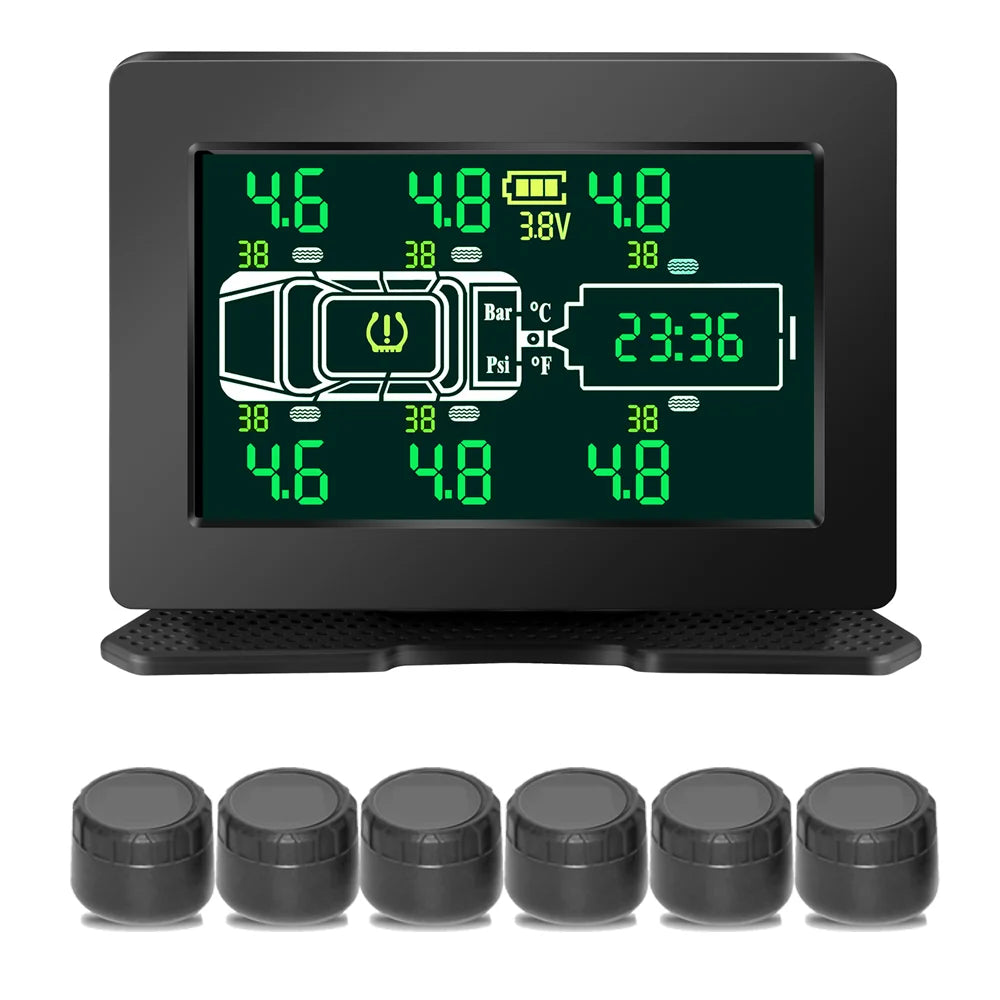
| Specification | GRUNDIG Caravan TPMS | GRUNDIG 550S | TireMinder i10 |
|---|---|---|---|
| Monitored wheel count | 4 / 6 / 8-wheel modes | 6 to 36 wheel configurations | Up to 20 tires (10 displayed simultaneously) |
| Operating pressure range | 14.5–116 PSI (1.0–8.0 bar) | 0–200 PSI | 0–199 PSI |
| Signal transmission range | Up to 40 meters (131 ft) | Up to 20 meters (booster included) | Long-range booster included |
| Accuracy rating | ±1.5 PSI / ±1°C | ±1.5 PSI / ±1°C | ±1 PSI / ±1°C |
| Display type | 5.0-inch panoramic HD color screen | 5.0-inch HD display with solar charging | 3.15-inch color LCD display |
| Sensor protection | IP67 waterproof and dustproof | IP67 waterproof external sensors | Lightweight brass external sensors |
Sources: GRUNDIG Caravan TPMS specifications, GRUNDIG 550S product guide, and TireMinder i10 user manual.
Pre-trip alarm configuration and setup sequence
Setting baseline pressure and temperature thresholds correctly prevents both nuisance alerts and delayed blowout warnings.
Follow this configuration sequence:
- Check and inflate all tow vehicle and trailer tires to their prescribed cold inflation pressures while tires are cold.
- Select desired measurement units (PSI and °F or °C) on the monitor before learning sensors.
- Configure the low-pressure threshold at 12–15% below cold inflation pressure and high-pressure threshold at 20–25% above cold baseline.
- Set the high-temperature alert threshold (commonly 158°F / 70°C) according to tire manufacturer guidance to catch overheating hubs or dragging brakes.
- Pair sensors to their assigned wheel locations in order from front to rear.
Frequently asked questions
Can a 6-wheel TPMS monitor a 4-tire truck and a 2-tire trailer together?
Yes. In 6-wheel mode, the display assigns four positions to the front tow vehicle and two positions to the single trailer axle, reporting pressure and temperature for all six tires simultaneously.
How does real-time temperature monitoring help prevent blowouts?
Rapid temperature elevation without sudden pressure loss typically indicates an overheated wheel bearing, dragging brake caliper or severe tire under-inflation. Catching temperature spikes early allows pulling over safely before tread separation.
When is a signal booster necessary for travel trailers?
For trailers exceeding 25 feet or rigs with heavy aluminum or fiberglass siding, a signal booster mounted near the trailer tongue reinforces RF signal transmission and eliminates intermittent sensor dropouts in the cab.
Check your Caravan TPMS configuration
Verify your trailer's required cold PSI, total monitored tire positions and tongue-to-cab distance before selecting your sensor bundle.