

For trailer tires above 80 PSI, choose a TPMS by pressure headroom, alarm settings and the total number of monitored tires.
The best trailer tire pressure sensor system for reliable monitoring above 80 PSI is the one that fits the complete operating requirement. GRUNDIG Caravan TPMS is a candidate for four-, six- or eight-tire applications within its 116 PSI limit. When required pressure or expected operating readings approach that ceiling, compare a higher-range option such as the 200 PSI GRUNDIG 550S or 199 PSI TireMinder i10. A larger number on the box does not prove better leak detection or higher reliability.
Start with the trailer and tire manufacturers' prescribed cold inflation requirements. A TPMS reports pressure; it does not determine the correct inflation pressure or increase the rating of a tire, wheel or valve.
Why “over 80 PSI” is not a complete specification
Three pressures serve different purposes:
| Pressure term | What it means for your purchase |
|---|---|
| Required cold inflation | The pressure specified for the actual vehicle, tires and load; establish this before configuring the monitor |
| Operating pressure reading | The pressure measured during use, which can rise as tires warm |
| TPMS measurement and alarm limits | The range the electronics support and the limits available in its settings; neither is a tire inflation recommendation |
Goodyear's RV tire care guide explains that hot tire pressure can be 10–15 PSI higher than cold pressure and says not to bleed air from hot tires. That is guidance for understanding pressure changes, not a prediction for every journey or a universal alarm-setting formula.
An 80 PSI cold requirement and a 110 PSI cold requirement therefore create different purchase decisions. The first may leave useful room within a 116 PSI system; the second warrants a careful check of expected operating readings and usually a higher-range shortlist. Do not lower required tire pressure to make a monitor fit.
Worked screening example: what remains below a 116 PSI ceiling?
For illustration only, apply the guide's 10–15 PSI warming example to three assumed cold readings. The calculations are ours: illustrative operating reading = cold reading + assumed rise; remaining range = 116 − illustrative operating reading. This is a purchase-screening exercise, not a forecast, inflation instruction or recommended alarm setting.
| Assumed cold reading | Illustrative reading after a 10–15 PSI rise | Remaining range below 116 PSI | Screening implication |
|---|---|---|---|
| 90 PSI | 100–105 PSI | 11–16 PSI | Below the ceiling in this example; still verify actual requirements |
| 100 PSI | 110–115 PSI | 1–6 PSI | Little room remains; compare a higher-range system |
| 110 PSI | 120–125 PSI | Exceeds the ceiling by 4–9 PSI | A 116 PSI system does not cover these illustrative readings |
The calculation explains why “supports 110 PSI cold” is an incomplete sales answer. Ask whether both the measurement range and available alarm settings fit your actual use. This table does not certify that any remaining margin is sufficient.
Compare three documented choices
Manufacturer specifications checked on October 21, 2026. This is a specification comparison, not an independent accuracy, endurance or blowout-prevention trial.
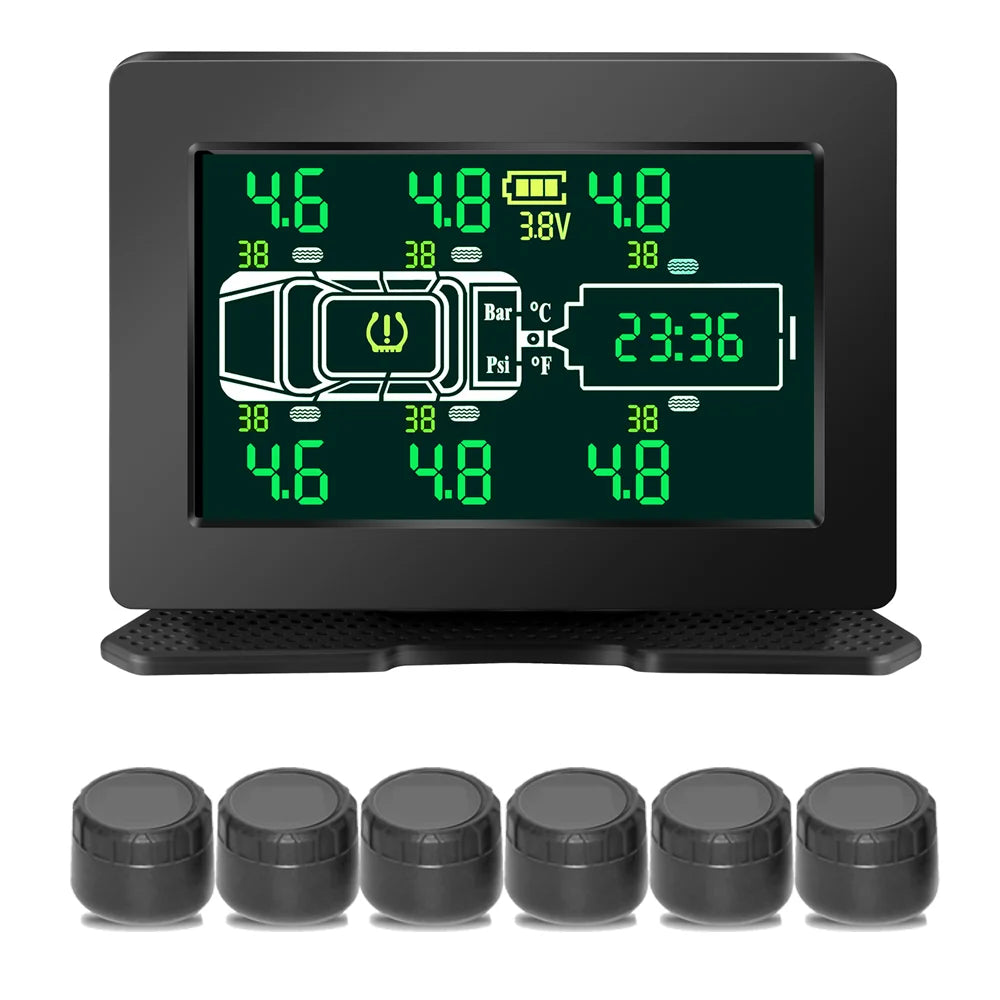
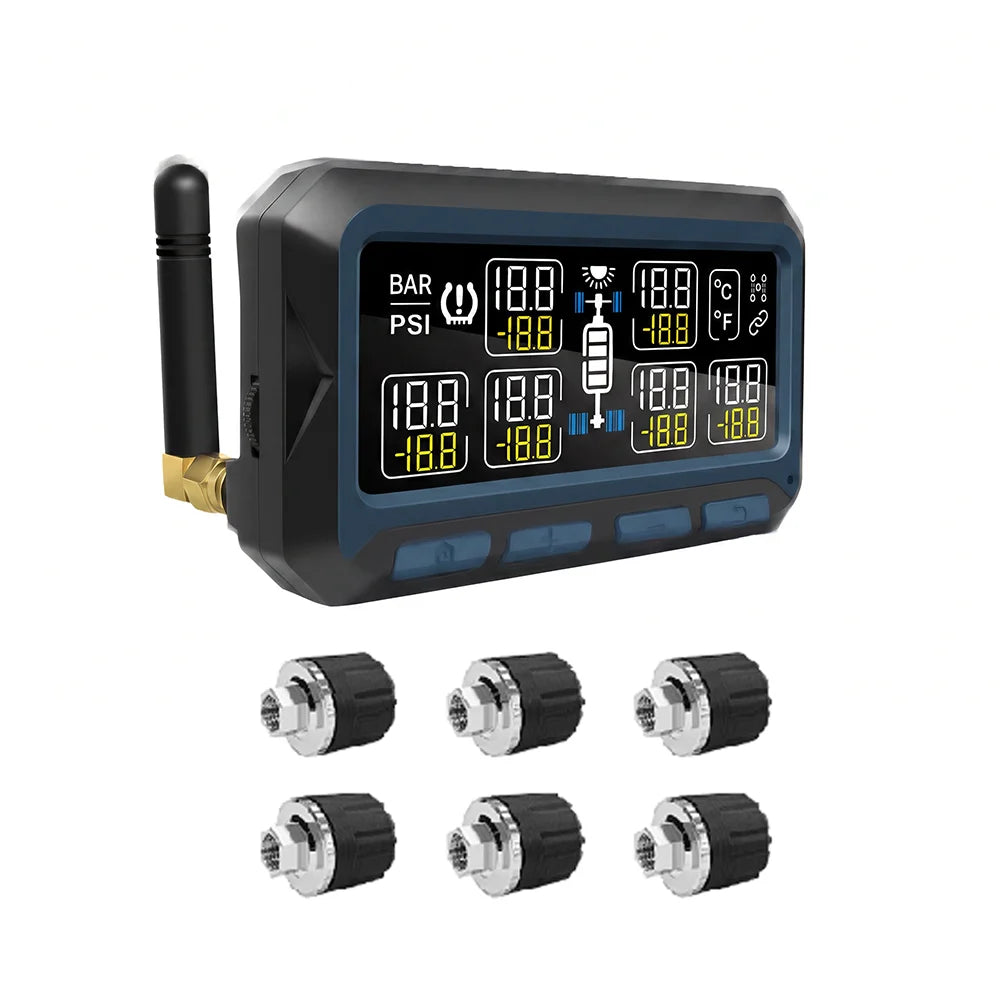
Image source: TireMinder i10 monitor with ten transmitters from its official kit listing.

| Field | GRUNDIG Caravan TPMS | GRUNDIG 550S, external version | TireMinder i10 |
|---|---|---|---|
| Pressure specification | 14.5–116 PSI pressure-setting range; 116 PSI listed maximum | 0–200 PSI | 0–199 PSI |
| Tire-count specification | 4/6/8-wheel modes; choose matching sensor quantity | External configurations from 6–36 positions | Up to 20 monitored tires; ten displayed at once |
| Display / setup feature | Five-inch display | Independent axle pressure alarms | 3.15-inch color display |
| Published accuracy claim | ±1.5 PSI | ±1.5 PSI | ±1 PSI |
| Practical advantage | Direct fit for a modest tire count when the pressure requirement stays comfortably within range | More pressure headroom and larger towing combinations | More positions than the Caravan model and a higher pressure range |
| Boundary to check | Near-116 PSI operation and combinations exceeding eight tires | Actual kit contents and booster arrangement | Actual kit contents and booster installation |
Sources: Caravan specifications and precautions, 550S configurations and specifications, and TireMinder i10 specifications.
The accuracy figures above are manufacturers' claims, not measured errors from a shared test. They do not establish which system will detect a small leak first. Update behavior, alarm settings, correct installation and signal continuity matter too.
Match the kit to the trailer and tow vehicle
Count monitored tires rather than axles. A four-tire pickup plus a four-tire trailer requires eight sensors if both vehicles will appear on the aftermarket display. A six-tire dually plus that same trailer requires ten; the Caravan model's eight-wheel mode does not cover all ten.
Factory monitoring on the tow vehicle may let you buy an aftermarket system for the trailer alone, but verify what the factory display actually supports. Do not assume it pairs with aftermarket trailer sensors. Decide whether you want one combined display or two separate systems before comparing kit prices.
For the 550S, choose the intended external-sensor variant. The product family also lists an internal-sensor option, so a family name alone does not establish sensor type or quantity. For any system, check valve compatibility, access to inner duals, service parts and the required booster before ordering.
Set the alarms before the first trip
The Caravan product page warns buyers to change car-oriented defaults before installation. Its warning text and current specification table contain different default-pressure statements. Inspect the actual low and high settings on the supplied monitor rather than relying on a quoted factory number.
Use this sequence:
- Record the prescribed cold pressures for the tow vehicle and trailer, using the appropriate vehicle, tire and load guidance.
- Set the display units to PSI or BAR as intended. Do not enter a PSI value while the monitor is in BAR mode.
- Configure low-pressure, high-pressure and temperature alerts according to the system manual and vehicle/tire guidance. Different axles may need different settings.
- Check that every required threshold is available within the selected system's adjustment range. If it is not, choose another system.
- Power the monitor and install or pair sensors in the manufacturer's stated order. Verify the wheel map before departure.
Do not solve an immediate alarm by muting it permanently or choosing the widest possible limits. First distinguish an incorrect setting from a tire that requires attention. A high-pressure warning can also reflect warming during operation; stopping safely to assess it is different from automatically releasing air from a hot tire.
Different brands can use different alarm logic
The TireMinder i10 manual, printed page 5, defines low and high warnings relative to the configured cold baseline: a fall of 15% or more and a rise of 20% or more. For an assumed 110 PSI baseline, those boundaries calculate to 93.5 and 132 PSI. These are examples of that model's logic, not recommended settings for every trailer or instructions for configuring GRUNDIG.
The same manual distinguishes rapid- and slow-leak alerts from those percentage warnings. Its rapid-leak definition is a loss of at least 3 PSI in under two minutes; its slow-leak definition is at least 6 PSI in two to ten minutes. Those are published algorithm definitions, not independent detection-test results. A displayed reading, a low-pressure threshold and a leak-rate alert answer different questions.
Verify readings and reception on the installed trailer
A practical pre-trip check should establish three things: the sensor is mapped to the correct tire, the reading is current, and the alarm settings are appropriate. This is a proposed check, not a completed field test of these products.
With the vehicle safely parked and tires cold, compare each position with a suitable pressure gauge. Record both readings and resolve a persistent discrepancy according to the manufacturer; the gauge also needs to be suitable and serviceable. Repeat after battery replacement or wheel-position changes.
Check the farthest trailer sensor with the trailer coupled, normally loaded and compartments closed. GRUNDIG's Caravan page recommends a booster for longer or metal-clad applications; follow the actual configuration guidance. Display size and pressure range cannot establish radio coverage.
If a reading drops out, treat that tire's current pressure as unknown until checked. A pressure value retained on screen is not evidence of an uninterrupted live connection. Before a long journey, confirm the manufacturer's sensor-loss indication and reconnection behavior.
Keep a simple acceptance record rather than relying on memory:
| Record for each wheel | What to enter |
|---|---|
| Identity | Vehicle/trailer, axle, side, inner/outer position and sensor ID |
| Cold-pressure check | Date, ambient conditions, prescribed pressure, gauge reading and monitor reading |
| Configuration | Units, actual low/high/temperature settings and the manual revision used |
| Communication check | Booster supply and location, latest confirmed update and any sensor-loss indication |
| Unresolved issue | Description, action taken and recheck result before the long trip |
This is a blank acceptance method, not evidence that these products have passed a shared test. If a sensor remains unverified, check the tire directly and resolve the installation issue before treating its display value as current.
Choose pressure headroom without buying unnecessary capacity
Shortlist Caravan when your tire count and required settings fit within its stated range with suitable operating headroom. Compare 550S when higher pressures, separate axle settings or additional tires make the smaller system unsuitable. Include TireMinder i10 when you want another documented higher-range alternative.
For cost comparisons, request the price of the complete matching kit: enough sensors, any required booster, electrical installation where needed and service consumables. A low starting price may refer to a smaller sensor bundle. No fuel-saving percentage or replacement-tire payback is assumed here.
TPMS can alert you to pressure and temperature changes. It cannot guarantee that every tire failure will be predicted, and it does not replace inspections for age, damage, loading or valve condition.
Frequently asked questions
Can a 116 PSI TPMS monitor trailer tires inflated to 80 PSI cold?
It is a candidate if the tire count, alarm settings and expected operating readings fit its limits. Verify the complete application; 80 PSI cold alone is not a compatibility certificate.
Should I select a 200 PSI model for tires prescribed at 110 PSI cold?
A higher-range model is a sensible shortlist because a 116 PSI ceiling leaves little room above 110 PSI. Confirm the required operating and alarm range without changing the prescribed inflation pressure.
Does a ±1 PSI claim prove faster slow-leak detection than ±1.5 PSI?
No. Claimed accuracy alone does not establish detection speed. Transmission behavior, alert thresholds, mapping and reception also affect the information the driver receives.
Is the highest tire sidewall pressure the number I should enter everywhere?
No. Establish the appropriate cold pressure for the vehicle, tire and load. Configure each alarm according to the system instructions and the relevant vehicle/tire guidance rather than copying one maximum into every field.
Can the Caravan eight-wheel mode cover a dually pickup and a four-tire trailer?
Not if all ten tires need aftermarket monitoring. Six pickup tires plus four trailer tires require ten positions; choose a suitable larger system or verify a separate factory-and-trailer arrangement.
Check your Caravan configuration
Have your tire count, prescribed cold pressures, expected pressure headroom and trailer length ready. If these exceed the Caravan model's limits, use the higher-range comparison above before purchasing.