

The most common mistake people make when buying a tire pressure monitor is not picking the wrong brand — it is buying the wrong number of sensors. A 4-wheel TPMS does not protect a dually truck. A 6-wheel system leaves your trailer unmonitored. And a monitor that tops out at 12 wheels is useless the day you add a second trailer. Before you compare features, you have to answer one question: how many sensors do you actually need?
This guide walks you through counting your tires, what "6-wheel" and "8-wheel" TPMS really mean, why buying too few sensors is money wasted, and how to pick a system with room to grow. There is a live calculator at the end that does the counting for you.
How Many Tires Does Your Rig Actually Have? (Count Them)
Start by physically walking around your whole combination and counting every tire that touches the road. Do not count in your head — count out loud. Most people undercount, because they forget the inner duals, the tag axle, or the fact that a "tandem trailer" is four tires, not two.
The rule is simple: every tire that carries your load needs a sensor. If you would not drive it with a flat tire, you should be monitoring it. For a dually truck, that is six tires. Add a tandem-axle trailer and you are at ten. Add a gooseneck with a triple axle and the count keeps climbing.
Wheel Count by Vehicle Type
- Single-rear-wheel pickup — 4 wheels.
- Dually pickup truck — 6 wheels (2 front, 4 rear).
- Single-axle trailer — 2 wheels.
- Tandem-axle trailer — 4 wheels.
- Triple-axle trailer — 6 wheels.
- Gooseneck / 5th-wheel trailer — typically 6 wheels.
- Class A diesel pusher with tag axle — 8 wheels.
Add your tow vehicle to your trailer count and you get your total. A dually (6) towing a tandem trailer (4) is ten tires — which is why an "8-wheel" system that looks generous on paper is already one trailer short.
6-Wheel vs 8-Wheel vs 12-Wheel TPMS: What the Numbers Really Mean
When a TPMS is sold as "6-wheel" or "8-wheel," the number refers to how many sensors the system can monitor simultaneously — how many tire positions the display can track at once. It is a hard ceiling, not a suggestion. A 6-wheel monitor has six sensor channels; the seventh tire has nowhere to report.
That is why the number matters more than any other spec on the box. You can upgrade the display later, but the wheel capacity is set by the hardware you buy. The smart move is to buy for the largest combination you expect to run, with a little room for a spare or an extra trailer — not for the exact setup you have today.
Why Buying Too Few Sensors Is a Waste of Money
A TPMS that covers only part of your rig protects only part of your rig — and the unmonitored tires are usually the ones that fail. The trailer tires, which carry the load and sit out of sight, are the most likely to blow. Buy a truck-only 6-wheel system and you have just left the most dangerous tires in the combination unmonitored.
There is a second, quieter cost: when you inevitably add a trailer or a bigger rig, an undersized system has no upgrade path. You cannot bolt extra channels onto a 6-wheel monitor. You end up buying the right system twice — once too small, once correct. Buying expandability up front is the cheaper path.
Sensor Types: What Scales With Your Wheel Count
Once you know your number, the next choice is how those sensors mount. The two options behave very differently as the count climbs.
External sensors screw onto the valve stem in about two minutes per tire, no dismounting required. They use a user-replaceable CR1632 coin cell and can be moved between trailers in seconds. For a rig with six, ten, or twenty tires, external sensors are the practical choice — installation is fast, and a dead sensor battery is a two-dollar, two-minute fix on the side of the road.
Internal sensors mount inside the tire, which means a professional install and a tire dismount to service. They are sealed against weather and theft, which makes them attractive for fleets and permanent installations — but the trade-off is that every tire change becomes a sensor job. Most dually and trailer owners start with external sensors and only move to internal if theft or harsh conditions demand it.
Whichever type you pick, the count is the same: one sensor per tire, on every tire you depend on. The type changes how you install them; the number changes what they protect.
Expandability: From 6 Wheels All the Way to 110
The GRUNDIG line is built so the monitor grows with your operation instead of forcing a replacement. Three systems cover the full spectrum, and the only real question is how big you expect to go.
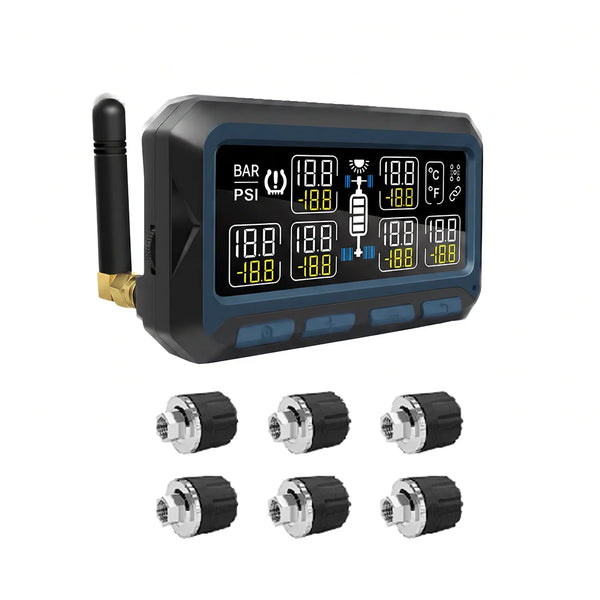
GRUNDIG 550S — 6 to 36 Wheels
200 PSI, solar + Type-C, ±1.5 PSI accuracy. The all-rounder for a dually truck and one or two trailers.
View the 550S Solar TPMS →
GRUNDIG D550 — 6 to 40 Wheels, Independent Axle Alerts
200 PSI with independent axle pressure alerts. Built for commercial trailers where each axle runs its own pressure.
View the D550 TPMS →
GRUNDIG 860 — 6 to 110 Wheels, Multi-Trailer Switching
5" touch screen, multi-trailer switching, optional GPS. The flagship for fleets and the longest combinations.
View the 860 Touch-Screen TPMS →Signal Range: Why More Wheels Means a Booster
As your wheel count climbs, so does the physical length of your combination — and that length is the enemy of a wireless signal. The sensors on the rearmost trailer tire have to reach the display in the cab, and on a long combination that distance is enough to drop a weak signal. The fix is a signal booster (repeater) mounted mid-trailer, which relays the rearmost sensors to the display.
This is why the higher-capacity GRUNDIG systems ship boosters by default. The 550S and D550 include a booster on larger configurations, and the 860 scales up to six boosters so that even a 110-wheel road train keeps every sensor reporting. When you plan for more wheels, plan for the signal path too — a monitor that can count 40 tires but cannot reach them is no better than one that cannot count them.
Wheel Count Calculator: Find Your Total in Seconds
Check every vehicle and trailer in your combination below. The total updates live, and we will match it to the right GRUNDIG system.
How Many Sensors Do You Need?
Check all that apply to your setup.
Check your rig above
Add your truck and trailers to see your total wheel count and the matching GRUNDIG system.
Vehicle → Wheel Count → Sensors → Recommended Model
| Combination | Total wheels | Sensors needed | Recommended model |
|---|---|---|---|
| Dually truck only | 6 | 6 | 550S |
| Dually + single-axle trailer | 8 | 8 | 550S |
| Dually + tandem-axle trailer | 10 | 10 | 550S |
| Dually + gooseneck | 12 | 12 | 550S / D550 |
| Long combination (multi-trailer) | 13–40 | 13–40 | D550 AXLE ALERTS |
| Fleet / road train | 41–110 | 41–110 | 860 MULTI-TRAILER |
How Many Sensors for Spares & Tag Axles?
Two easy-to-miss wheels deserve their own sensors: the spare and the tag axle. A spare tire goes flat sitting in the carrier, and you only discover it the one time you actually need it — which is why monitoring the spare is worth one extra sensor. A tag axle, common on Class A diesel pushers, adds two more tires that carry real load and belong in the monitor.
The rule of thumb stays the same: if it is a tire you depend on, give it a sensor. Add the spare to your count and buy one sensor over your current total, so you are not one wheel short the first time you change a tire.
A Real Example: From a Single Dually to a Growing Fleet
Here is how the math plays out in real life. An owner-operator starts with a dually pickup — six tires — and buys a six-wheel monitor. A year later they pick up a tandem trailer for hauling, and the combination is now ten tires. The six-wheel monitor cannot cover the trailer, so the most vulnerable tires on the whole rig are unmonitored, and they end up buying a second system.
Had they bought a 6–36 wheel monitor up front, that same system would have absorbed the trailer without missing a beat — six tires on day one, ten tires a year later, no second purchase. The same logic repeats for a small fleet operator who grows from a few trucks to a multi-trailer operation: capacity bought early is money not spent twice. That is the entire case for buying expandability rather than the exact count you need today — buy once, cover every tire you will ever run, and stop counting sensors every time you add a trailer.
Frequently Asked Questions
How do I know if I need 6, 8, or 12 sensors?
Can I buy fewer sensors now and add more later?
Do trailer tires really need sensors, or just the truck?
What is a tag axle, and does it need sensors?
Is there a downside to buying a higher-capacity system than I need?
How many sensors should I order if I also want to monitor the spare?
Does a signal booster add wheel capacity?
Get the Right Number of Sensors the First Time
From 6 wheels to 110, there is a GRUNDIG system sized for your rig — with room to grow when you add a trailer.
Shop TPMS Systems →Free shipping · Trusted German Heritage since 1945