

A dually truck towing a tandem trailer is one of the hardest-working setups on the road. You have six tires on the truck alone, then four, six, or even eight more rolling behind you — and if any single one of them starts losing air, you might not feel it until it is too late. A tire pressure monitoring system (TPMS) built for dually trucks and tandem trailers is the difference between catching a slow leak at 60 mph and standing on the shoulder watching a shredded tire.
This guide breaks down exactly what to look for in a dually TPMS, compares the systems that actually hold up under heavy loads, and helps you pick the right one for your rig. We build these systems, so we will be upfront about what each one is good at — and where a different model fits better.
Why a Dually Truck Needs a TPMS (Not Just Any RV One)
Dually trucks put two tires on each rear corner for a reason: load capacity and stability under a heavy pin weight or trailer load. That same setup creates a serious blind spot. The inner dual tire sits tucked behind the outer one, nearly impossible to see from the driver's seat and awkward to reach with a pressure gauge. When the inner tire loses air, the outer tire quietly takes on double the load, overheats, and can blow — often while the driver still thinks everything is fine.
Standard passenger-car TPMS systems simply do not cover this. Most four-wheel systems max out around 60–80 PSI and monitor only four positions, leaving your dually's inner rear tires completely unmonitored. Even many "RV" TPMS units stop at 87 or 116 PSI, which is nowhere near enough for the 110–130 PSI that a loaded dually or heavy trailer tire runs. A genuine dually truck tire pressure monitoring system must monitor six or more wheels and read high pressures accurately.
The Real Stakes: What a Missed Dually Tire Failure Costs
Talk to anyone who has lost a dually inner tire at highway speed and they will describe the same sequence: a faint vibration they ignored, then a bang, then a shredded carcass whipping against the trailer frame, fender, and brake lines. By the time a blowout announces itself, the damage is rarely limited to the tire. It commonly takes out the rim, the fender, and often the wiring harness or brake line on that corner.
None of that happens without warning — the warning just is not visible from the driver's seat. A tire that is 15–20 PSI low is building heat for miles before it fails, and the only instrument that can tell you is a pressure sensor on that specific wheel. That is the entire job of a TPMS: turn an invisible problem into a number on a screen, with an alarm before it becomes a roadside emergency. For a loaded dually towing a tandem trailer, that early warning is measured in the difference between a five-minute air-up and a two-hour roadside wait — or worse.
The 5 Specs That Matter When Buying a Dually TPMS
Ignore the marketing copy and check five numbers first. These five specs separate a system that protects your rig from one that just beeps occasionally.
1. PSI Range — Why 87–116 PSI Systems Fall Short
Load Range G and H trailer tires run 110–125 PSI cold. Many heavy truck steer tires run 110–130 PSI. If your monitor tops out at 116 PSI, it physically cannot read those tires — it will flash an error or, worse, show a wrong number. Look for a system rated to at least 200 PSI. The GRUNDIG lineup is built around 200 PSI across the board, with the S08 going up to 217 PSI for high-pressure rigs.
2. Wheel Capacity — 6, 8, 12… or 110?
Count your tires. A dually truck alone is six. Add a tandem-axle trailer and you are at ten or twelve. A gooseneck with a triple axle pushes higher. Buy a system with room to grow: the 550S monitors 6–36 wheels, the D550 goes to 40, and the 860 reaches a staggering 110 wheels for fleets and road trains.
3. Signal Range & Boosters on Long Rigs
Sensors mount on the tires; the display sits in the cab. On a 30-foot trailer, that distance is enough to drop weak signals. A signal booster (repeater) solves it. Every GRUNDIG system above 10 wheels ships with at least one booster, and the 860 scales up to six boosters for the longest combinations.
4. Sensor Type — External vs Internal
External sensors screw onto the valve stem in about two minutes per tire and use user-replaceable CR1632 batteries. Internal sensors mount inside the tire (professional install) but are sealed against theft and weather. For most dually and trailer owners, external sensors are the practical choice — no tire dismounting, and you can swap them between trailers.
5. Display & Power — Solar vs Wired
A solar display with a USB-C backup (like the 550S) means no wiring and no dead monitor on long hauls. Larger rigs benefit from a bigger screen: the S08 and 860 carry a 5-inch HD or touch display so you can read all positions at a glance.
The Best TPMS for Dually Trucks & Tandem Trailers, Compared
Here is how our four systems line up for different dually and heavy-trailer jobs. Pick the one that matches your pressure, wheel count, and whether you tow one rig or a whole fleet.
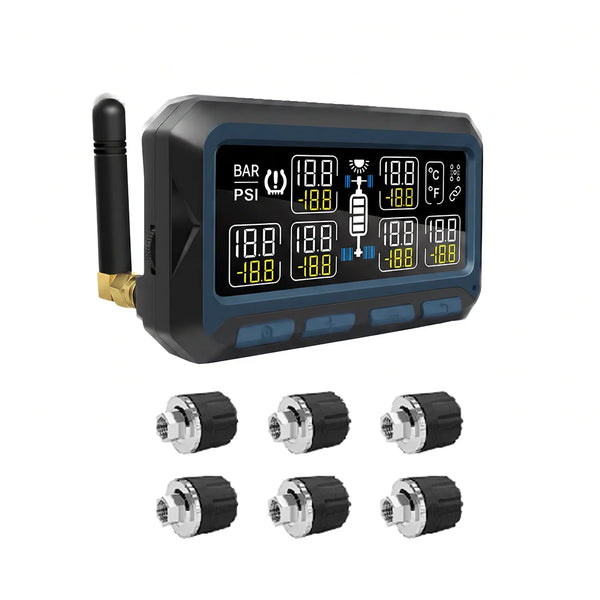
GRUNDIG 550S — Best Solar for Daily Dually Operators
6–36 wheels, 200 PSI, solar + Type-C, Infineon chip, ±1.5 PSI accuracy, IP67 sensors. The workhorse for a dually truck and its trailers.
View the 550S Solar TPMS →
GRUNDIG S08 — Best for High-Pressure (217 PSI) Rigs
8/10/12 wheels, 217 PSI max, 5" HD display, 40m range, anti-theft nuts. Built for Class A diesels and heavy trailers running above 116 PSI.
View the S08 Heavy-Duty TPMS →
GRUNDIG 860 — Best for Fleets & Multi-Trailer Switching
6–110 wheels, 200 PSI, 5" touch screen, multi-trailer switching, independent axle alerts, optional GPS. The flagship for operators who run more than one rig.
View the 860 Touch-Screen TPMS →
GRUNDIG D550 — Best for Independent Axle Alerts
6–40 wheels, 200 PSI, independent axle pressure alerts. Purpose-built for commercial trailers where each axle needs its own pressure threshold.
View the D550 TPMS →Model Comparison Table
| Feature | 550S | S08 | D550 | 860 |
|---|---|---|---|---|
| Max pressure | 200 PSI | 217 PSI | 200 PSI | 200 PSI |
| Wheel capacity | 6–36 | 8/10/12 | 6–40 | 6–110 |
| Display | Backlit LCD | 5" HD | LCD | 5" touch screen |
| Power | Solar + Type-C | Built-in battery | Wired / battery | Wired / battery |
| Standout feature | Solar, Infineon chip | Anti-theft, 40m range | Independent axle alerts | Multi-trailer + GPS |
| Best for | Daily dually operator | High-PSI rigs | Commercial trailers | Fleets & road trains |
Every system above covers your dually's inner duals, reads real-time pressure and temperature, and alerts on high/low pressure, high temperature, fast leak, and sensor fault.
What Happens in the Cab When a Tire Drops
A good dually TPMS does more than display numbers. The moment a sensor detects a problem, the display fires both a visual and an audible alarm so you do not have to be staring at the screen to catch it. GRUNDIG systems alert on six conditions: high pressure, low pressure, high temperature, fast air leak, low sensor battery, and sensor fault.
The two alerts that matter most for a dually are fast leak and high temperature. Fast-leak detection reacts to a rapid pressure drop in seconds — the kind caused by a puncture or a failing valve stem — before the tire fully deflates. High-temperature alerting catches the slower killer: a tire that is underinflated enough to overheat on a long grade, but not yet flat. Either way, you get the heads-up while there is still a safe place to pull over.
For a tandem trailer, one more setting changes everything: independent axle alerts. Different axles carry different loads and run different pressures. The D550 and 860 let you set a separate threshold per axle, so the trailer's tires are judged against the pressure they should actually run — not a one-size-fits-all number.
How to Choose: Answer These 3 Questions
Answer three questions and we will point you to the right model. No fluff, just the match.
Which GRUNDIG TPMS Fits Your Rig?
Answer all three questions, then tap "Show my match".
1. What is the maximum cold pressure on your tire sidewall?
2. How many wheels do you need to monitor in total?
3. Do you tow or switch between multiple trailers, or run a fleet?
Frequently Asked Questions
Do I need a signal booster for a tandem trailer TPMS?
Will a standard RV TPMS work on my dually truck?
Can one TPMS monitor my truck and my trailer at the same time?
Are external sensors accurate enough for heavy trailers?
How long do the sensors last before I need new batteries?
Is a dually TPMS worth it if I already do a pre-trip walkaround?
Can I move the sensors between trucks and trailers?
What if my tires run above 200 PSI?
Find the Right TPMS for Your Dually & Trailer
From a single dually truck to a 110-wheel road train, there is a GRUNDIG system sized for it — 200–217 PSI, real-time alerts, and inner-dual coverage standard.
Shop All TPMS Systems →Free shipping · Trusted German Heritage since 1945