


How to Choose the Right TPMS for Your Vehicle:
RV, Truck, or Commercial Fleet
Three vehicle types. Three different pressure ranges, wheel counts, and operating conditions. One guide that matches the right system to your actual setup.
Tire pressure monitoring systems are not interchangeable across vehicle types. A TPMS rated to 58 PSI cannot monitor a Class A motorhome's rear tires at their 100+ PSI operating pressure. A 4-wheel system cannot monitor a dually truck with inner rear tires. A standard battery-powered monitor requires active power management that commercial operators running daily routes cannot reliably maintain. The right system is the one matched to your specific pressure range, wheel count, and operational context — and the gap between a system that fits your vehicle on paper and one that actually works for your use case is significant.
This guide covers the three Grundig TPMS systems currently available — the complete Grundig TPMS range — and the specific vehicle types and operating conditions each one was designed for. The decision logic is straightforward once the matching criteria are clear: maximum PSI, wheel count, and power source preference determine which system applies to your situation.
If you're not sure which category your vehicle falls into, the decision tool below narrows it down in three questions.
3-Question Decision Tool
Find Your System in Under a Minute
How many wheels does your complete setup have?
Count every tire that will be on the road, including trailer tires if you tow. A dually pickup has 6. A dually with a single-axle trailer has 8. A Class A motorhome towing a vehicle has 8 or more.
If 4–8 wheels → consider RV TPMS or Solar 6-Wheel · If 8–12 wheels → consider S08What is the maximum inflation pressure on your rear tires?
Find this on the tire sidewall — it's the maximum cold inflation, not the recommended operating pressure. For most Class B and C motorhomes: under 90 PSI. For Class A motorhomes: 100–120 PSI. For heavy commercial: potentially 130+ PSI.
Under 116 PSI → RV TPMS or Solar 6-Wheel · 116–218 PSI → S08 requiredIs this vehicle in daily commercial operation or recreational use?
Commercial daily operators benefit from solar charging on the monitor unit, eliminating monitor battery management in the daily maintenance schedule. Recreational operators can manage a battery-powered monitor without difficulty.
Daily commercial dually → Solar 6-Wheel · Recreational RV → RV TPMS · Heavy commercial → S08Side-by-Side Comparison
All Three Systems Against Every Key Specification
| Specification | RV TPMS | Solar 6-Wheel | S08 Heavy-Duty |
|---|---|---|---|
| Max PSI range | 116 PSI | ~116 PSI | 218 PSI |
| Wheel coverage | 4 / 6 / 8 switchable | 6 wheels | 8 / 12 switchable |
| Display size | 5.0" color | Standard | Standard |
| Monitor power | Battery | Solar + USB | Battery |
| Alarm modes | 5 alarm types | 6 alarm types | 5 alarm types |
| Best for | Class A/B/C motorhomes, RV towing combos | Dually trucks, daily commercial | Class A diesel, heavy commercial |
| Not suitable for | Pressures above 116 PSI | More than 6 wheels | 4–6 wheel lighter vehicles |
| Price | $119 | — | $259 |
System 1
Grundig RV TPMS — For Most Recreational RV Owners
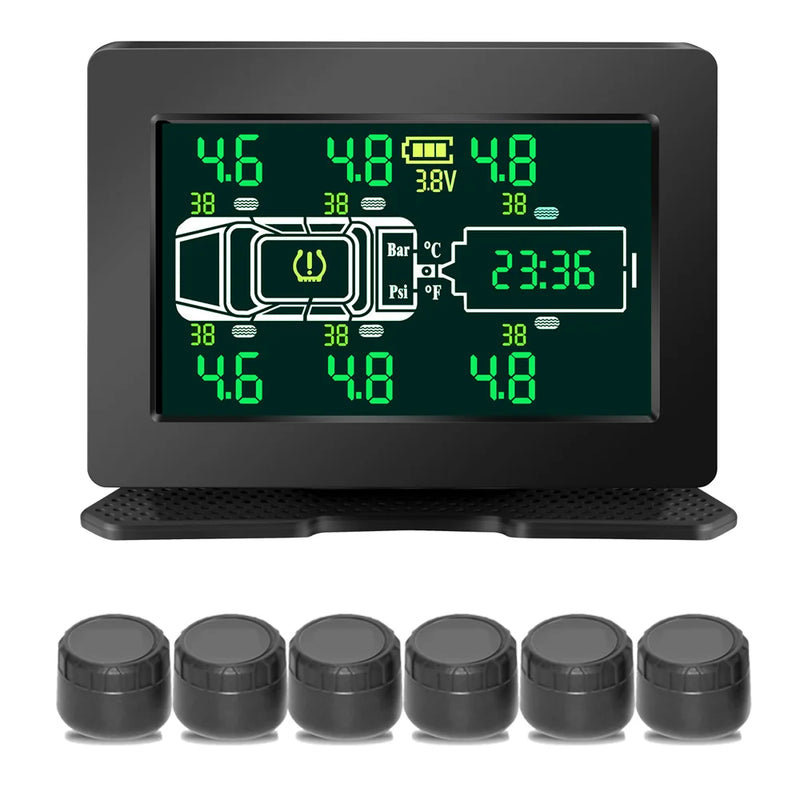
Grundig RV TPMS
Class A, B & C motorhomes · 5th wheel towing combinations · Dually tow vehicle + trailer up to 8 wheels
116 PSI max · ±1.5 PSI accuracy · 5.0" display · 4/6/8-wheel switchable · 5 alarm types
$119
Shop RV TPMS →The right choice for the majority of recreational RV owners. The 4/6/8-wheel switchable design covers configurations from a Class B campervan to a Class A motorhome towing a dinghy vehicle, and the 116 PSI ceiling covers the operating range of all Class B and C motorhomes and most Class A motorhomes not on commercial chassis. The 5.0" display is the largest in the range — important for drivers who want to read all tire positions at a glance without looking away from the road.
System 2
Grundig Solar TPMS 6-Wheel — For Daily Dually Truck Operators
Grundig Solar TPMS
6-Wheel Truck System
Ford F-350/F-450 · Ram 3500/4500 · GMC Sierra 3500HD · Any 6-wheel dually in daily commercial use
Solar + USB charging · 6 sensors · Inner dual coverage · 6 alarm modes · No monitor battery management
See product page
Shop Solar TPMS →The right choice for dually pickup truck operators who use their vehicle for daily commercial work and need inner dual rear tire coverage without the monitor battery management that battery-powered systems require. The solar charging maintains continuous power throughout all daylight driving hours, with USB backup for overnight and covered parking. All six tire positions are monitored simultaneously, eliminating the inner dual blind spot that standard 4-wheel systems leave unmonitored.
System 3
Grundig S08 Heavy-Duty TPMS — For Class A Diesel and Heavy Commercial
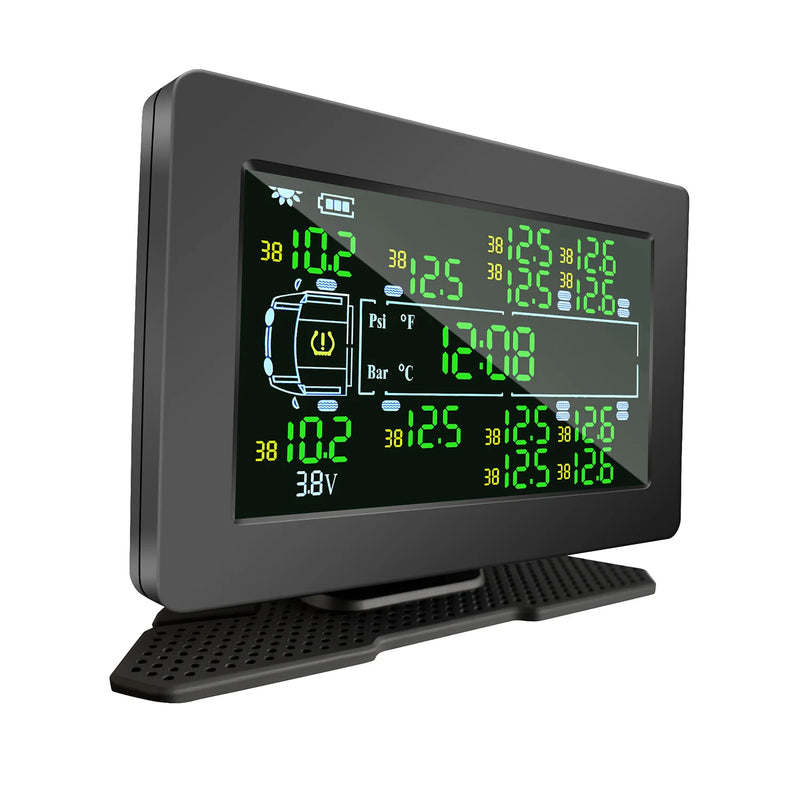
Grundig S08
Heavy-Duty TPMS
Class A diesel pushers · Commercial chassis motorhomes · Heavy dually + tandem trailer · 8–12 wheel configurations
218 PSI max · 8/12-wheel switchable · Purpose-built sensors for high-pressure operation · Full alarm suite
$259
Shop S08 TPMS →The only choice for vehicles where rear axle pressure exceeds 116 PSI or where total wheel count reaches 12. A Class A diesel pusher on a Freightliner or Spartan chassis running 100–120 PSI on dual rear tires requires a monitoring system that can actually read those pressures — a standard RV TPMS at its 116 PSI ceiling has no reserve capacity for the high end of that operating range. The S08 provides 218 PSI maximum range with sensor construction rated for the sustained mechanical demands of high-pressure commercial operation.
Find the right TPMS for your vehicle and configuration. Free shipping on all systems · RV / Solar / Heavy-Duty
Browse All TPMS Systems →