

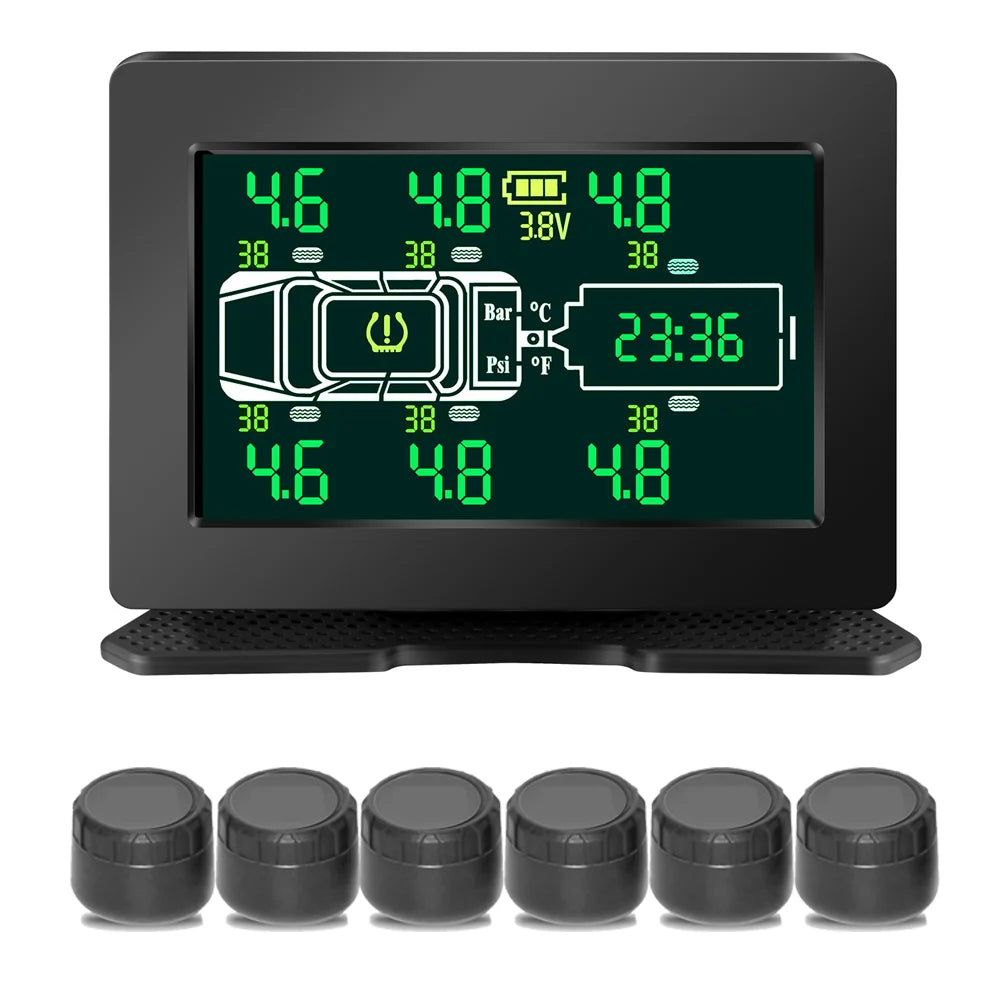
How to Read Your TPMS Display:
Pressure Readings, Temperature Data, and Alarm Codes Explained
Installing a TPMS is the first step. Understanding what it's telling you is the step most drivers skip. This guide covers everything the display is showing — and what to do about it.
A TPMS display showing readings from six tire positions generates more information than most drivers know how to use. The pressure numbers are straightforward enough — but what does a temperature reading of 155°F mean for a highway drive? How much below the alarm threshold can a tire drop before it matters at low speed vs high speed? When two alarms fire simultaneously on different positions, which one demands immediate action and which one can wait for the next rest stop? The complete Grundig TPMS range monitors both pressure and temperature for every tire position simultaneously — and getting the most from that monitoring requires understanding what each reading type represents and how to interpret combinations of readings together rather than in isolation.
This guide covers every data type displayed by a TPMS system, the correct interpretation of each alarm type, how to set threshold values that produce useful warnings rather than constant false alarms, and the standard response protocol for each alarm scenario. Most of this information is not in the product manual — it requires understanding how tire pressure physics relates to the numbers on the screen.
Reading Types
Pressure vs Temperature: What Each Number Is Actually Telling You
What it measures and what it means
Pressure readings show gauge pressure — the difference between internal tire pressure and atmospheric pressure at the sensor's location. This number changes with temperature (approximately 1 PSI per 10°F), altitude (approximately 0.5 PSI per 1,000 feet of altitude gain), and load (pressure rises slightly as the tire deforms under weight). A "correct" pressure reading is one that falls within the range appropriate for the tire's current temperature, load, and altitude conditions — not simply a fixed number regardless of operating environment.
The early warning that pressure misses
Temperature readings show the air temperature inside the tire cavity, which reflects both ambient conditions and heat generated by tire flex. A tire generating excess heat from underinflation, overloading, brake heat transfer, or an internal defect will show elevated temperature before the heat affects pressure enough to trigger a pressure alarm. Temperature is the early warning signal — a tire running significantly hotter than the others on the same vehicle in the same conditions warrants investigation even if pressure appears normal.
Setting Thresholds
How to Configure Alarm Values That Work in Real Conditions
Factory-default alarm thresholds are calibrated for passenger car configurations at typical passenger car pressures. For RV owners and commercial truck operators running pressures of 80 to 120+ PSI, these defaults are almost always wrong — set either too low (generating false alarms during normal heat buildup) or too high (failing to alarm when actual underinflation develops). Configuring thresholds correctly requires understanding what "correct" means for your specific vehicle, load, and operating environment.
Low Pressure Alarm Threshold
Set to 15–20% below the correct cold inflation for your maximum loaded weight. For a tire requiring 100 PSI when fully loaded, set the low-pressure alarm at 80–85 PSI. This provides meaningful warning before the underinflation becomes dangerous, while avoiding alarms triggered by normal cold-morning pressure variation or altitude effects. Do not set this threshold at the cold inflation specification — normal operating temperature will push pressure above the alarm level within 30 minutes, generating constant false alarms.
High Pressure Alarm Threshold
Set to 15% above the correct cold inflation for summer operation. For a 100 PSI cold specification, set the high alarm at 114–115 PSI. This catches genuine overinflation events — which occur when heat stack (ambient + friction + solar) pushes pressure beyond the tire's structural comfort zone — while not alarming on the normal pressure rise from cold start to operating temperature. This alarm is critical in summer and often not configured by drivers who focus only on low-pressure protection.
High Temperature Alarm Threshold
Most commercial tire manufacturers specify a maximum operating temperature of 200–220°F for the tire interior. Set the high temperature alarm at 175–185°F — providing warning before the structural limit is approached. A tire at 190°F is operating outside its designed thermal range; a tire at 160°F after a long mountain descent is elevated but within normal range. Context matters: a consistently hot tire is a problem; a briefly elevated temperature on a specific drive segment requires judgment rather than immediate action.
Rapid Pressure Loss Alarm
This threshold should be pre-set by the manufacturer and typically triggers when pressure drops more than 20% in a short time window — indicating a sudden loss event rather than gradual leakage. Unlike the other thresholds, this one should not require user configuration. If the system is generating rapid-loss alarms without corresponding physical events, check sensor battery status and valve stem integrity before adjusting the threshold.
Alarm Response Guide
The Correct Action for Every Alarm Type
Normal Reading Ranges
What to Expect at Different Points in a Typical Drive
Pre-departure (cold tires): Pressure should match gauge reading ±1–2 PSI. Temperature should be near ambient air temperature. Any position more than 3 PSI different from others warrants investigation before departure.
30 minutes at highway speed: Pressure 4–7 PSI above cold reading. Temperature 40–60°F above ambient. All positions should be rising at similar rates — a position that isn't warming as expected may have insufficient inflation for its load.
Peak summer highway (2–4 hours): Pressure 8–12 PSI above cold reading. Temperature up to 80°F above ambient in extreme conditions. High-pressure alarm may approach if summer heat stack is severe — correct response is to reduce speed, not release air.
After mountain descent: Temperature may be 20–40°F above pre-descent reading from brake heat transfer. Allow 20–30 minutes of normal driving for temperature to normalise before interpreting readings as representative of tire condition.
The Complete Range
Grundig RV TPMS
116 PSI, 4/6/8-wheel. 5.0" display showing all positions. Pressure + temperature per position. Full alarm suite with configurable thresholds. $119.
$119
Shop Now →Solar TPMS 6-Wheel
6 positions including inner duals. Solar powered. 6 alarm types. All readings individually reported — no averaging between inner and outer dual positions.
See product
Shop Now →Grundig S08 TPMS
218 PSI ceiling, 8/12-wheel. Designed for Class A diesel and heavy commercial where pressure ranges require a system calibrated for high-pressure operation. $259.
$259
Shop Now →Every reading, every position, explained — and monitored. Free shipping on all systems · From $119
Shop All TPMS →