

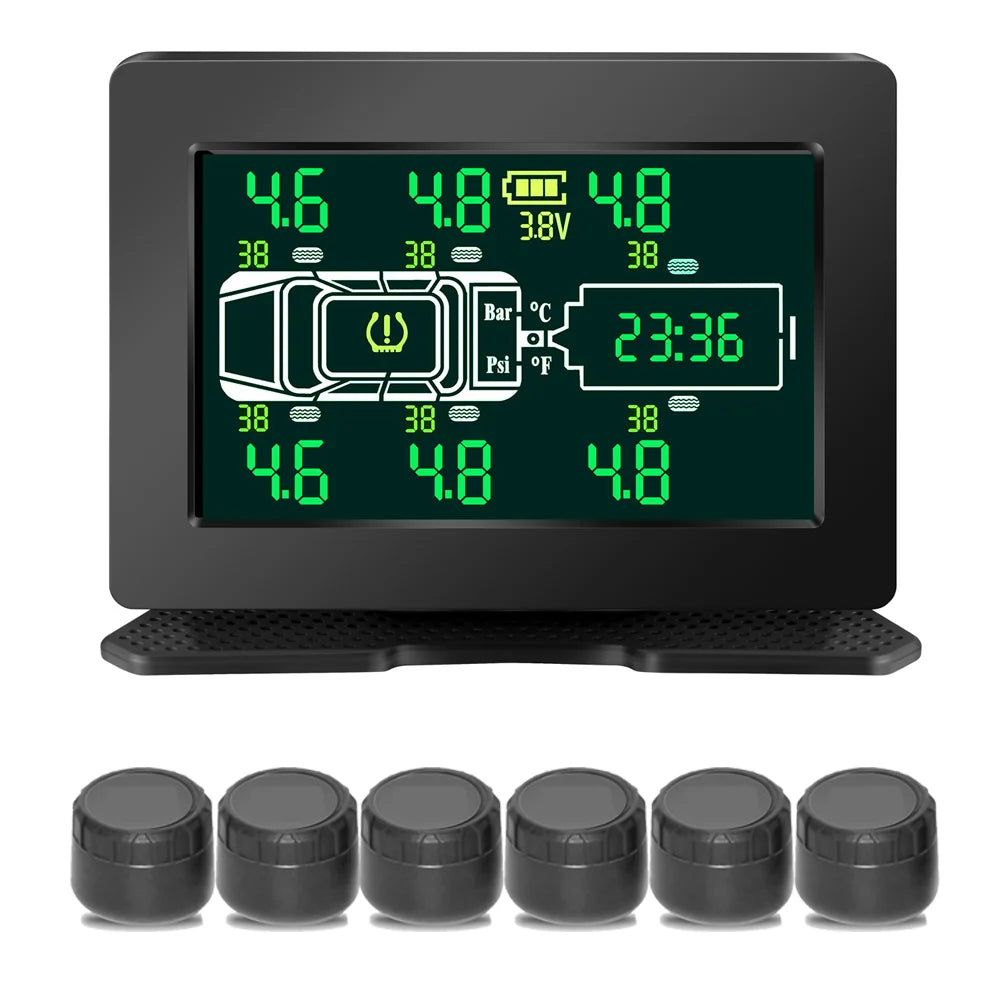
Summer RV Road Trip Tire Safety Guide:
Heat, Load, and Why Pressure Matters More Than You Think
Summer is peak RV season and peak tire failure season. The physics of why are specific, predictable, and entirely preventable with the right information.
Summer is the busiest season for RV travel and, consistently, the season with the highest rate of RV tire failures on US highways. The correlation is not coincidental. Heat is the single greatest accelerator of tire degradation, and summer RV travel combines three heat sources that compound each other: ambient temperature, solar radiation on dark tire sidewalls, and the heat generated by the tire itself under sustained load at highway speed.
Understanding the physics is more useful than understanding the statistics, because the physics tells you specifically what to do differently. The rule that governs summer tire pressure management is this: tire pressure increases approximately 1 PSI for every 10°F of temperature rise. For an RV departing at 65°F on a cool morning and reaching driving conditions of 95°F by mid-afternoon on a desert highway, that means a 3 PSI pressure increase from ambient temperature alone — before road heat and load heat are added. A real-time RV tire pressure monitoring system is the only way to know where actual tire pressure is at any point in that temperature curve, rather than estimating from a morning cold reading taken hours earlier.
This guide covers the specific summer variables that affect RV tire pressure management, what the load factor adds to the temperature equation, and the monitoring approach that gives RV owners accurate information throughout a summer drive rather than only at departure.
The Physics
How Temperature Changes Tire Pressure — The Numbers
The relationship between temperature and tire pressure follows Gay-Lussac's Law: at constant volume, pressure is proportional to temperature. In practical terms for RV tires, this means every 10°F of temperature increase produces approximately 1 PSI of pressure increase. This is why manufacturers specify cold inflation pressure — they assume the tire is at ambient temperature before driving, not at operating temperature after 45 minutes at highway speed.
The implication is that a tire correctly inflated for a cold morning departure may be operating 8 or more PSI above its cold inflation rating by mid-afternoon — which is normal and accounted for in manufacturer specifications. The problem arises when a tire is set at the wrong cold pressure in the morning, either because the owner used a summer-appropriate inflation without accounting for the full heat rise, or because the tire was underinflated at departure and the heat rise compounds the deficit into a structural risk.
Load and Heat Combined
Why a Fully Loaded Summer RV Is the Hardest Condition a Tire Faces
The temperature effect compounds with load. A tire carrying more weight generates more heat internally through flexion — each rotation of an overloaded or underinflated tire produces more sidewall flex, and that flex generates heat. In a summer driving scenario, the tire is simultaneously dealing with heat from the ambient environment and heat from its own operation under load.
| Scenario | Pressure Effect | Risk Level |
|---|---|---|
| Cool morning, lightly loaded | Normal cold pressure, minimal heat rise | Low |
| Cool morning, fully loaded | Higher required cold pressure, moderate heat rise | Moderate — requires load-specific cold inflation |
| Hot afternoon, lightly loaded | Elevated from ambient, manageable range | Moderate — monitor for overinflation |
| Hot afternoon, fully loaded, highway speed | Three heat sources compounding simultaneously | High — requires real-time monitoring |
| Mountain descent, fully loaded, summer | Brake heat adds to already-elevated tire temperature | Highest — stop and check before descent |
The fully loaded summer afternoon highway scenario is where most RV tire failures occur, precisely because it combines the maximum number of heat sources operating simultaneously on tires that may already be at or below their required load-inflation pressure. The gap between "should be fine" and "actually fine" is only visible with real-time data.
Loaded vs Empty
Managing the Pressure Difference Between Full and Empty
The inflation pressure required for a fully loaded RV is not the same as the pressure required when the vehicle is empty. The difference can be substantial — on a Class A motorhome, the rear axle inflation difference between the empty and fully loaded condition can be 15 to 20 PSI or more.
Many RV owners set their tire pressure for their typical loaded condition and leave it fixed — which means they're over-inflating slightly when empty and correctly inflated when loaded. This is actually the safer error of the two. The more common and more dangerous pattern is setting inflation for the empty condition, then loading the vehicle without adjusting pressure. Those tires are operating at the wrong inflation for their actual carried weight from the moment of departure.
1. Check tire pressure cold, before departure, every morning · 2. Use the inflation appropriate for your actual loaded weight that day, not a fixed number · 3. After 30–40 minutes of highway driving, verify with TPMS that pressures have settled in the expected range · 4. Monitor continuously for the duration of the drive — a slow leak developing at mile 80 needs to be caught at mile 90, not at mile 200
Summer-Specific Monitoring
What Real-Time TPMS Adds to Summer RV Safety
The static morning pressure check confirms where the tires are at 7am and 65°F. Real-time monitoring confirms where they are at 2pm and 95°F after 200 miles of interstate driving with a full load. These are different pieces of information, and both matter — but during a summer road trip, the second piece is the one that catches the failures the morning check cannot predict.
The high-temperature alarm is particularly important in summer conditions. A tire that enters a stretch of desert highway at normal operating pressure can reach its maximum inflation limit within an extended driving period if ambient temperatures are high enough. The TPMS high-pressure alarm catches this before it becomes a safety concern — the correct response is to pull over and allow the tire to cool, not to reduce pressure on a hot tire and then re-check when cold.
The temperature monitoring capability is equally important. A tire showing normal pressure but elevated temperature is experiencing excess heat generation — typically from underinflation relative to load, from extended high-speed driving, or from brake heat transfer. The temperature alarm provides early warning of thermal stress before it reaches the pressure threshold that indicates structural risk. Browse the full Grundig TPMS lineup for the complete range of configurations and coverage options.
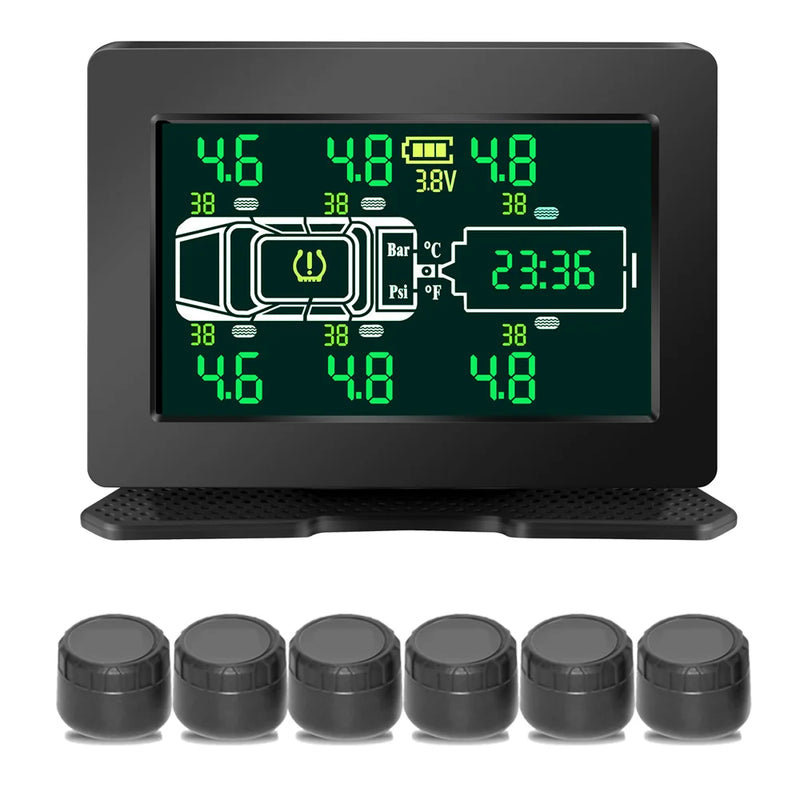
Grundig RV TPMS
4/6/8-Wheel Switchable
116 PSI range, ±1.5 PSI precision. Real-time pressure AND temperature for all positions. High-temperature alarm catches heat stress before pressure reaches critical. 5.0" display. 4/6/8-wheel modes. $119. Free shipping.
$119
Shop Now →Know your tire pressure at mile 200, not just at departure. Free shipping · Real-time pressure & temperature · 116 PSI range
Shop RV TPMS →