

Ask ten trailer owners what pressure they run, and you will get ten different answers — most of them guesses. The truth is that tandem dually trailer tire pressure is not a number you guess. It is a number printed on the sidewall, tied to a load range, and checked cold. Get it wrong and the result is not a rough ride; it is a blowout, usually at highway speed, usually fully loaded.
This guide walks through exactly what PSI your tandem dually trailer tires should run, what load range means, why you only ever check pressure cold, and how a 200 PSI TPMS removes the guesswork from every tire on a multi-axle trailer. We build the monitor we recommend at the end, so we will keep the numbers concrete and the advice specific.
What Is a Tandem Dually Trailer? (And How Many Tires Are We Talking About?)
A tandem trailer has two axles positioned close together toward the rear. A dually runs two wheels on each end of an axle — four tires across, instead of two. Put them together and a tandem dually trailer is rolling on eight or more tires, each one carrying a share of the load and each one needing to be at the right pressure. Add the tow vehicle and a heavy combination can easily have ten, twelve, or more tires to keep track of.
The reason the distinction matters is tire math. Two axles spread the load, but only if every tire is doing its job. One underinflated tire in a tandem setup shifts its share of weight onto its neighbors, which then overheat in turn. On a dually, the inner tire is especially vulnerable because you cannot see it — but more on that later.
What PSI Should Tandem Dually Trailer Tires Run?
Reading the Sidewall: "Max Load at XX PSI Cold"
The correct pressure is not in your truck manual, and it is not on a generic chart. It is molded into the tire itself. Find the line on the sidewall that reads something like "Max Load 3,420 lbs at 110 PSI Cold". That 110 PSI is the maximum cold pressure — and for trailer tires, the maximum cold pressure is exactly where you should run them.
This is the single biggest difference between trailer tires and car tires. On a car, you often run below the sidewall maximum for ride comfort. On a trailer, the tire reaches its full load rating only at its maximum cold pressure, so that is where it belongs. Under-inflate and you silently cut its load capacity.
Trailer Tire Load Range Chart: B to H
The "Load Range" letter on the sidewall is shorthand for how much air the tire is built to hold and how much weight it can carry at that pressure. Two trailers with identical 8-lug wheels can need completely different pressures if they wear different load-range tires, so always read the tire — never assume from the wheel.
Cold vs Hot Tire Pressure: Why You Only Check Tires Cold
"Cold" in tire language means before the vehicle has driven — parked overnight, or driven less than a mile at low speed. A tire heats up as it rolls, and the air inside expands, raising the pressure. After an hour on the highway, a trailer tire reads 4–8 PSI higher than its cold pressure.
The 1 PSI per 10°F Rule (Temperature & Tire Pressure)
Ambient temperature moves the number too. Tire pressure changes roughly 1 PSI for every 10°F change in air temperature. A tire set to 80 PSI on a 70°F day reads about 73 PSI on a 0°F winter morning — seven pounds low, purely from the weather. That is why you re-check when the seasons turn, and why a monitor that shows live pressure matters more than a once-a-month gauge.
Trailer Tires vs Truck Tires: Why They Inflate Differently
Trailer tires are built for a different job than the truck's tires. An ST (Special Trailer) tire has stiffer sidewalls to resist sway and is designed around the assumption that the axle carries load but never steers or drives. That is why trailer tires are run at their maximum cold pressure: there is no comfort trade-off to optimize, only load capacity and heat management. The truck's tires, by contrast, are inflated to balance load, handling, and ride — which is why the two sets live at different pressures and should never be treated the same.
It also means you cannot swap a passenger tire onto a trailer and expect it to survive. Trailer tires need that stiffer construction and full-pressure operation to handle the sustained, straight-line load a trailer imposes mile after mile.
How to Set Your Trailer Tires Correctly (The Cold Check)
Setting pressure correctly is a three-step routine that takes ten minutes and prevents most trailer tire failures. Do it in the morning, in the shade, before the trailer has moved — that is what "cold" means.
- Read the sidewall. Find "Max Load … at XX PSI Cold" and write that number down. That is your target for every tire of that size and load range.
- Check with a quality gauge. A cheap stick gauge can be off by 5 PSI or more. Use a dial or digital gauge rated for truck pressures (at least 100 PSI), and verify it against a known-good reference occasionally.
- Set every tire to the target. All tires of the same size and load range should sit at the same pressure. On a dually, do not skip the inner tire — reach its stem with a dual-foot gauge or angled chuck.
Do not bleed a hot tire down to its cold target. The higher reading after driving is normal heat expansion; bleeding it back down leaves the tire underinflated once it cools. Set it cold, then let the TPMS watch it from there.
Underinflation: The #1 Cause of Tandem Trailer Tire Failure
Every trailer-tire failure statistic points the same direction: underinflation is the leading cause. An underinflated tire flexes more in the sidewall, and that flex generates heat. Heat breaks down the rubber compound and the belt adhesion inside the tire, and the failure comes suddenly — often with no visible warning.
How Heat Builds and Destroys the Tire Casing
Here is the part most people miss: a tire that is 10–15 PSI low looks almost identical to a full tire. The damage is happening inside the casing, where excessive flex is cooking the rubber. By the time the tire looks wrong, the structural damage is already done, and the blowout happens at the worst possible moment. That is the entire argument for real-time monitoring — you cannot see underinflation, but a sensor can measure it.
Checking 6, 8, or 12 Tires by Hand Without Missing One
On a tandem dually trailer, a manual pressure check is a small project. You have to reach every valve stem, and on a dually the inner tire's stem is tucked behind the outer wheel where a standard gauge barely fits. Most people skip the inner tire, or check it wrong, or check it only when they remember — which is exactly when a slow leak has already done its damage.
Even if you check every tire before departure, a manual check is a snapshot. It cannot tell you what happens at mile 200, when a puncture starts, when a tire overheats on a long grade, or when a valve stem fails. For a snapshot you use a gauge; for the whole trip you use a monitor.
A 200 PSI TPMS for Multi-Axle Trailers: Real-Time, Set-and-Forget
The fix for the guessing is a tire pressure monitoring system with enough range to actually read your tires. A 200 PSI TPMS covers every load range from B all the way through H, so it never saturates at the top of its range the way a 116 PSI RV monitor does on heavy trailer rubber.
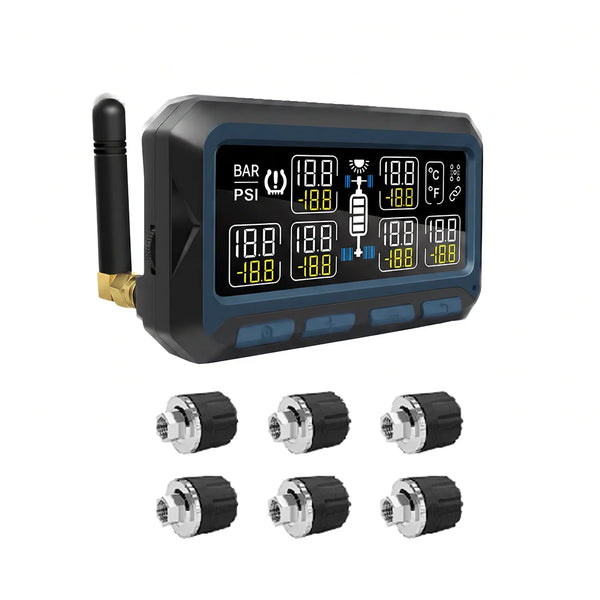
GRUNDIG 550S Solar TPMS — How It Monitors 6 to 36 Wheels
200 PSI range, solar + Type-C, German Infineon chip, ±1.5 PSI accuracy, IP67 sensors. Watches every tire on your dually truck and tandem trailer at once, with real-time pressure and temperature alerts.
View the 550S Solar TPMS →Each external sensor screws onto a valve stem in about two minutes and reports pressure and temperature to a solar-powered display in the cab. You set the thresholds, and the system alerts the instant any tire drops out of range — a slow leak, a fast leak, a hot tire, or a failing sensor. For a tandem dually trailer, that means the inner tires you cannot see are monitored just as closely as the outer ones.
Load Range → Ply Rating → Max Cold PSI → Typical Use
| Load Range | Ply rating | Max cold PSI | Typical use |
|---|---|---|---|
| B | 4-ply | 35 PSI | Light utility trailers |
| C | 6-ply | 50 PSI | Light cargo & boat trailers |
| D | 8-ply | 65 PSI | Dump, equipment, enclosed trailers |
| E | 10-ply | 80 PSI | Heavy enclosed & car haulers |
| F | 12-ply | 95 PSI | Heavy equipment trailers |
| G | 14-ply | 110 PSI | Heavy tandem trailers |
| H | 16-ply | 125 PSI | Heavy trucks & trailers |
These are typical values — the number molded into your sidewall is always the final authority. Note the pressure spreads even within a load range (some D tires run 50 PSI, others 65 PSI), which is exactly why you read the tire, not the chart.
PSI ↔ BAR ↔ kPa Converter
Trailer pressures get quoted in PSI (North America), BAR (Europe), or kPa (Australia). Convert any value instantly below.
Pressure Unit Converter
Type in any field — the other two update automatically.
Frequently Asked Questions
Do I inflate tandem trailer tires to the sidewall max?
Why does my trailer tire read higher after an hour of driving?
How often should I check trailer tire pressure?
Can a 200 PSI TPMS read my low-pressure trailer tires too?
What happens if I run a tandem trailer with one tire low?
Do all tires on the trailer need to be the same PSI?
Stop Guessing Your Trailer Tire Pressure
A 200 PSI solar TPMS watches every tire on your dually truck and tandem trailer — inner, outer, and every axle — in real time.
Shop TPMS Systems →Free shipping · Trusted German Heritage since 1945