

TPMS Error Messages: What Every Warning Means and How to Clear It
Five error types. Specific OBD codes. Severity levels. And why the Grundig TPMS display tells you in seconds what a warning light takes a scan tool to decode.
Quick Answer: The five most common TPMS error messages are: (1) Low Pressure Warning — 25%+ below recommended inflation; (2) Sensor Fault / Not Detected — sensor stopped transmitting; (3) System Error — receiver module issue; (4) Low Battery — sensor battery near end of life; (5) Not Ready / Relearn Required — sensors not registered after tire service. The Grundig TPMS monitor identifies all five states with the exact wheel position and live PSI — replacing single-light ambiguity with specific, actionable data.
A TPMS warning light is the least informative safety alert a vehicle displays. It illuminates for five completely different reasons — ranging from a tire that needs 3 PSI to a sensor that has permanently stopped transmitting — and the light looks identical in every case. Understanding what each error state means, how to verify it, and what resolves it is the difference between a 5-minute fix at the gas station and an unnecessary dealer visit. The Grundig TPMS system eliminates this ambiguity by replacing the warning light with a live display showing position-specific data for every sensor.
The Complete TPMS Error Message Reference
| Error Message | Meaning | Severity | Immediate Action | Grundig TPMS Display |
|---|---|---|---|---|
| Low Pressure / Tire Pressure Low | One or more tires 25%+ below recommended PSI | High | Check all tires immediately. Inflate to spec before highway driving. | Exact position shown with current PSI and temperature |
| TPMS Fault / Sensor Fault | Specific sensor stopped transmitting — battery dead or sensor failed | High | Identify failed position. Replace sensor or install aftermarket system. | Position shows dropout (dashes) or low-battery symbol |
| TPMS System Error | Receiver module or ECU communication failure | High | Requires scan tool diagnosis. May need receiver module replacement. | All positions may show normally — identifies factory system issue |
| Low Battery / Sensor Battery Low | Sensor battery approaching end of life — dropout imminent | Medium | Plan sensor replacement. Continue monitoring — dropout may be weeks away. | Battery icon at specific position — proactive warning unique to Grundig |
| Not Ready / Relearn Required | Sensor positions not registered — after rotation, new tires, or sensor replacement | Medium | Complete relearn procedure for system type. Required for OBD inspection pass. | Re-pair Grundig sensors in 5 min via monitor pairing mode |
| TPMS Sensor Signal Lost | Intermittent — sensor transmitting but signal dropping | Medium | Check sensor housing and valve stem. Usually precedes full battery dropout. | Position appears intermittently on Grundig display — early warning |
| Calibration Required (Indirect TPMS) | Wheel speed baselines need resetting after pressure change or rotation | Low | Follow vehicle recalibration procedure. Usually a button sequence or menu reset. | Does not apply — Grundig uses direct sensors, not wheel speed inference |
OBD Fault Codes: What the Numbers Mean
For drivers with an OBD-II scanner, TPMS errors produce specific diagnostic codes that identify the exact position and failure type. The most common sets by manufacturer:
| OBD Code | Brand | Position | Meaning |
|---|---|---|---|
| C0750 | GM | Left Front | TPMS sensor malfunction — LF position not transmitting |
| C0755 | GM | Right Front | TPMS sensor malfunction — RF position not transmitting |
| C0760 | GM | Left Rear | TPMS sensor malfunction — LR position not transmitting |
| C0765 | GM | Right Rear | TPMS sensor malfunction — RR position not transmitting |
| C1A00–C1A07 | Ford | All positions | Tire pressure monitor sensor fault — position-specific suffix |
| B0083 | Ford | System | Low tire pressure indicator circuit failure |
| C0040–C0043 | Chrysler/FCA | All positions | TPMS sensor communication fault by position |
| P0456 | Universal | System | EVAP system small leak — often confused with TPMS; unrelated |
How to Clear Each Error Type
Low Pressure Warning — Inflate and Drive
Inflate all tires to the correct cold specification. Drive above 25 mph for 10–20 minutes. On most vehicles, the system auto-resets once all positions return to acceptable pressure. If light stays on after inflation and driving, the cause is not pressure — move to sensor fault diagnosis.
Sensor Fault — Identify and Replace
Use a per-position display (Grundig TPMS monitor or scan tool) to identify the dropout position. Replace the dead sensor. Complete the relearn procedure. For vehicles with multiple sensors near end of life, consider replacing all sensors or installing a Grundig 4/6/8-wheel monitoring system at this point.
System Error — Scan and Diagnose
A system error requires OBD fault code reading. Confirm whether the code indicates a sensor position fault (replace sensor) or a receiver module fault (dealer diagnosis). The Grundig TPMS system operates independently of the vehicle receiver module — installing a Grundig tire pressure monitor provides continuous monitoring regardless of factory receiver module status.
Low Battery — Plan Replacement
The low-battery warning on a Grundig TPMS display typically precedes complete dropout by days to weeks. This advance warning — not available on factory systems — allows planned replacement rather than reactive repair. Order the replacement sensor and install before the sensor goes silent.
Relearn Required — Complete the Procedure
After tire rotation or sensor replacement, complete the relearn procedure appropriate to the system type. For Grundig TPMS, enter pairing mode on the monitor and activate each sensor in sequence. The entire process takes under 5 minutes with no external tools. For factory direct TPMS, use a relearn tool or the vehicle's button sequence if supported.
What Grundig TPMS Shows That a Warning Light Cannot
Factory TPMS shows one warning light for five different error types. The Grundig TPMS monitor differentiates all of them:
Grundig TPMS Display States and What They Mean

Grundig RV TPMS
4/6/8-Wheel
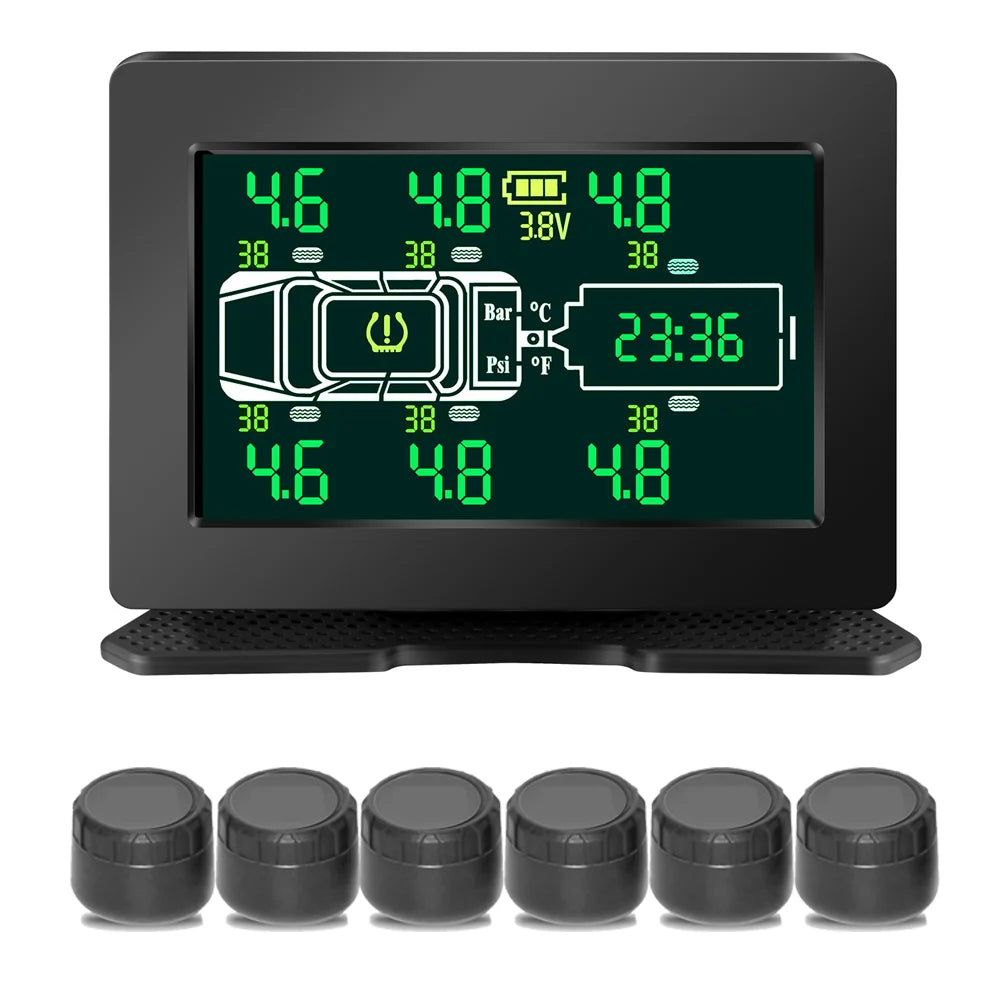
The Grundig TPMS 5.0" monitor shows PSI, temperature, battery status, and sensor signal state for every position. Low pressure, high pressure, high temperature, sensor dropout, and low battery — each displayed with the exact wheel position. Replaces five identical warning lights with specific, actionable information. $119, free shipping.
$119 Free shipping
Shop Now →Frequently Asked Questions
What are the most common TPMS error messages?
Five types: low pressure warning, sensor fault/not detected, system error, low battery warning, and not ready/relearn required. Grundig TPMS displays all five states with exact position and live PSI — factory systems show a single identical warning light for all five.
How do I clear a TPMS error?
Depends on the error: inflate tires for pressure warnings, replace faulty sensors for dropout faults, complete a relearn procedure for registration errors. Never clear a fault code without resolving the underlying cause — it will return and may create an OBD inspection failure from a "not ready" monitor status.
What does OBD code C0750 mean?
GM-specific TPMS fault code indicating the Left Front sensor is malfunctioning — not transmitting. C0755 is Right Front, C0760 Left Rear, C0765 Right Rear. All indicate a sensor requiring replacement at the specified position.
What does TPMS sensor not detected mean?
The receiver is not receiving a transmission from one or more sensors. Most commonly caused by a dead sensor battery. On a Grundig TPMS monitor, a non-detected sensor shows as a position dropout, identifying exactly which wheel is affected.
Why does my TPMS show an error after rotation?
Indirect systems need recalibration; direct systems may need position relearn. Grundig TPMS sensors re-pair to the monitor in 5 minutes after any configuration change with no external tools or vehicle ECU involvement.
Can I drive with a TPMS error?
For system faults (not low pressure): driving is possible but means operating with impaired monitoring at the affected position. For low pressure alerts: check all tires before driving. Grundig TPMS shows exactly which error type is occurring, enabling an informed decision.
Replace the warning light with actual data — position, PSI, temperature, battery. Grundig TPMS · 4/6/8-wheel · $119 · Free shipping
View Grundig TPMS Systems →