


What Happens to Tire Pressure at Highway Speed:
The Physics Most RV Owners Don't Know
Your pre-trip pressure check is accurate for the driveway at 7am. It says nothing about what's happening to your tires at mile 150, at highway speed, under full load, in the afternoon heat.
A tire sitting in the driveway and a tire running at 65 mph under load are not the same object in the same physical state. The pre-trip pressure check is accurate and necessary — it establishes the correct baseline cold inflation. What it cannot predict is where that pressure and the tire's structural condition will be after sustained highway operation at the intersection of heat, load, and centrifugal force. Understanding the physics is more useful than understanding the statistics, because the physics tells you precisely why a morning check is insufficient and what monitoring during the drive is actually detecting.
This is the gap that real-time tire pressure monitoring addresses — not redundancy with the morning check, but coverage of the hours of dynamic operation between departure and destination. The Grundig RV TPMS monitors pressure and temperature continuously throughout the drive, providing data from the conditions that matter most: highway speed, sustained load, and the heat accumulation that occurs between mile 0 and mile 300.
This article covers three physical phenomena that affect RV tires at highway speed — friction heat, dynamic load, and centrifugal deformation — and explains what each means for the accuracy of a static morning pressure reading taken before any of them begin.
Physics Factor 1
Friction Heat: What Happens Inside the Tire Carcass at Speed
As a tire rotates, the portion of the sidewall that contacts the road flattens slightly and then rebounds with each rotation. This repeated flex generates heat in the sidewall and carcass plies — a process called hysteresis. At normal inflation levels, this heat generation is within the tire's designed operating range. At low inflation levels, the sidewall flexes more than designed on each rotation, generating proportionally more heat.
At highway speed, a large RV tire completes 400–500 rotations per minute. Each rotation generates a small increment of heat. Over 30 minutes of highway driving, this accumulation raises the internal tire temperature significantly — typically 40–60°F above ambient on a correctly inflated tire, and potentially 80–100°F above ambient on an underinflated one. Internal air pressure rises with temperature at the rate of approximately 1 PSI per 10°F. A tire that starts at 100 PSI cold at 65°F may be at 106–108 PSI after 30 minutes of highway operation.
Physics Factor 2
Dynamic Load: How Load Distribution Changes at Speed
The load on each tire is not fixed during highway driving. Acceleration, braking, cornering, and road surface variations all shift the weight distribution between axles and between tires on the same axle. At highway speeds, these load variations occur rapidly and repeatedly — each one creating a moment of increased stress on the tire carcass structures that are bearing the shifted load.
For RVs, the dynamic load effect is amplified by the vehicle's height and mass. A fully loaded Class A motorhome has a high center of gravity. In a lane change at highway speed, the outboard tires on the direction of the change momentarily bear significantly more load than their static calculation would indicate. An underinflated tire in that position — carrying excess load while already generating above-normal heat from the flex of underinflation — is being subjected to compounded stresses that a morning static check cannot predict or detect.
Physics Factor 3
Centrifugal Deformation: How High Speed Changes Tire Shape
At highway speeds, centrifugal force causes the tire tread to move outward from the wheel center. This creates a subtle but real change in the tire's cross-sectional geometry — the tread area lifts slightly, changing the contact patch shape and the distribution of load within the tire structure. In a correctly inflated tire, this effect is within designed operating parameters. In an underinflated tire, where sidewall rigidity is already reduced, the centrifugal deformation is more pronounced and creates stress concentrations in the carcass plies at specific locations.
These stress concentrations are cumulative. Each mile at speed adds incrementally to the fatigue loading at the affected locations. The failure this produces — carcass separation — typically occurs after extended exposure to the combined effects of underinflation, heat, and centrifugal stress, not at a single identifiable moment. The driver has no tactile warning. The TPMS temperature sensor detects the elevated heat signature of a tire carcass under abnormal stress before the structural failure event.
What the Temperature Sensor Catches That Pressure Doesn't
A tire can maintain normal pressure while its carcass is experiencing abnormal heat generation — for example, when a structural defect, an internal air pocket, or excessive flex from a non-obvious underinflation for the actual load is generating localized heat. The temperature sensor detects this condition as elevated tire temperature before it produces the pressure change that a pressure-only alarm would catch. On systems that monitor both, temperature alarms can provide earlier warning than pressure alarms in specific failure scenarios.
What a Rapid Pressure Drop Alarm Means at Highway Speed
A sudden sharp pressure drop detected by the TPMS while at highway speed is a different signal from a gradual pressure decline. A sharp drop indicates a sudden air loss event — a nail puncture reaching the air cavity, a valve stem failure, or a structural breach. The TPMS rapid leak alarm distinguishes this from normal slow pressure variation and signals the driver to reduce speed and pull over immediately. Without monitoring, the driver discovers the same event when the tire fails completely — which at highway speed is a materially different and more dangerous situation.
The Products
Monitoring the Physics, Not Just the Parking Lot

Grundig RV TPMS
116 PSI range. Real-time pressure AND temperature. 4/6/8-wheel switchable. 5.0" display. Full alarm suite including rapid leak and high-temperature alerts. $119.
$119
Shop Now →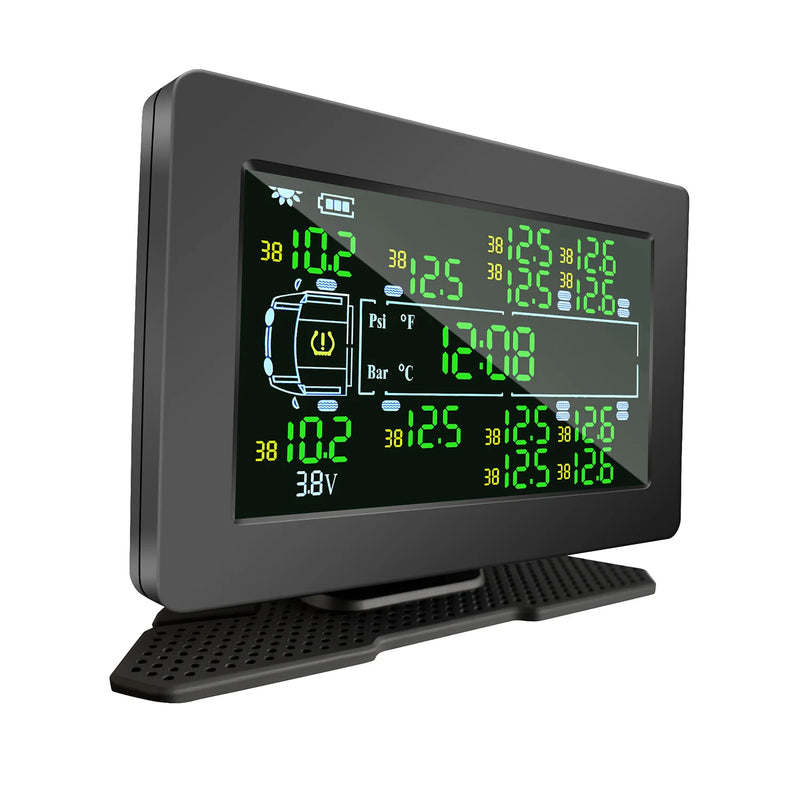
Grundig S08 TPMS
218 PSI range. 8/12-wheel switchable. Purpose-built for Class A diesel pushers and heavy commercial vehicles where highway physics create the highest pressure and temperature demands. $259.
$259
Shop Now →Browse the complete Grundig TPMS range to match your vehicle configuration to the system rated for your operating pressures and wheel count.
Friction heat, dynamic load shifts, and centrifugal deformation are continuous processes that operate from the moment the vehicle reaches speed until it stops. None of them are visible in a morning gauge reading. All of them are monitored continuously by a properly configured TPMS — which is why the two tools are complementary rather than redundant, and why highway driving specifically requires the one that provides information during the drive.
Monitor the physics of the drive, not just the driveway. Real-time pressure & temperature · Free shipping · RV / S08 systems
Shop RV TPMS →