

Trailer tires fail in a pattern so consistent it is almost boring — and almost entirely preventable. The cause is rarely a manufacturing defect. It is usually something the owner could have seen, measured, or monitored, and the failure arrives at the worst possible moment: highway speed, fully loaded, miles from help. Understanding why trailer tires blow out is the first step to making sure it never happens to you.
This guide breaks down the causes in order of how often they actually occur, then shows you the one piece of equipment that turns a tire blowout from an emergency into a non-event. We build it, so we will be direct about what it does and where its limits are.
Why Do Trailer Tires Blow Out? The One Cause That Beats All Others
If you had to name a single cause behind the majority of trailer tire blowouts, it would be underinflation. Not nails, not cheap rubber, not bad luck — a tire running below its rated pressure. Study after study and fleet after fleet keep arriving at the same conclusion: the tire that failed was almost always low on air, and nobody knew it.
The frustrating part is that underinflation is invisible. A tire 10–15 PSI low looks identical to a full one, especially on a loaded trailer where the sidewall bulge is hidden by the fender. By the time it looks wrong, the structural damage inside the casing has already been done. That is why the fix is not "check more carefully" — it is continuous monitoring. The good news is that every one of these failures leaves a measurable trace long before the tire lets go, and a pressure and temperature sensor is the only thing that reads it.
Underinflation: Heat Is the Real Killer
Here is the mechanism, because understanding it changes how you think about the problem. A tire is a flexible structure. Every time it rolls, the sidewall flexes slightly and then springs back. That flex, repeated thousands of times per mile, generates heat — and heat is what destroys a tire.
An underinflated tire flexes more than a properly inflated one. More flex means more heat. More heat means the rubber compound and the internal belt adhesion start to break down. The tire does not fail because it was "worn out" — it fails because the heat cooked it from the inside, usually at the point where the sidewall meets the tread. And because the damage is internal, there is no visible warning before the blowout.
An underinflated tire is not "a little soft." It is a tire that is steadily overheating toward failure, and the only instrument that can tell you is a pressure and temperature sensor on that wheel.
The Other Four Causes of Trailer Tire Blowouts
Underinflation is the leader, but it is not alone. These four finish the list, and most are just as easy to guard against once you know they exist.
Overloading & Exceeding Load Range
Every tire has a maximum load it can carry at its rated pressure — the "Max Load at XX PSI" line on the sidewall. Exceed it, and the tire runs overloaded even at full pressure, flexing and heating the same way an underinflated tire does. A trailer that is fine empty can be dangerously overloaded the moment you add that extra pallet or heavy equipment.
Tire Age & Dry Rot (the 5–7 Year Rule)
Trailer tires age out long before the tread wears down. After five to seven years, the rubber compounds oxidize, the sidewalls crack, and the tire loses the internal strength it had when new — even if the tread looks deep. Check the DOT date code on the sidewall and replace by age, not just by tread depth.
Road Hazards, Curb Strikes & Impact Damage
A hard hit against a curb, a pothole at speed, or road debris can damage the tire's internal structure without leaving an obvious mark on the outside. That hidden damage becomes the seed of a blowout days or weeks later. If you strike something hard, inspect the tire — and watch its pressure for the next few hundred miles.
Speed Ratings & Heat at Highway Speeds
Many trailer tires carry a speed rating, and sustained driving above it compounds the heat problem. A long interstate run at 75+ mph on a tire rated for 65 generates heat faster than the tire can shed it. Match your speed to the tire, especially when loaded and in summer heat.
The Warning Signs You're About to Blow a Trailer Tire
By the time a blowout is imminent, a few signs usually appear — if you know to look. Cracks or bulges in the sidewall are the obvious ones. A tire that feels hot to the touch after a stop (when its neighbors are merely warm) is a red flag. A vibration that comes and goes can be a tire beginning to come apart. And a tire that keeps losing a little air between checks is already telling you something is wrong.
The problem is that these signs are easy to miss on a trailer you only glance at during fuel stops. The tire is behind you, often in the shade of a fender, and you are tired. That is exactly why the reliable warning comes from a sensor, not from your eyes.
How a TPMS Turns a Blowout into a Non-Event
Real-Time Pressure & Temperature Alerts
A tire pressure monitoring system puts a sensor on every tire — including the trailer's — and reports pressure and temperature to a display in the cab, updating continuously. The moment a tire drops below its threshold or climbs above its temperature limit, the display fires a visual and audible alarm while there is still time to pull over safely.
Fast-Leak Detection vs Slow Leak
Two different failures need two different alarms. A fast leak — a puncture or a valve-stem failure — drops pressure in seconds and needs an immediate alert. A slow leak or a heating tire creeps up over miles and needs a threshold alarm. A good system covers both, and that coverage is what turns "I hope it holds until the next exit" into "I'll pull off and air it up now."
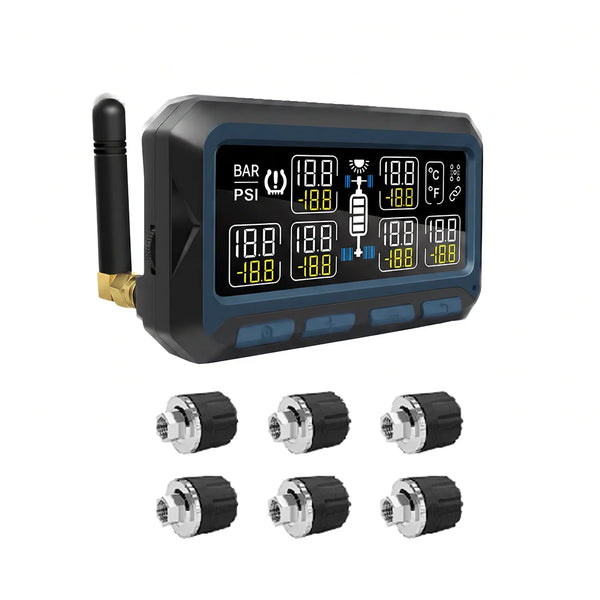
GRUNDIG 550S Solar TPMS — Early Warning for Every Tire
6–36 wheels, 200 PSI, solar + Type-C, ±1.5 PSI accuracy. Real-time high/low pressure, high temperature, fast-leak, and sensor-fault alerts.
View the 550S Solar TPMS →
GRUNDIG S08 Heavy-Duty TPMS — For High-Pressure Rigs
8/10/12 wheels, 217 PSI, 5" HD display, 40m range. The heavy-duty option when your trailer runs above 116 PSI.
View the S08 Heavy-Duty TPMS →A 7-Step Trailer Tire Blowout Prevention Checklist
- Set every tire to its sidewall cold PSI before each trip — checked cold, in the shade.
- Verify load range and load — make sure the trailer's weight stays within each tire's rating.
- Check the DOT date code and retire any tire past its 5–7 year service life.
- Inspect sidewalls for cracks, bulges, and cuts at every stop.
- Respect the speed rating, especially when loaded in hot weather.
- Mount a TPMS so pressure and temperature are monitored every mile, not just at the start.
- Act on the first alert — a slow leak today is a blowout tomorrow.
If It Happens Anyway: What to Do in the Moment
Even with every precaution, a blowout can still happen — a hidden impact break, a piece of debris, or a tire that was already compromised before you owned it. What you do in the first three seconds determines whether it stays a tire change or becomes an accident.
First, do not slam the brakes. Braking hard shifts weight forward and can turn a blown trailer tire into a jackknife. Hold the steering wheel straight and steady, ease off the accelerator, and let the combination slow gradually. Once speed has dropped, signal and pull well off the roadway — ideally onto a level shoulder with room to work. If the trailer is swaying, resist the instinct to steer hard against it; gentle, smooth corrections keep the rig stable until it slows.
When you are stopped, set out triangles, then assess. A blown tire on a tandem axle usually means the other tire on that side carried the load for a moment — check it for damage and heat before continuing. And this is where the TPMS earns its keep a second time: as you limp to the next exit, it tells you whether the surviving tires are holding pressure or starting to overheat too.
Blowout Cause → Warning Sign → Prevention
| Cause | Warning sign | How to prevent it |
|---|---|---|
| Underinflation #1 CAUSE | None visible — heat builds inside | Set cold PSI + real-time TPMS alerts |
| Overload / wrong load range | Sagging, hot tires, rapid wear | Stay within the tire's load rating |
| Tire age / dry rot | Sidewall cracks, stiff rubber | Replace every 5–7 years by DOT date |
| Impact damage | Bulge, cut, or hidden internal break | Inspect after hard hits, watch pressure |
| Speed / heat buildup | Hot hubs, hot tires after stops | Respect the tire's speed rating |
Frequently Asked Questions
Why do trailer tires blow out more than truck tires?
Can a TPMS prevent a blowout, or only warn about it?
How hot is too hot for a trailer tire?
Do I need sensors on my trailer, or just the truck?
How much pressure loss is dangerous?
How do I read the tire's DOT date code?
Do trailer tires blow out more in hot weather?
Never Let a Slow Leak Become a Blowout
Real-time pressure and temperature alerts on every tire — truck and trailer — catch the problem miles before it becomes an emergency.
Shop TPMS Systems →Free shipping · Trusted German Heritage since 1945