

TPMS After a Tire Rotation or Replacement: What Changes and What to Check
A tire rotation or new set of tires is the moment most drivers forget about their TPMS. It's also the moment the system most needs attention.
Tire rotation and replacement are routine maintenance events for any RV or commercial truck owner. What is less routinely understood is how each event interacts with the tire pressure monitoring system already installed on the vehicle. The answer depends critically on which type of system is in use — and the two main types respond to tire rotation in ways that are almost opposite to each other. A direct TPMS system with a physical sensor on each valve stem requires no recalibration after tire rotation and continues monitoring accurately from the new position. An indirect TPMS — which infers pressure from wheel speed data — must be recalibrated after every rotation or the system is effectively comparing the wrong wheels to each other and may fail to alarm when it should.
For drivers who have installed an aftermarket direct TPMS alongside their factory indirect system, understanding which system is doing what becomes important at the service interval. This article covers what actually happens to each type of system when tires are rotated or replaced, what needs to be done before leaving the service bay, and how to verify the system is working correctly before returning to highway driving.
The Core Difference
How Direct and Indirect TPMS Respond to Tire Rotation
Recalibration required every time
- System compares wheel speeds between positions to infer pressure differences
- After rotation, the baseline wheel speed ratios are no longer valid
- Must be reset / recalibrated before the new rotation is correctly monitored
- Failure to recalibrate can produce false alarms or miss real pressure loss
- Recalibration procedure varies by vehicle — consult owner's manual
- Cannot detect uniform pressure loss across all four tires even after recalibration
No recalibration needed — sensor moves with the tire
- Physical sensor on the valve stem moves to the new position with the tire
- Continues measuring actual pressure in the new location immediately
- Monitor display position labels may need updating to reflect new layout
- No recalibration or reset procedure required
- Readings are valid from the moment the vehicle moves after service
- Verify all positions are still transmitting before highway driving
After Tire Replacement
New Tires, New Sensors — What the Service Visit Should Include
A complete tire replacement introduces additional considerations beyond rotation. New tires are mounted without sensors — the sensors from the old tires must be transferred to the new ones, or new sensors must be installed if the old ones are at or beyond their service life. This is a step that service technicians sometimes omit without informing the customer, leaving the vehicle with new tires and non-functional monitoring.
There are three outcomes that can result from a tire replacement service, ranging from correct to problematic:
-
✓Old sensors transferred to new tires — idealIf sensors are within their service life (typically under 5 years old), they are removed from the old tires during dismounting and reinstalled during mounting of the new tires. The system continues functioning with no changes required beyond verifying that all positions are transmitting after service.
-
!New sensors installed — requires pairingWhen old sensors are at end of life and replaced, the new sensors must be paired to the monitor before they will transmit readings. The pairing procedure varies by system — most aftermarket direct systems have a dedicated pairing mode accessible through the monitor. Verify all new sensors are recognized by the monitor before leaving the service bay.
-
✗Sensors not transferred — monitoring gapIf old tires are dismounted and the sensors remain attached to the removed tires (in the tire disposal pile), the new tires have no sensors. The monitor will show position dropouts — one or more positions will stop transmitting. This is the scenario most likely to be missed if the driver doesn't check the monitor display after service.
Post-Service Verification
The Four-Step Check Before Leaving the Service Bay
Regardless of whether the service was a rotation, a partial replacement, or a full set of new tires, four verification steps should be completed before returning to highway driving.
-
1Confirm all positions are transmittingTurn on the TPMS monitor and verify that every position shows a reading. A position that shows no reading or a dashes symbol indicates a sensor that is not transmitting — either because it was not transferred during service, the battery is dead, or the pairing was not completed.
-
2Cross-check TPMS readings against a gaugeFor each position, compare the monitor reading to a physical gauge check. New tires are often inflated to a standard shop pressure that may not match your vehicle's correct loaded specification. Any discrepancy greater than 2 PSI warrants correction before departure — and confirms the sensor is reading accurately.
-
3Update position labels if neededIf tires were rotated to new positions, update the display labels on your TPMS monitor to reflect the new layout. Most direct TPMS monitors allow position labels to be reassigned. This is not required for the system to function correctly, but makes interpreting alarms easier during driving.
-
4Recalibrate indirect system if applicableIf your vehicle has a factory indirect TPMS in addition to an aftermarket direct system, recalibrate the factory system after any rotation following the procedure in your vehicle's owner's manual — typically a button sequence in the settings menu or instrument cluster.
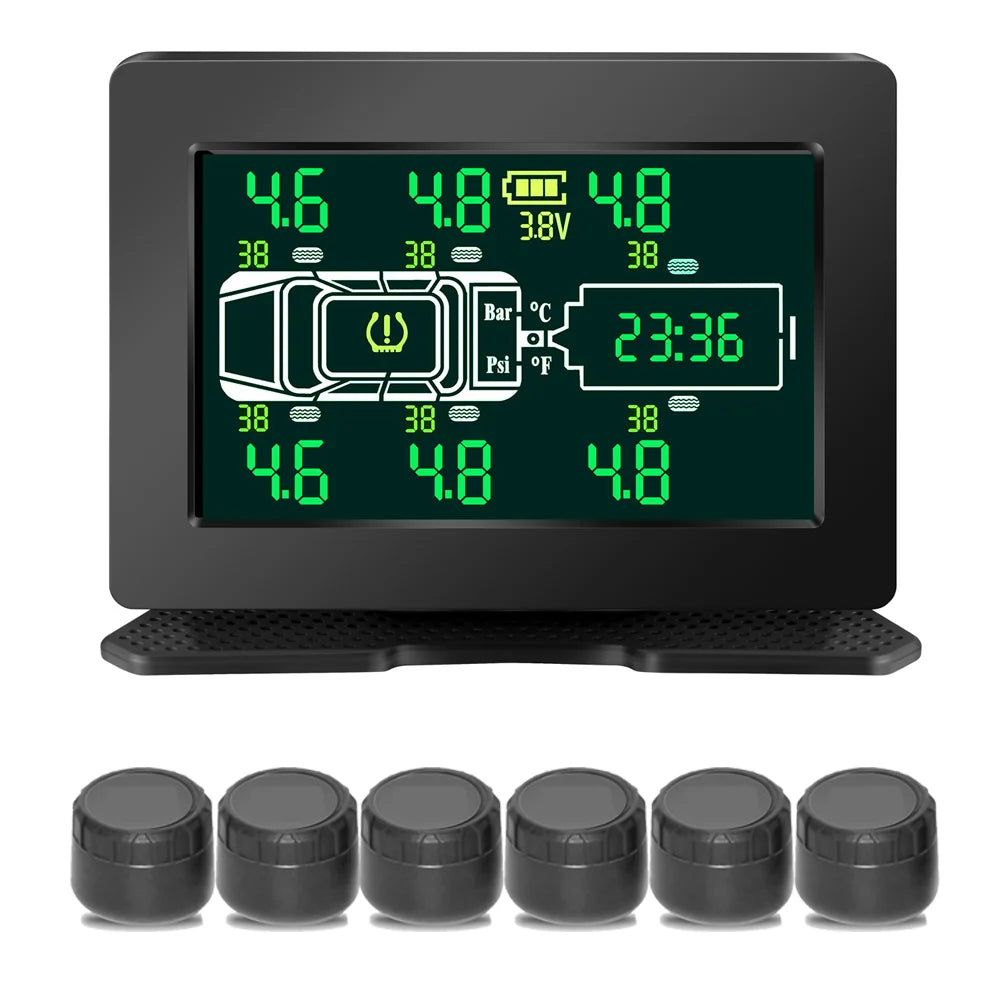
Browse the full Grundig TPMS range to find the right replacement system or additional sensors for your vehicle configuration. The Solar TPMS 6-Wheel is purpose-built for dually configurations where sensor management across inner dual positions is the most commonly overlooked part of post-rotation verification.
Grundig RV TPMS
Direct sensors move with the tire — no recalibration after rotation. 116 PSI, 4/6/8-wheel. Verify all positions post-service in seconds on the 5.0" display.
$119
Shop Now →Solar TPMS 6-Wheel
6 direct sensors including inner duals. Solar powered. Post-rotation: verify all 6 positions on the display before departure — no wheel speed recalibration required.
$109
Shop Now →Grundig S08 TPMS
218 PSI, 8/12-wheel. Direct sensors require no recalibration after service. Post-replacement: pair new sensors to monitor, verify all positions, gauge-check, and depart.
$259
Shop Now →Direct sensors. No recalibration. Always monitoring. RV · Dually · Heavy Commercial · Free shipping
Shop All TPMS →