


TPMS and Fuel Economy: How Correct Tire Pressure Saves RV and Truck Owners Money at the Pump
Underinflated tires don't just create safety risks. They burn fuel that should be moving the vehicle forward. Here's what the numbers actually look like over a driving season.
Tire pressure and fuel economy are connected by straightforward physics: an underinflated tire deforms more under load than a correctly inflated one, increasing rolling resistance and forcing the engine to work harder to maintain speed. The Department of Energy estimates that fuel economy drops by approximately 0.2% for every 1 PSI of underinflation across all four tires — a number that sounds negligible until it's applied to the operating pressures and fuel consumption of a Class A motorhome or a commercial dually running 50,000 miles a year. A tire pressure monitoring system that maintains correct inflation throughout the drive — not just at the pre-departure check — is simultaneously a safety tool and a fuel management tool, though the fuel economy angle rarely receives the attention it deserves.
The pre-departure gauge check addresses the static morning pressure. It says nothing about what happens to that pressure over the next 200 miles, as ambient temperature rises, friction heat builds in the tire carcass, and load distribution shifts between axles. A tire that was correctly inflated at 7am may be 3 PSI below its loaded minimum by mid-afternoon on a summer highway — and the fuel efficiency penalty has been accumulating for every mile of that decline.
The Numbers
What Underinflation Actually Costs at the Pump
The fuel economy penalty from underinflation is modest per PSI and significant in aggregate. The relationship is approximately linear: each PSI of underinflation across all monitored tires adds about 0.2% to fuel consumption. On a vehicle with six monitored positions, each PSI of uniform underinflation across all six tires produces a combined rolling resistance increase that translates to a measurable fuel cost over a driving season.
For a Class A motorhome averaging 8 mpg and covering 15,000 miles per season, a consistent 1% fuel economy penalty costs approximately 190 additional gallons of diesel per year. At current diesel prices, that is a meaningful annual cost — one that exceeds the hardware cost of a TPMS system in a single season of driving.
| Vehicle Type | Avg Fuel Economy | Annual Mileage | 1% Penalty Cost (est.) |
|---|---|---|---|
| Class A Motorhome | 7–9 mpg diesel | 10,000–20,000 mi | $120–$240/year |
| Class B Campervan | 18–22 mpg | 15,000–25,000 mi | $60–$110/year |
| Dually Tow Vehicle | 12–16 mpg | 20,000–50,000 mi | $100–$280/year |
| Commercial Fleet Truck | 8–12 mpg | 60,000–120,000 mi | $400–$900/year |
For commercial fleet operators, the aggregate fuel cost of running vehicles at even marginally underinflated pressures compounds dramatically across a full fleet. Ten trucks each running 1 PSI low across six tires for a full operating year represent a fleet-level fuel cost that is entirely preventable with monitoring.
Why Static Checks Are Insufficient
How Pressure Drifts During a Drive — and What That Costs
The fuel economy case for TPMS goes beyond the morning cold-check scenario. Pressure changes continuously during a drive, and the changes are not always in the direction that improves efficiency.
The Overnight Deficit Scenario
A vehicle parked overnight in 45°F conditions with tires set to 100 PSI at 65°F will have tires reading approximately 96–97 PSI by morning. Departing without correcting this 3–4 PSI deficit means the vehicle runs with elevated rolling resistance for the entire first driving segment — often the longest of the day.
The Slow Leak Scenario
A nail puncture losing 2 PSI per hour is invisible in pre-departure checks and produces no noticeable handling change for the first 60–90 miles. Over a 300-mile driving day, the affected tire averages 6 PSI below its correct pressure — generating both a fuel penalty and structural heat that shortens tire life.
The Loaded vs Empty Mismatch
A vehicle whose inflation was set for empty conditions but is now carrying full passenger and cargo load is operating with insufficient pressure for its actual weight. The rolling resistance penalty from load-related underinflation is larger than the temperature-related version because the deformation under load is more pronounced.
The Multi-Stop Trip
A driving day with multiple stops and departures — common for RV owners visiting campgrounds or commercial operators making deliveries — allows the tire pressure to cool and drop at each stop. Each departure restarts with a slightly lower pressure baseline, and the cumulative rolling resistance penalty across a multi-stop day is higher than a single-leg highway run of the same total mileage.
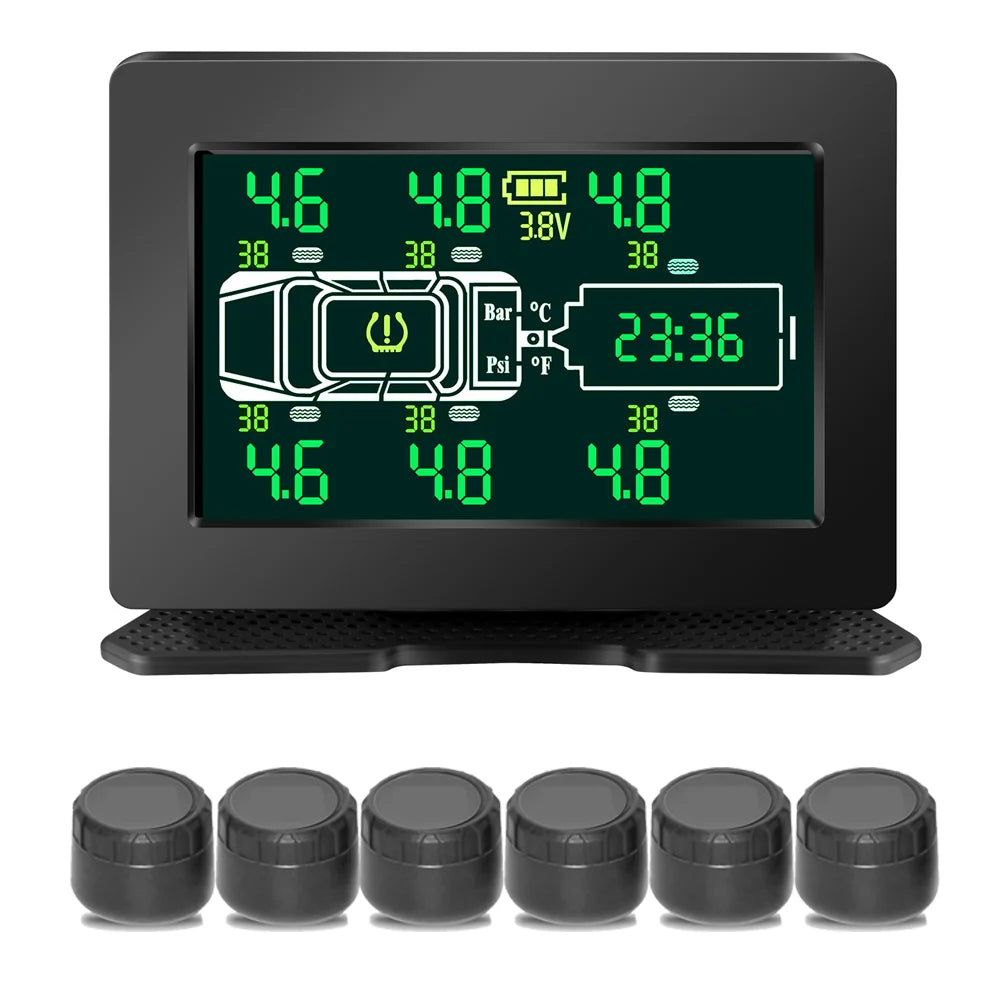
Loaded vs Empty
Why RV and Truck Fuel Economy Is More Pressure-Sensitive Than Passenger Cars
The fuel economy impact of underinflation scales with vehicle weight. Heavier vehicles generate more rolling resistance per PSI of underinflation because the deformation of the tire carcass under load is greater. A 1 PSI underinflation on a 40,000 lb loaded Class A motorhome produces more rolling resistance than the same 1 PSI deficit on a 3,500 lb passenger car.
This weight scaling means that the 0.2% per PSI estimate used for passenger cars understates the fuel economy impact for the heavier vehicles that benefit most from TPMS monitoring. For Class A diesel operators and commercial fleet trucks, the correct inflation window is also narrower — these vehicles are typically running closer to their tire load ratings than passenger cars, meaning a given pressure deficit represents a larger proportion of the available load-carrying margin.
The Grundig RV TPMS covers 4, 6, and 8-wheel configurations at up to 116 PSI, while the Grundig S08 extends coverage to 218 PSI across 8 and 12-wheel configurations for Class A diesel and heavy commercial applications — both providing the continuous pressure data that allows fuel-efficient inflation to be maintained throughout the drive rather than approximated at departure.
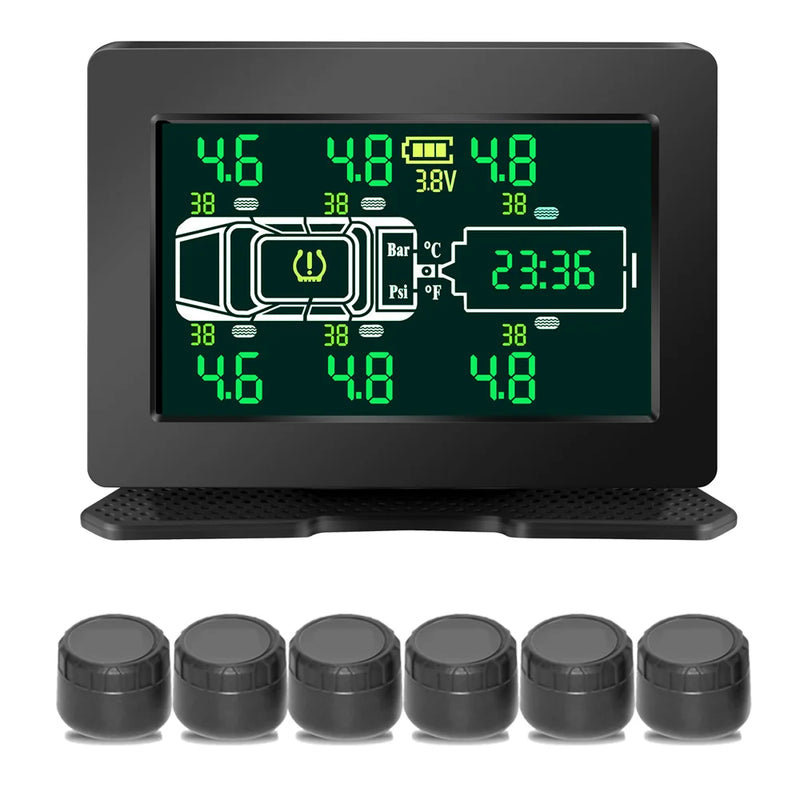
Grundig RV TPMS
4/6/8-Wheel Switchable
Real-time pressure monitoring across all positions. Catches the sub-alarm pressure drift that costs fuel economy without triggering safety alarms. 116 PSI range, ±1.5 PSI accuracy, 5.0" display. Free shipping.
$119
Shop Now →Save fuel on every mile, not just the ones you check. RV · Truck · Commercial · Free shipping · From $119
Shop All TPMS →