


TPMS for Car Hauler Trailers: Protecting the Load and the Tires Underneath It
A car hauler runs at near-maximum load capacity on every trip. The trailer tires carry vehicles worth more than the trailer itself — and they do it without any factory monitoring, any driver feedback, and often on tires that haven't been checked since the last delivery.
Car hauler trailers occupy a particular niche in the towing world: they are purpose-built to carry extremely high loads, they run at or near their rated capacity on every trip by design, and the tires supporting those loads are outside the tow vehicle's factory tire pressure monitoring coverage entirely. An open car hauler transporting two vehicles on a tandem axle trailer is running its axle tires near their load rating maximums, on tires that are typically higher-ply and higher-pressure than passenger car tires, generating heat at highway speed that a static pre-departure check taken hours earlier cannot predict. A tire failure under these conditions — with multiple vehicles as the load — is expensive, dangerous, and entirely preventable with monitoring that covers every position on the trailer, not just the truck pulling it.
The comparison between car haulers and other trailer types reveals why the monitoring requirements are specific. A boat trailer sits lightly loaded at rest and accumulates weight only when the boat is aboard. A horse trailer carries a dynamic live load. A car hauler carries a fixed, heavy, static load that is concentrated at specific points on the trailer deck — the vehicle contact points — and cannot shift during transit. This makes the load calculation more predictable than a horse trailer but no less demanding, and the tire pressure implications of that constant high load are directly addressable with real-time monitoring.
The Specific Risk Profile
Why Car Hauler Trailer Tires Fail When They Shouldn't
Sustained Near-Maximum Load on Every Trip
Unlike a recreational trailer that might carry varying loads, a car hauler is designed to be loaded to capacity on every revenue-generating trip. Trailer tires operating at 90–100% of their load rating continuously have less thermal margin than the same tires at lighter loads — which means a pressure deficit that would be tolerable at half-load becomes a structural risk at full capacity.
Extended Storage Between Deliveries
Open car haulers often sit between jobs with tires slowly losing pressure through natural permeation. A trailer that picked up vehicles yesterday with tires at 110 PSI may be at 108 PSI today and 105 PSI a week later — still within a range that appears adequate, but incrementally compressing the thermal safety margin on a trailer that will be loaded to capacity for its next run.
Uneven Load Distribution Across Axles
The front and rear axle of a tandem car hauler rarely carry identical loads. The placement of vehicles on the deck determines load distribution — and vehicles are not always positioned optimally. An axle carrying 10% more than the other is running its tires harder, generating more heat per mile, and working through its pressure safety margin faster. Monitoring each axle independently identifies this imbalance in pressure and temperature readings before it produces a failure.
Highway Speed Plus High Load Plus Summer Heat
The compounding of highway friction heat, ambient summer temperature, and sustained near-maximum load creates the most demanding tire operating environment in common towing applications. A car hauler on an interstate in July, fully loaded, at 65 mph, may be pushing its trailer tires to temperature and pressure levels that only real-time monitoring can track.
Car Hauler vs Other Trailer Types
How the Monitoring Requirements Differ
| Characteristic | Car Hauler | Horse Trailer | Boat Trailer |
|---|---|---|---|
| Load per trip | Near-maximum every trip | Variable — 1 to 4+ horses | Variable — boat size |
| Load dynamics | Fixed, static — predictable | Live, shifting — unpredictable | Fixed when loaded |
| Load value | Often $20,000–$100,000+ | High — animals + equipment | Variable |
| Ramp submersion | None | None | Regular — moisture risk |
| Long static periods | Between jobs — common | Seasonal — off-season risk | Off-season — very common |
| Axle load imbalance | Common from vehicle placement | Common from animal position | Rare — boat position fixed |
| Monitoring urgency | High — load value + sustained max load | High — live load dynamics | Moderate to high |
Configuration for Car Hauler Setups
Matching Wheel Mode to Your Hauler Configuration
Most car hauler configurations involve a standard or dually pickup truck and a single or tandem axle trailer. The wheel count determines the appropriate monitoring mode:
Standard truck + single-axle car hauler: 4 + 2 = 6 wheels → 6-wheel mode
Standard truck + tandem-axle car hauler: 4 + 4 = 8 wheels → 8-wheel mode
Dually truck + tandem-axle car hauler: 6 + 4 = 10 wheels → two separate systems or 8-wheel covering trailer + partial truck
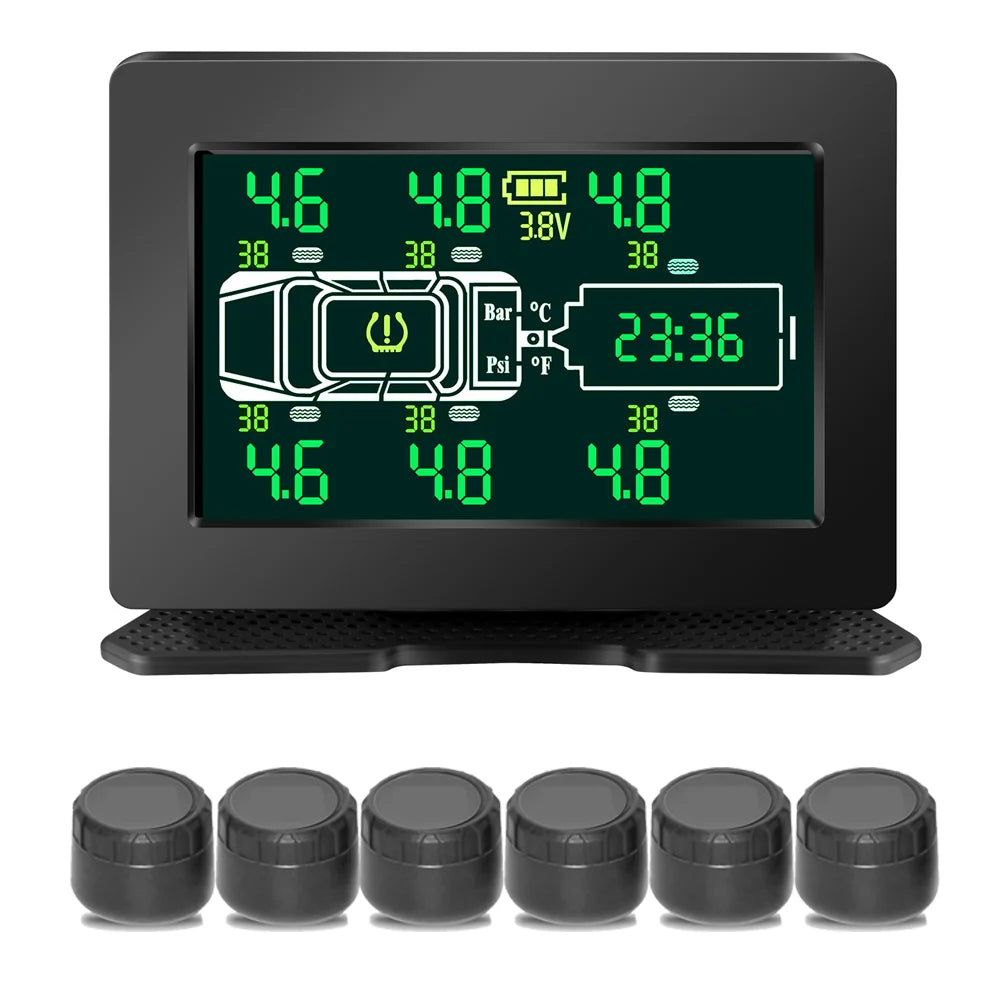
For dually truck operators, the Grundig Solar 6-Wheel TPMS covers all six truck positions including inner duals, with solar charging suited to operators running daily delivery routes.
The priority for car hauler monitoring is the trailer axles — specifically both positions on each axle independently, not an average of the two. An axle where one tire is at 108 PSI and the other is at 94 PSI is carrying an imbalanced load that will generate different wear rates and heat profiles on each side, even though the average looks acceptable. The Grundig RV TPMS provides individual readings for every monitored position simultaneously, making this axle-level imbalance visible in real time.
The Full Range
Systems for Every Car Hauler Configuration
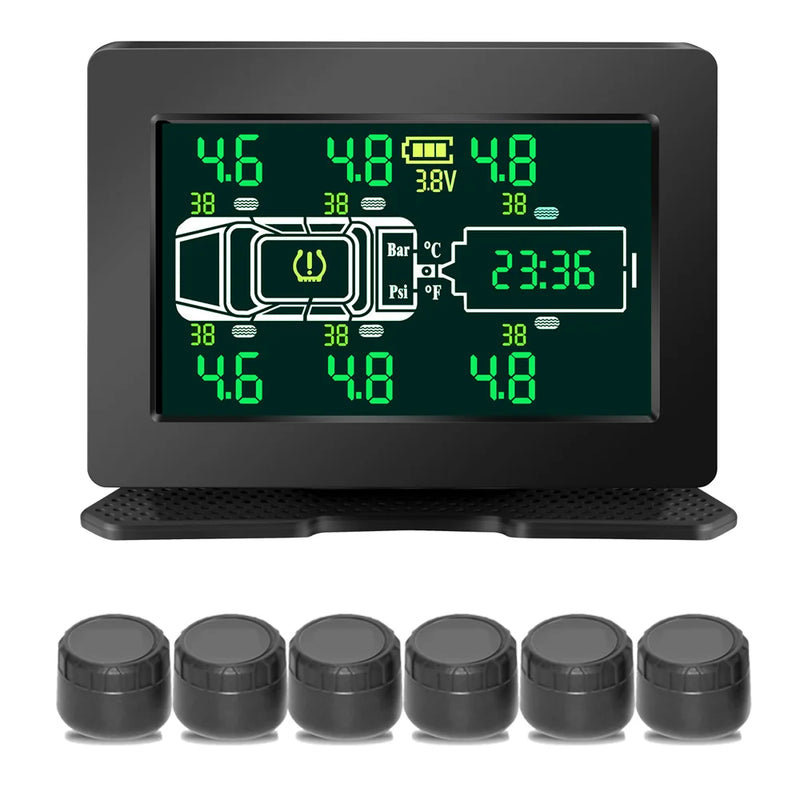
Grundig RV TPMS
4/6/8-Wheel Switchable
116 PSI, 4/6/8-wheel. Covers standard truck + single or tandem-axle car hauler. Individual readings per position catch axle load imbalance. $119, free shipping.
$119
Shop Now →Grundig Solar TPMS
6-Wheel System
Solar + USB charging — no battery management for daily delivery operations. Covers all 6 dually truck positions including inner duals. Add RV TPMS for trailer coverage.
$109
Shop Now →For operators running heavy commercial car haulers on commercial chassis where rear axle pressures exceed 116 PSI, the Grundig S08 TPMS provides 218 PSI ceiling coverage across 8 and 12-wheel configurations.
Monitor the trailer tires carrying the load — not just the truck pulling it. RV TPMS $119 · Solar 6-Wheel for dually · Free shipping
Shop All TPMS →