


TPMS for Horse Trailers: Why Equestrian Haulers Need Every Axle Monitored
A horse trailer carries a live load that shifts continuously, stops in locations that stress tires in specific ways, and often travels long distances between inspections. Every axle needs monitoring — not just the truck.
Horse trailer tires operate under conditions that have no parallel in conventional towing. The load is alive and moves — shifting weight forward, backward, and laterally with every acceleration, deceleration, and cornering input. A 1,200 lb horse moving to the left during a highway lane change generates a momentary lateral load transfer that a static tire pressure calculation cannot predict. A trailer parked for six hours at a summer show ground in direct sun on black asphalt has accumulated heat in its tires that its departure pressure did not account for. These are not edge cases — they are the normal operating conditions of equestrian hauling, and they are precisely the scenarios where a real-time tire monitoring system covering every trailer axle provides information that no pre-departure check can supply.
The argument for monitoring only the tow vehicle and not the trailer tires is one that most experienced equestrian haulers have already rejected — often after a trailer tire failure that the truck's sensors said nothing about. Trailer tires are outside the tow vehicle's factory TPMS coverage, invisible from the driver's seat, and carrying a load whose dynamic behaviour creates tire stress that static calculations underestimate. This guide covers the specific pressure challenges that horse trailers create and the monitoring configuration that addresses them.
The Live Load Problem
Why Horse Trailer Tires Face Conditions That Static Calculations Don't Cover
Dynamic Load Shift During Transit
A horse repositioning itself during transit generates lateral and longitudinal load transfers that momentarily concentrate weight on one or two tire positions. A single 1,200 lb horse shifting its weight to the right rear in a right-hand corner increases the load on the right rear tire by a significant margin above its static calculation — repeatedly, across every mile of highway travel. Trailer tires experiencing these repeated load spikes while simultaneously building friction heat from highway speed are in a more demanding operating environment than most trailer applications. Monitoring temperature alongside pressure catches the heat signature of sustained high-stress operation before pressure deviation is measurable.
Show Ground and Event Parking — Heat Without Movement
A horse trailer parked at a summer show ground for four to six hours sits on asphalt that can reach 150°F surface temperature. The trailer tires in direct contact with that surface absorb heat through the contact patch while solar radiation heats the sidewalls. This heat accumulation occurs without the cooling airflow of highway driving that would normally dissipate some of the heat load. When the trailer departs — typically with a horse that has been standing still and is now restless and moving — it does so with tires that are at peak heat from the parking period and immediately subjected to the dynamic loads of a live and active animal.
Multi-Stop Event Days — Repeated Heat Cycles
A competition day may involve multiple trailer moves — from the home barn to the event venue, from the trailer park to warm-up areas, from the venue to an overnight stop. Each move involves loading, transit, parking, and heat accumulation, then another departure from elevated temperature. The tire pressure at the start of the third move of the day is not the same as the pressure at the start of the first move, even if no air has been added or lost. Real-time monitoring tracks this cumulative pressure and temperature change across every segment of the day rather than assuming the pre-departure reading remains representative.
Long Static Periods Between Season Use
Between competition seasons or during winter, horse trailers may sit for weeks or months. Natural rubber permeation causes trailer tires to lose 1–3 PSI per month in static storage. A trailer retrieved from a six-month winter layup may have trailer axle tires that are 6–18 PSI below their correct inflation — which is the starting point for a spring season opener, often a long-distance hauling trip to an early competition.
Configuration Guide
Matching Wheel Mode to Your Towing Setup
| Towing Configuration | Total Wheels | Recommended Mode |
|---|---|---|
| Standard truck + single-axle 2-horse trailer | 4 + 2 = 6 | 6-wheel mode |
| Standard truck + tandem-axle 3-4 horse trailer | 4 + 4 = 8 | 8-wheel mode |
| Dually truck + single-axle trailer | 6 + 2 = 8 | 8-wheel mode |
| Dually truck + tandem-axle trailer | 6 + 4 = 10 | Multiple systems or 8-wheel + separate trailer system |
| Living quarters trailer (LQ) — typically tandem or tri-axle | 4 + 4–6 = 8–10 | 8-wheel mode covers most configurations |
The 4/6/8-wheel switchable design of the Grundig RV TPMS covers the most common equestrian hauling configurations on a single system. For dually truck owners who need six-wheel coverage for the truck alone before adding trailer positions, the Grundig Solar 6-Wheel TPMS provides truck-only coverage with solar charging suited to daily commercial horse transport operations.
The Hauling Day Protocol
When to Check TPMS and What to Look For Across a Competition Day
Pre-Departure — All Positions Cold
Check TPMS readings before the horse is loaded. Cold readings before the animal introduces dynamic load give the most accurate baseline. Verify all positions are transmitting and match a gauge check within 2 PSI. Correct any deficit from overnight temperature drop or storage pressure loss before loading.
30 Minutes Into Transit — Confirm Warmup Pattern
All positions should show rising pressure from friction heat buildup. A trailer axle tire that is not warming at the same rate as the truck tires may be running significantly underinflated for its current load — the horse's weight is compressing the carcass more than designed, generating abnormal heat that shows as elevated temperature before pressure deviation becomes measurable.
Before Re-Departure From Show Ground
After extended parking in summer conditions, trailer tire pressure will be elevated from heat accumulation. Check that trailer tires are not exceeding the high-pressure threshold before departure. Do not release air — the pressure will drop as the tires cool during the first 20 minutes of highway driving. If pressure is at the high alarm threshold, allow 15–20 minutes of low-speed driving before returning to highway speed.
Monitor Continuously During Return Trip
The return trip — horse loaded after a day of competition, potentially restless, trailer tires carrying accumulated heat from the day's multiple moves — is typically the highest-risk segment of a competition day. Continuous monitoring during the return journey covers the combination of live load dynamics, heat carryover from the show ground, and late-afternoon ambient temperature conditions.
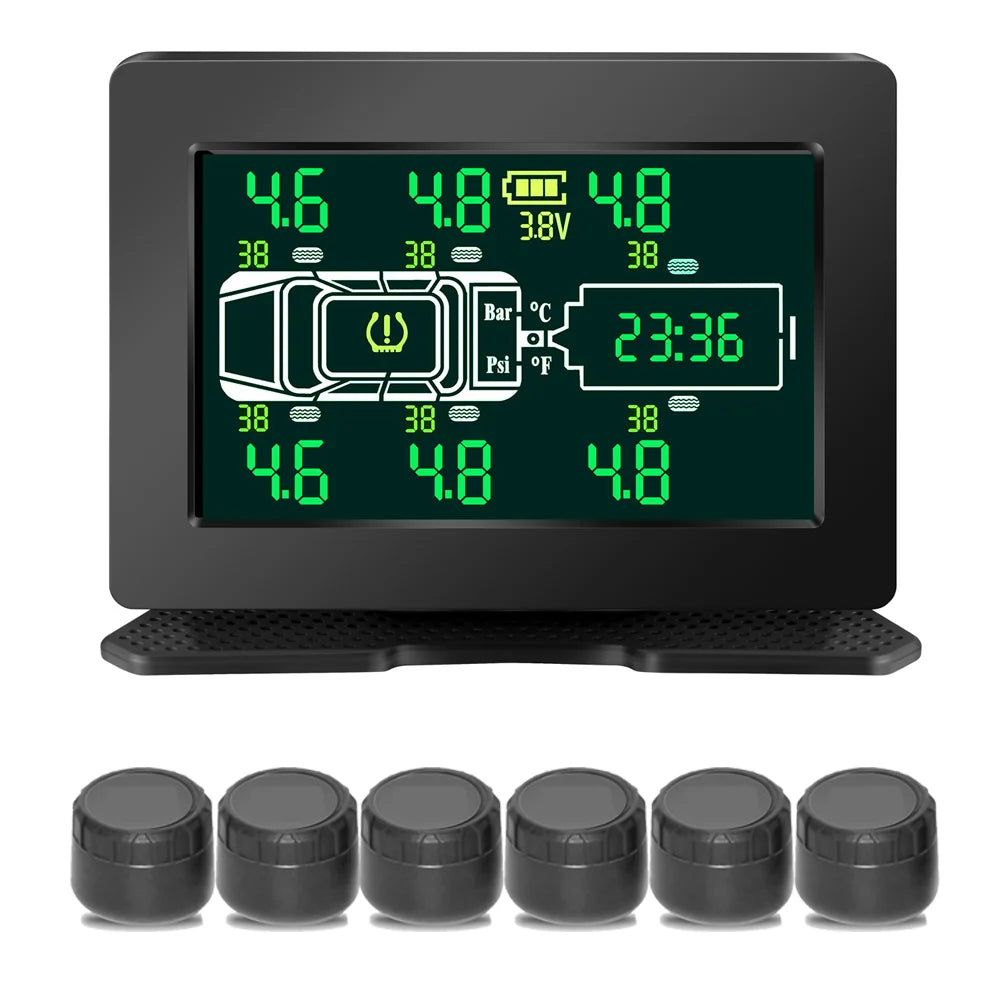
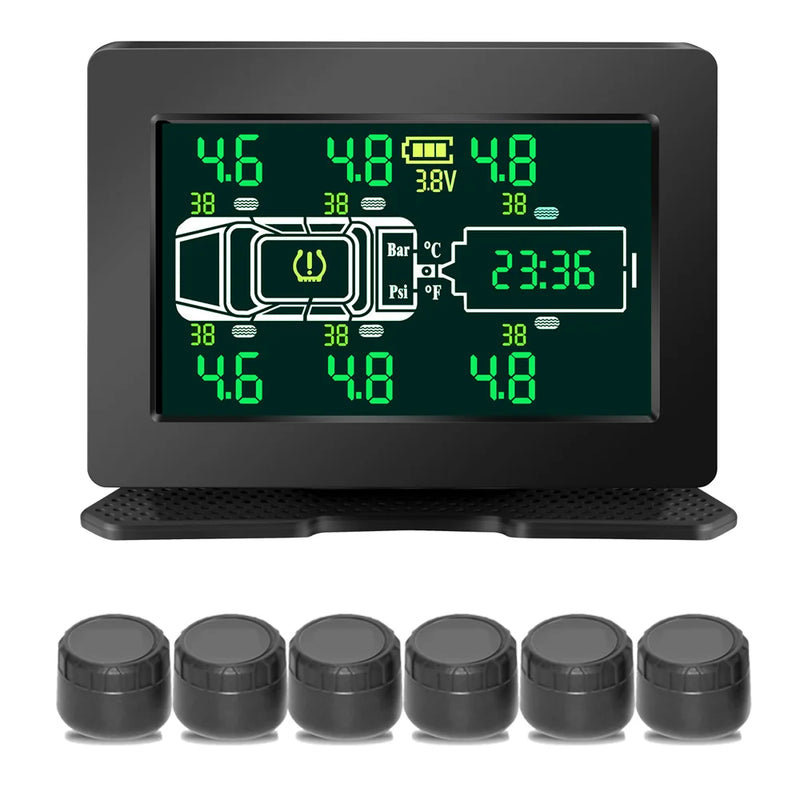
Grundig RV TPMS
4/6/8-Wheel Switchable
Covers truck + single or tandem-axle horse trailer simultaneously. Real-time pressure and temperature for every position. Catches trailer axle heat from live load dynamics before pressure failure. 116 PSI range, 5.0" display, $119. Free shipping.
$119
Shop Now →Monitor every axle on every move — truck and trailer together. 6-wheel mode: truck + single-axle trailer · 8-wheel: dually + trailer · $119
Shop All TPMS →