
TPMS for 5th Wheel Trailers & Toy Haulers — heavy loads, watched live.
Fifth wheels and toy haulers put more weight on each tire than almost any other RV — and the back axle can be 35 feet behind your seat. A TPMS for your 5th wheel shows every tire's pressure and temperature in the cab, axle by axle.
- 8–12tires, truck included
- 217 PSIfor Load Range G/H
- Boosterfor 30 ft+ rigs
- IP67waterproof sensors
Kits sized for tandem and triple-axle rigs
Choose by your trailer's tire pressure and how many axles you pull.

8/10/12 Wheels · Up to 217 PSI
Grundig S08 Heavy-Duty TPMS
The go-to kit for heavy fifth wheels and toy haulers — truck and trailer together, up to 12 tires.
- 217 PSI sensors for Load Range G/H
- 8 / 10 / 12-wheel modes
- Signal booster option

6 Sensors · Up to 217 PSI · Solar
Solar Powered TPMS
Six sensors for a triple-axle trailer on its own, with a solar display that needs no cable.
- Covers all six triple-axle tires
- 116 or 217 PSI versions
- Solar + Type-C
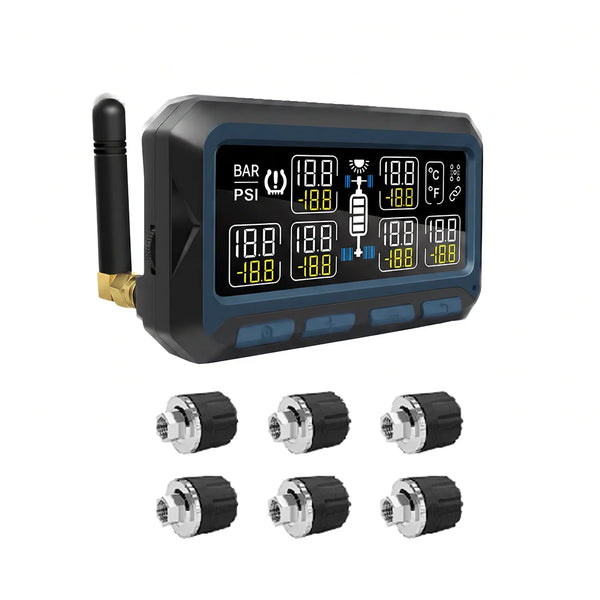
6–36 Wheels · 200 PSI · Solar
GRUNDIG 550S Solar TPMS
Set different limits for the truck, the trailer front axle and the loaded garage axle.
- Independent alarms per axle
- Expandable kit sizes
- On-screen tire position swap

4/6/8 Wheels · 116 PSI
GRUNDIG RV TPMS
For tandem fifth wheels on Load Range E tires behind a single-rear-wheel truck — 8 tires in all.
- 8-wheel mode for truck + trailer
- 40 m signal range
- 5-inch HD display
Why fifth wheels and toy haulers are hard on tires
Big rigs, high pressures
Heavier fifth wheels often ride on Load Range G or H tires inflated to 110 PSI or more. Lose 20% of that and the tire is carrying its load on soft sidewalls.
Toy haulers shift the load
Bikes, side-by-sides and fuel in the garage push weight toward the rear axle. Those tires work harder than the front set — and it only shows in the numbers.
Triple axles fight tight turns
In tight campground turns, the tires on a triple-axle trailer scrub sideways. That stress adds heat and wear you can catch on the temperature readout.
Trailer pressure isn't set-and-forget: fifth wheels often sit for weeks between trips and lose pressure while parked. A TPMS shows the cold reading the moment you power up, before you pull out.
Which TPMS kit fits your fifth wheel or toy hauler?
Count truck tires plus trailer tires, then check the max cold PSI on the trailer sidewall.
| Setup | Tires | Typical trailer tire | Recommended kit |
|---|---|---|---|
| Mid-size tandem 5th wheel + SRW truck | 8 | Load Range E (around 80 PSI) | GRUNDIG RV TPMS (8-wheel) |
| Heavy tandem 5th wheel + dually | 10 | Load Range G/H (110 PSI+) | Grundig S08 (10-wheel, 217 PSI) |
| Triple-axle 5th wheel or toy hauler + dually | 12 | Load Range G/H | Grundig S08 (12-wheel, 217 PSI) |
| Triple-axle trailer only | 6 | Any | Solar Powered TPMS (217 PSI version) |
| Toy hauler with different front/rear pressures | 8–12 | Mixed | GRUNDIG 550S with per-axle limits |
Towing with a dually? See the dually TPMS guide for inner-dual fitment tips.
Loading the garage? Check the rear axle
The first trip with toys in the garage tells you how your rig really carries its load. Set your alarm limits from the sidewall, then watch the temperature on each axle for the first 30 minutes on the highway.
If the rear axle consistently runs hotter than the front, the garage load is working those tires harder. Recheck your tire load rating against the actual axle weight — a weigh station or CAT scale gives you the numbers — and adjust how you load before the next trip.
Getting a stable signal from 35+ feet back
433MHz radio, not Bluetooth
Grundig sensors transmit on 433.92MHz, which carries farther and passes aluminum walls and steel frames better than phone-paired Bluetooth sensors.
Add a booster past 30 feet
From the truck cab to the rear axle of a 40-foot fifth wheel is a long way. A booster mounted mid-trailer relays the rear sensors to the monitor.
Mount the monitor high
Put the display on the windshield or high on the dash, clear of metal mounts, for the cleanest line back to the trailer.
Watch for blank positions
If a rear position drops out at highway speed, it's a range issue — move the booster closer to the rear axle.
TPMS for 5th Wheel Trailers FAQ
Do I need 217 PSI sensors for my fifth wheel?
Check the max cold pressure on your trailer tire sidewall. If it is 110 PSI or more — common on Load Range G and H tires — choose 217 PSI sensors so hot running pressure stays inside the sensor range. Most Load Range E fifth wheels at 80 PSI are fine with 116 PSI sensors.
Can I monitor my truck and fifth wheel on one screen?
Yes. A single-rear-wheel truck plus a tandem fifth wheel is 8 tires; a dually plus a tandem is 10; a dually plus a triple-axle is 12. The Grundig S08 switches between 8, 10 and 12-wheel modes.
Where should I mount the signal booster on a fifth wheel?
Mount it near the middle of the trailer, on a constant 12V source, so it sits between the rear axle sensors and the truck cab. Boosters are recommended once truck plus trailer goes past about 30 feet.
Should I change tire pressure when my toy hauler is loaded?
Run the pressure your tire maker specifies for the load you're carrying — for ST tires that is usually the max cold pressure on the sidewall. Watch the rear axle temperatures on your first trip loaded; they show whether the garage weight is working those tires harder.
Do the sensors work while my fifth wheel is in storage?
The sensors stay on the valve stems and keep their pairing. The monitor sleeps when the rig isn't moving, so check pressures with the monitor awake before your first trip of the season — trailers lose pressure while they sit.
How long do the sensor batteries last?
Grundig external sensors use replaceable CR1632 coin cells rated for about one to two years depending on the model, and the monitor flags a low battery at its wheel position.
More guides: RV TPMS · Class A motorhome TPMS · RV TPMS by brand
Big rig. Every tire accounted for.
From mid-size fifth wheels to triple-axle toy haulers, there's a Grundig TPMS built for the load you pull.